
利用源自酱香型白酒发酵谷物的创新发酵策略提升玫瑰香葡萄酒品质
Improving Muscat Hamburg Wine Quality with Innovative Fermentation Strategies Using Derived from Fermented Grains of Sauce-Flavor Baijiu.
作者信息
Lyu Xiaotong, Zhou Yifei, Li Furong, Zhou Meiyi, Wei Chunhui, Lin Liangcai, Li Xin, Zhang Cuiying
机构信息
State Key Laboratory of Food Nutrition and Safety, Key Laboratory of Industrial Fermentation Microbiology, Ministry of Education, Tianjin Key Laboratory of Industrial Microbiology, College of Biotechnology, Tianjin University of Science and Technology, Tianjin 300457, China.
Guizhou Guotai Liquor Group Co., Ltd., Renhuai 564500, China.
出版信息
Foods. 2024 May 24;13(11):1648. doi: 10.3390/foods13111648.
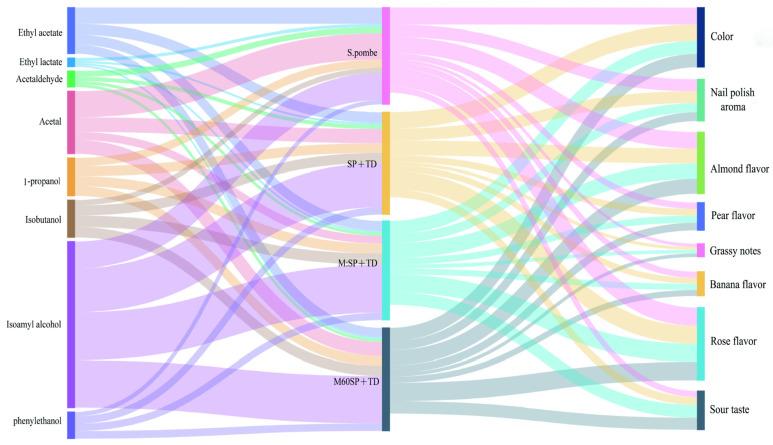
This study investigates innovative approaches to improve the quality and aroma characteristics of Muscat Hamburg wine production by substituting the conventional yeast with an efficient fermentation strain of . The typical use of in Muscat Hamburg wine often leads to uniformity and prolonged processing times, requiring subsequent malolactic fermentation to degrade excessive malic acid. The study advocates for the replacement of with a specific strain, , isolated from the fermented grains of sauce-flavor Baijiu, a Chinese spirit. Muscat Hamburg wine fermented with the strain demonstrates decreased malic acid levels, offering a potential alternative to malolactic fermentation. However, exclusive fermentation may result in an overproduction of acetic acid metabolites, leading to a monotonous taste. In response, the study proposes a mixed fermentation approach, combining the strain with a strain and a non- yeast, . The optimized mixed fermentation strategies (M:SP+TD and M60SP+TD) involve specific proportions and intervals of inoculation, aiming to enhance the quality and aroma complexity of Muscat Hamburg wine. In conclusion, this research contributes to advancing the production of high-quality Muscat Hamburg wines, utilizing as the primary yeast strain and implementing mixed fermentation methodologies.
本研究通过用一种高效发酵菌株替代传统酵母,探索提高玫瑰香葡萄酒品质和香气特征的创新方法。在玫瑰香葡萄酒中典型使用的[传统酵母名称]常常导致风味单一和加工时间延长,需要后续的苹果酸-乳酸发酵来降解过量的苹果酸。该研究主张用从中国白酒酱香型白酒发酵谷物中分离出的一种特定的[发酵菌株名称]菌株替代[传统酵母名称]。用[发酵菌株名称]菌株发酵的玫瑰香葡萄酒显示出苹果酸水平降低,为苹果酸-乳酸发酵提供了一种潜在替代方案。然而,单独使用[发酵菌株名称]发酵可能导致乙酸代谢产物过量产生,导致口感单调。作为回应,该研究提出了一种混合发酵方法,将[发酵菌株名称]菌株与[另一种发酵菌株名称]菌株和一种非酵母[微生物名称]相结合。优化的混合发酵策略(M:SP+TD和M60SP+TD)涉及特定的接种比例和间隔,旨在提高玫瑰香葡萄酒的品质和香气复杂性。总之,本研究通过将[发酵菌株名称]作为主要酵母菌株并采用混合发酵方法,为推进高品质玫瑰香葡萄酒的生产做出了贡献。


 Zotero 插件