
代谢组学与心力衰竭患者的心血管风险:系统评价和荟萃分析。
Metabolomics and Cardiovascular Risk in Patients with Heart Failure: A Systematic Review and Meta-Analysis.
机构信息
Cardiovascular R&D Centre, UnIC@RISE, Department of Surgery and Physiology, Faculty of Medicine, University of Porto, 4200-319 Porto, Portugal.
LAQV-REQUIMTE, Department of Chemistry, University of Aveiro, 3810-193 Aveiro, Portugal.
出版信息
Int J Mol Sci. 2024 May 23;25(11):5693. doi: 10.3390/ijms25115693.
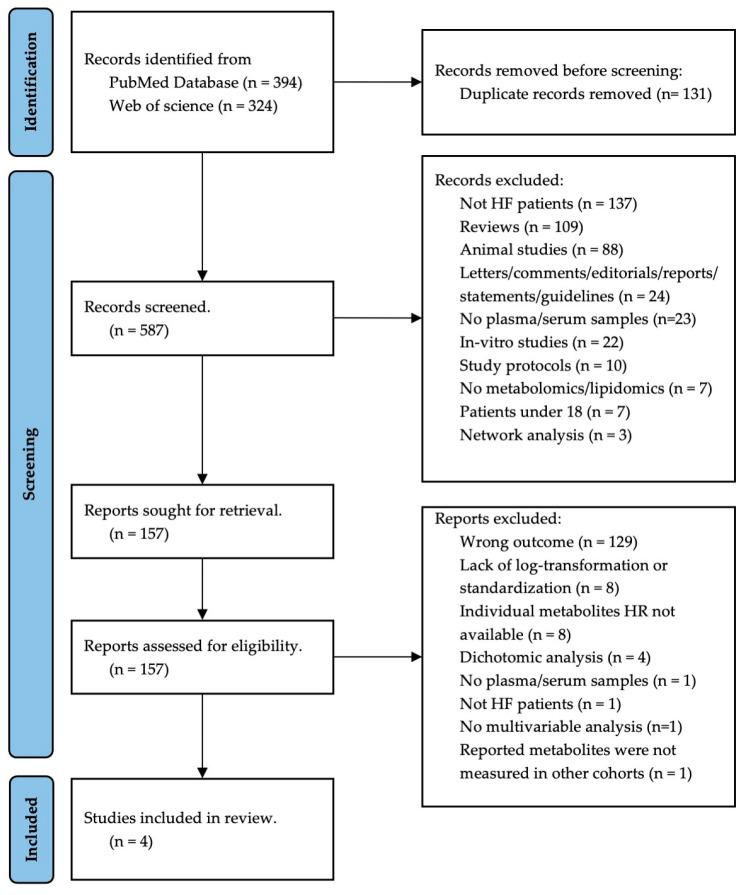
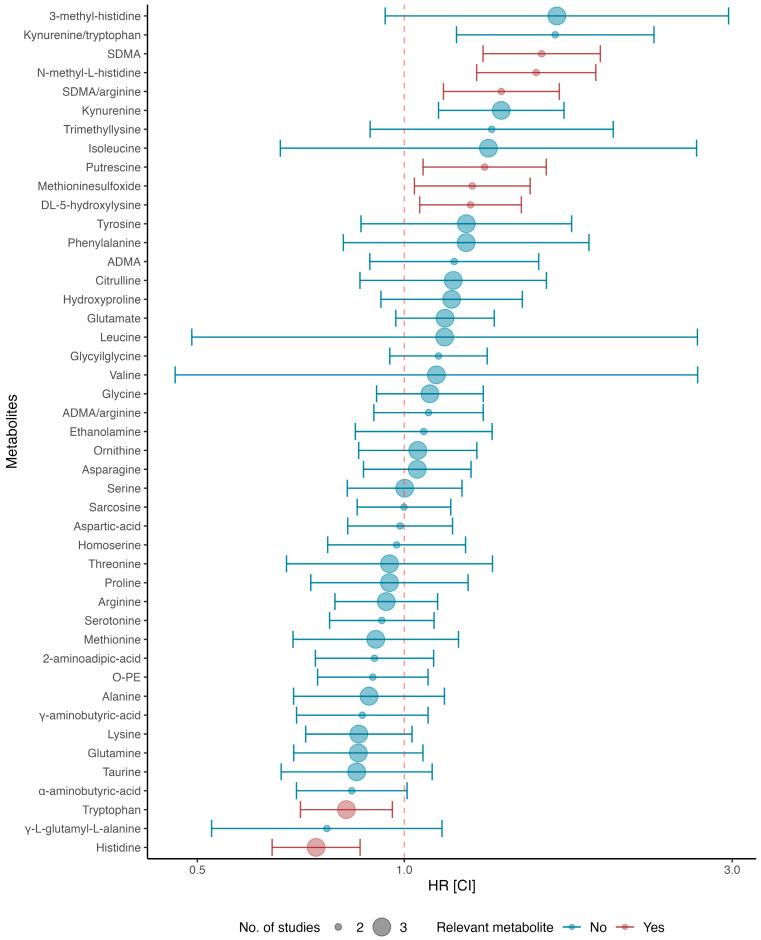
The associations of plasma metabolites with adverse cardiovascular (CV) outcomes are still underexplored and may be useful in CV risk stratification. We performed a systematic review and meta-analysis to establish correlations between blood metabolites and adverse CV outcomes in patients with heart failure (HF). Four cohorts were included, involving 83 metabolites and 37 metabolite ratios, measured in 1158 HF patients. Hazard ratios (HR) of 42 metabolites and 3 metabolite ratios, present in at least two studies, were combined through meta-analysis. Higher levels of histidine (HR 0.74, 95% CI [0.64; 0.86]) and tryptophan (HR 0.82 [0.71; 0.96]) seemed protective, whereas higher levels of symmetric dimethylarginine (SDMA) (HR 1.58 [1.30; 1.93]), N-methyl-1-histidine (HR 1.56 [1.27; 1.90]), SDMA/arginine (HR 1.38 [1.14; 1.68]), putrescine (HR 1.31 [1.06; 1.61]), methionine sulfoxide (HR 1.26 [1.03; 1.52]), and 5-hydroxylysine (HR 1.25 [1.05; 1.48]) were associated with a higher risk of CV events. Our findings corroborate important associations between metabolic imbalances and a higher risk of CV events in HF patients. However, the lack of standardization and data reporting hampered the comparison of a higher number of studies. In a future clinical scenario, metabolomics will greatly benefit from harmonizing sample handling, data analysis, reporting, and sharing.
血浆代谢物与不良心血管(CV)结局的相关性仍未得到充分探索,它们可能有助于 CV 风险分层。我们进行了一项系统回顾和荟萃分析,以确定心力衰竭(HF)患者血液代谢物与不良 CV 结局之间的相关性。共纳入 4 个队列,涉及 1158 例 HF 患者的 83 种代谢物和 37 种代谢物比值。通过荟萃分析,合并了至少有 2 项研究涉及的 42 种代谢物和 3 种代谢物比值的危险比(HR)。较高的组氨酸(HR 0.74,95%CI [0.64;0.86])和色氨酸(HR 0.82 [0.71;0.96])水平似乎具有保护作用,而较高的对称二甲基精氨酸(SDMA)(HR 1.58 [1.30;1.93])、N-甲基-1-组氨酸(HR 1.56 [1.27;1.90])、SDMA/精氨酸(HR 1.38 [1.14;1.68])、腐胺(HR 1.31 [1.06;1.61])、甲硫氨酸亚砜(HR 1.26 [1.03;1.52])和 5-羟基赖氨酸(HR 1.25 [1.05;1.48])水平与 CV 事件风险增加相关。我们的研究结果证实了代谢失衡与 HF 患者 CV 事件风险增加之间的重要关联。然而,缺乏标准化和数据报告阻碍了更多研究的比较。在未来的临床环境中,代谢组学将从样品处理、数据分析、报告和共享的协调中获益匪浅。

 Zotero 插件