
营养素对老年肌骨健康的协同作用:理解宏量营养素和微量营养素的综合影响。
Synergistic Effects of Nutrients on Musculoskeletal Health in Gerontology: Understanding the Combined Impact of Macronutrients and Micronutrients.
机构信息
School of Public Health, Wenzhou Medical University, Wenzhou 325035, China.
出版信息
Nutrients. 2024 May 27;16(11):1640. doi: 10.3390/nu16111640.
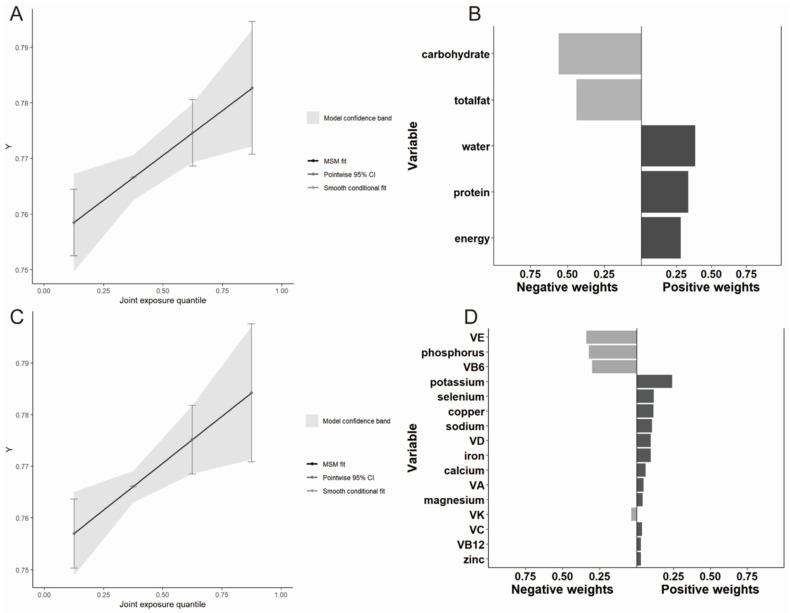
With the global aging population, addressing prevalent age-related conditions such as osteoporosis and sarcopenia is crucial. Traditional nutritional strategies focusing on single nutrients like calcium, vitamin D, or protein have limitations, prompting a nuanced exploration of the relationship between aging, nutrition, and musculoskeletal health. This cross-sectional study examines the complex interplay between dietary intake of macronutrients, common micronutrients, and water, as well as their association with musculoskeletal health in adults aged 50 to 80 years, using U.S. National Health and Nutrition Examination Survey data (NHANES). Employing multiple linear regression, restricted cubic splines, weighted quantile sum (WQS), and quantile-based g-computation (QGC) regression models, our initial analysis using the WQS model revealed that a one-quartile increase in mixed macronutrient intake was associated with a significant 0.009 unit increase in bone mineral density (BMD) and a 0.670 unit increase in grip strength, while a similar increase in mixed micronutrient intake showed a 0.007 unit increase in BMD and a 0.442 unit increase in grip strength. Our findings highlight the importance of a balanced dietary approach in promoting musculoskeletal health in the elderly, offering holistic strategies for overall well-being.
随着全球人口老龄化,解决普遍存在的与年龄相关的疾病,如骨质疏松症和肌肉减少症,至关重要。传统的营养策略侧重于单一营养素,如钙、维生素 D 或蛋白质,存在局限性,促使人们深入探讨衰老、营养与肌肉骨骼健康之间的关系。本横断面研究利用美国国家健康和营养调查(NHANES)数据,探讨了 50 至 80 岁成年人饮食中宏量营养素、常见微量营养素和水的摄入量与肌肉骨骼健康之间的复杂相互作用。采用多元线性回归、限制立方样条、加权分位数总和(WQS)和分位数基于的 g 计算(QGC)回归模型,我们使用 WQS 模型的初步分析表明,混合宏量营养素摄入量增加一个四分位数与骨矿物质密度(BMD)增加 0.009 个单位和握力增加 0.670 个单位显著相关,而类似的混合微量营养素摄入量增加与 BMD 增加 0.007 个单位和握力增加 0.442 个单位相关。我们的研究结果强调了在促进老年人肌肉骨骼健康方面采用均衡饮食方法的重要性,为整体健康提供了全面的策略。



 Zotero 插件