
玫瑰果( spp.)果汁中生物活性化合物的稳定性和抗氧化活性。
Stability of Bioactive Compounds and Antioxidant Activity in Rosehip Juice ( spp.).
机构信息
Departamento de Ciencias Químicas y Recursos Naturales, Scientific and Technological Bioresource Nucleus BIOREN-UFRO, Universidad de La Frontera, Temuco 4811230, Chile.
Programa de Doctorado en Ciencias Agroalimentarias y Medioambiente, Facultad de Ciencias Agropecuarias y Medioambiente, Universidad de La Frontera, Temuco, Región de la Araucanía, Temuco 4811230, Chile.
出版信息
Molecules. 2024 May 23;29(11):2448. doi: 10.3390/molecules29112448.
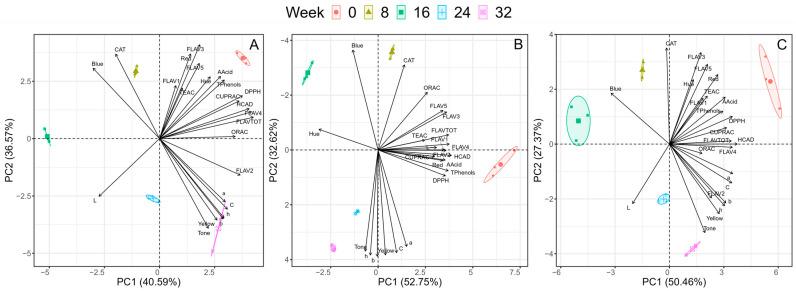
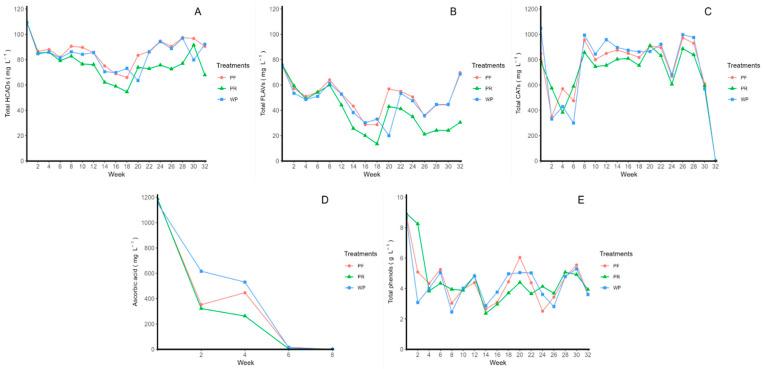
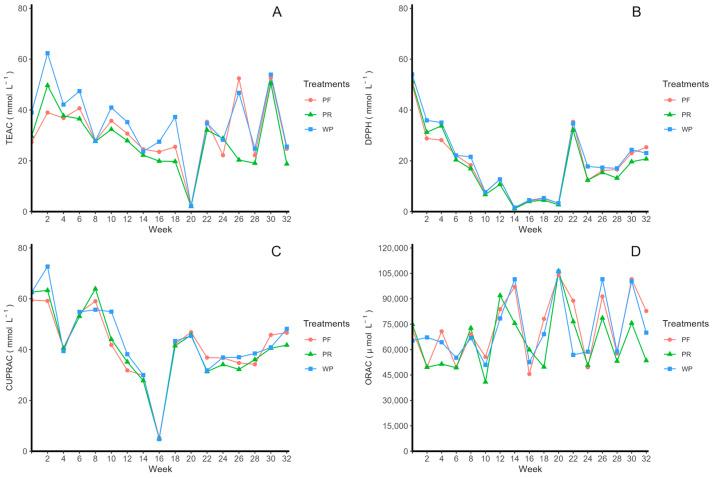
Rosehip fruits, characterized by their high concentrations of bioactive compounds and antioxidant activity (AA), have been traditionally used to make jams, infusions, and juices. Thus, the objective of this research was to evaluate the stability of rosehip juice by determining the concentrations of bioactive compounds and total phenols and the AA using chromatographic and spectroscopic methods. The stability of the juice was evaluated with three treatments and different storage conditions, namely, unpasteurized-refrigerated, pasteurized-room temperature, and pasteurized-refrigerated, and measurements were taken for eight months. Individual and total phenolic compounds, evaluated by chromatographic methods, reported differences until the end of this study. The total phenolic compounds by Folin-Ciocalteu method presented an average decrease of 57% in the three treatments in relation to the initial conditions. On the other hand, the ascorbic acid content decreased considerably, disappearing at week six. Furthermore, for the unpasteurized-refrigerated and pasteurized-refrigerated samples, a correlation was found between flavonols, total phenols, ascorbic acid, and antioxidant activity determined by the TEAC method. For the pasteurized-room temperature samples, correlations were found between the levels of several flavonols, hydroxycinnamic acid, total phenols, and ascorbic acid and the antioxidant activity determined by the CUPRAC method. The stability of the compounds was mainly correlated with the storage conditions of the juice and not with pasteurization. The highest stability was observed for the unpasteurized-refrigerated and pasteurized-refrigerated samples. Although the concentrations of the compounds evaluated decreased during this study, significant levels of AA persisted, providing beneficial characteristics for consumer health.
玫瑰果的果实富含生物活性化合物和抗氧化活性(AA),传统上被用于制作果酱、浸泡液和果汁。因此,本研究的目的是通过使用色谱和光谱方法测定生物活性化合物和总酚类物质以及 AA 的浓度来评估玫瑰果汁的稳定性。该果汁的稳定性通过三种处理和不同的储存条件进行评估,即未经巴氏杀菌的冷藏、巴氏杀菌的室温保存和巴氏杀菌的冷藏,并在八个月内进行测量。通过色谱方法评估的个体和总酚类化合物报告的差异持续到本研究结束。用 Folin-Ciocalteu 法测定的总酚类化合物在三种处理方式下与初始条件相比平均下降了 57%。另一方面,抗坏血酸含量明显下降,在第六周时消失。此外,对于未经巴氏杀菌的冷藏和巴氏杀菌的冷藏样品,在黄酮醇、总酚类物质、抗坏血酸和 TEAC 法测定的抗氧化活性之间发现了相关性。对于巴氏杀菌的室温保存样品,在几种黄酮醇、羟基肉桂酸、总酚类物质和抗坏血酸的水平以及 CUPRAC 法测定的抗氧化活性之间发现了相关性。化合物的稳定性主要与果汁的储存条件有关,而与巴氏杀菌无关。未经巴氏杀菌的冷藏和巴氏杀菌的冷藏样品的稳定性最高。尽管在研究过程中评估的化合物浓度下降,但仍保持着显著的 AA 水平,为消费者的健康提供了有益的特性。

 Zotero 插件