
中国药品集中带量采购对药品市场集中度的影响。
The impact of Chinese volume-based procurement on pharmaceutical market concentration.
作者信息
Yang Ying, Liu Yuxin, Mao Zongfu, Mao Jing, Jin Yalei
机构信息
School of Nursing, Tongji Medical College, Huazhong University of Science and Technology, Wuhan, China.
Global Health Institute, Wuhan University, Wuhan, China.
出版信息
Front Pharmacol. 2024 Jun 4;15:1386533. doi: 10.3389/fphar.2024.1386533. eCollection 2024.
OBJECTIVES
Optimizing the pharmaceutical industrial structure is the key mission of China's healthcare reform. From the industrial structure perspective, this study empirically evaluated the impact of China's national volume-based procurement (NVBP) policy on market concentration in the hospital-end drug market.
METHODS
This study used drug procurement data of China's public medical institutions which obtained from the national database. A quasi-natural experiment was designed involving eleven pairs of matched treatment-control region combinations, with NVBP policy as the intervention measure. The market was defined by drug name (molecular boundary) and city/province (geographical boundary). Market changes were measured from three dimensions: the number of enterprises and products, market share, and Herfindahl-Hirschman index (HHI). Dual comparison approach and difference-in-difference (DID) method with fixed effect model were applied to quantify policy impacts.
RESULTS
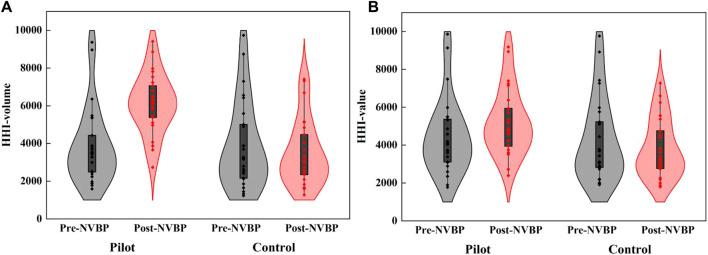
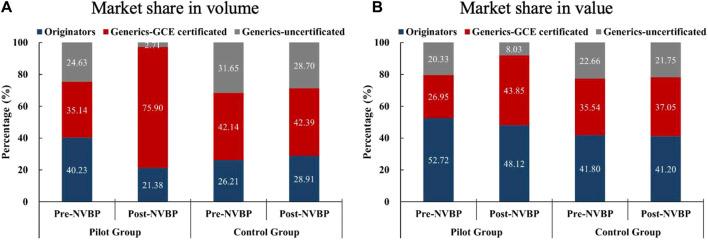
The number of enterprises and products decreased by 18 and 83 in pilot regions after NVBP policy, far more than the decreases in control regions (6 and 21). The accumulative market share of 15 bid-winning enterprises increased by 53.67% in volume and 18.79% in value, among which the increment of enterprises with low baseline market share was more prominent (66.64% and 36.40%). Among three enterprise types, the market share of generic consistency evaluation (GCE) certificated generics significantly increased, GCE uncertificated generics significantly decreased, and originators slightly decreased. DID models indicated significantly positive impact of NVBP policy on market concentration, with HHI-volume and HHI-value increasing by 49.33% ( = 0.401, < 0.01) and 21.05% ( = 0.191, < 0.01).
CONCLUSION
The implementation of NVBP promoted the intensive drug circulation and supply of Chinese public hospitals, intensifying the exit of GCE uncertificated generics from the hospital-end market. NVBP combined with GCE standards significantly improved market concentration, which brought a positive signal of pharmaceutical industrial structure optimization in China. In the future context of normalized and institutionalized NVBP, the balance should be further sought between low drug prices and reliable hospital drug supply, sustainable industry development.
目的
优化医药产业结构是中国医疗改革的关键任务。本研究从产业结构视角,实证评估了中国国家集中带量采购(NVBP)政策对医院端药品市场集中度的影响。
方法
本研究使用了从国家数据库获取的中国公立医疗机构药品采购数据。设计了一个准自然实验,涉及11对匹配的处理组-对照组区域组合,将NVBP政策作为干预措施。市场按药品名称(分子边界)和城市/省份(地理边界)定义。从企业和产品数量、市场份额以及赫芬达尔-赫希曼指数(HHI)三个维度衡量市场变化。应用双重比较法和固定效应模型的差分法(DID)来量化政策影响。
结果
NVBP政策实施后,试点地区的企业和产品数量分别减少了18家和83种,远多于对照组地区的减少量(6家和21种)。15家中标企业的累计市场份额在数量上增加了53.67%,在价值上增加了18.79%,其中基线市场份额较低的企业增量更为突出(66.64%和36.40%)。在三种企业类型中,通过仿制药一致性评价(GCE)的仿制药市场份额显著增加,未通过GCE的仿制药市场份额显著下降,原研药市场份额略有下降。DID模型表明NVBP政策对市场集中度有显著的正向影响,HHI-数量和HHI-价值分别增加了49.33%(β = 0.401,p < 0.01)和21.05%(β = 0.191,p < 0.01)。
结论
NVBP的实施促进了中国公立医院药品流通和供应的集约化,加剧了未通过GCE的仿制药退出医院端市场。NVBP与GCE标准相结合显著提高了市场集中度,这为中国医药产业结构优化带来了积极信号。在未来NVBP常态化、制度化的背景下,应进一步在低药价与可靠的医院药品供应、产业可持续发展之间寻求平衡。



 Zotero 插件