
有意义的消费者参与癌症护理:关于共同设计方法和流程的系统评价。
Meaningful consumer involvement in cancer care: a systematic review on co-design methods and processes.
机构信息
Institute for Physical Activity and Nutrition, Deakin University, Geelong, VIC, Australia.
Department of Health Services Research, Peter MacCallum Cancer Centre, Melbourne, VIC, Australia.
出版信息
JNCI Cancer Spectr. 2024 Jul 1;8(4). doi: 10.1093/jncics/pkae048.
OBJECTIVE
Although the benefits of consumer involvement in research and health care initiatives are known, there is a need to optimize this for all people with cancer. This systematic review aimed to synthesize and evaluate the application of co-design in the oncology literature and develop recommendations to guide the application of optimal co-design processes and reporting in oncology research, practice, and policy.
METHODS
A systematic review of co-design studies in adults with cancer was conducted, searching MEDLINE, CINAHL, Embase, and PsycINFO databases and included studies focused on 2 concepts, co-design and oncology.
RESULTS
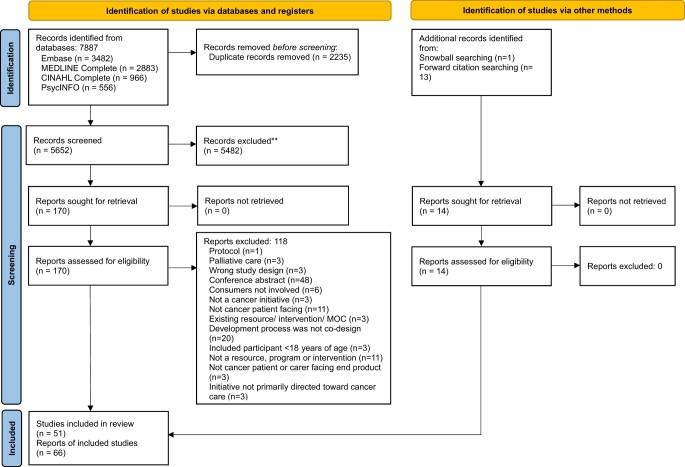
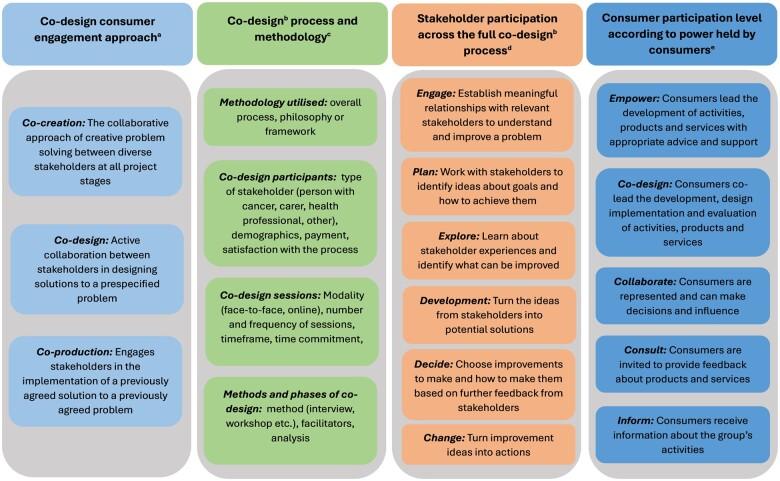
A total of 5652 titles and abstracts were screened, resulting in 66 eligible publications reporting on 51 unique studies. Four frameworks were applied to describe the co-design initiatives. Most co-design initiatives were designed for use in an outpatient setting (n = 38; 74%) and were predominantly digital resources (n = 14; 27%) or apps (n = 12; 23%). Most studies (n = 25; 49%) used a co-production approach to consumer engagement. Although some studies presented strong co-design methodology, most (n = 36; 70%) did not report the co-design approach, and 14% used no framework. Reporting was poor for the participant level of involvement, the frequency, and time commitment of co-design sessions. Consumer participation level was predominantly collaborate (n = 25; 49%).
CONCLUSIONS
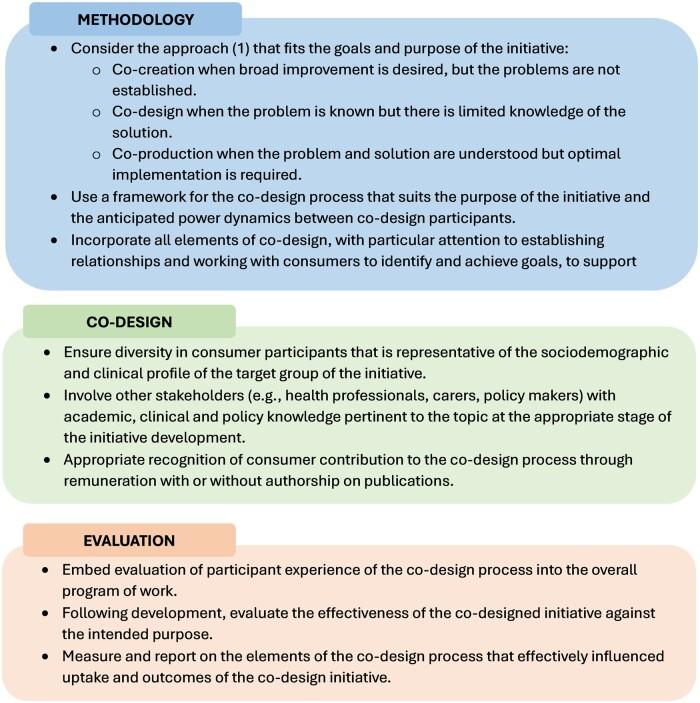
There are opportunities to improve the application of co-design in oncology research. This review has generated recommendations to guide 1) methodology and frameworks, 2) recruitment and engagement of co-design participants, and 3) evaluation of the co-design process. These recommendations can help drive appropriate, meaningful, and equitable co-design, leading to better cancer research and care.
目的
尽管人们已经认识到让消费者参与研究和医疗保健计划的好处,但仍需要为所有癌症患者优化这一过程。本系统评价旨在综合评估肿瘤学文献中共同设计的应用,并制定指导最佳共同设计流程在肿瘤学研究、实践和政策中的应用和报告的建议。
方法
对成人癌症共同设计研究进行了系统评价,检索了 MEDLINE、CINAHL、Embase 和 PsycINFO 数据库,包括关注共同设计和肿瘤学这两个概念的研究。
结果
共筛选出 5652 篇标题和摘要,最终纳入 66 篇符合条件的文献,报道了 51 项独特的研究。四个框架被用来描述共同设计计划。大多数共同设计计划旨在用于门诊环境(n=38;74%),主要是数字资源(n=14;27%)或应用程序(n=12;23%)。大多数研究(n=25;49%)采用共同生产方法让消费者参与其中。尽管一些研究提出了强有力的共同设计方法,但大多数(n=36;70%)没有报告共同设计方法,14%的研究没有使用框架。参与者参与程度、共同设计会议的频率和时间承诺的报告情况较差。消费者参与水平主要是协作(n=25;49%)。
结论
在肿瘤学研究中进一步改进共同设计的应用有很大的空间。本综述提出了一些建议,以指导 1)方法和框架,2)共同设计参与者的招募和参与,3)共同设计过程的评估。这些建议有助于推动适当、有意义和公平的共同设计,从而改善癌症的研究和护理。
 Zotero 插件