
基于主成分分析的临床衰老时钟可识别健康衰老的特征和临床干预的靶点。
Principal component-based clinical aging clocks identify signatures of healthy aging and targets for clinical intervention.
机构信息
Department of Geriatric Medicine, Singapore General Hospital, Singapore, Singapore.
Clinical and Translational Sciences PhD Program, Duke-NUS Medical School, Singapore, Singapore.
出版信息
Nat Aging. 2024 Aug;4(8):1137-1152. doi: 10.1038/s43587-024-00646-8. Epub 2024 Jun 19.
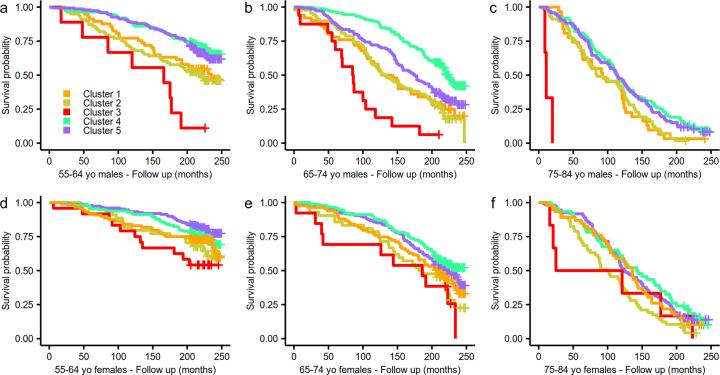
Clocks that measure biological age should predict all-cause mortality and give rise to actionable insights to promote healthy aging. Here we applied dimensionality reduction by principal component analysis to clinical data to generate a clinical aging clock (PCAge) identifying signatures (principal components) separating healthy and unhealthy aging trajectories. We found signatures of metabolic dysregulation, cardiac and renal dysfunction and inflammation that predict unsuccessful aging, and we demonstrate that these processes can be impacted using well-established drug interventions. Furthermore, we generated a streamlined aging clock (LinAge), based directly on PCAge, which maintains equivalent predictive power but relies on substantially fewer features. Finally, we demonstrate that our approach can be tailored to individual datasets, by re-training a custom clinical clock (CALinAge), for use in the Comprehensive Assessment of Long-term Effects of Reducing Intake of Energy (CALERIE) study of caloric restriction. Our analysis of CALERIE participants suggests that 2 years of mild caloric restriction significantly reduces biological age. Altogether, we demonstrate that this dimensionality reduction approach, through integrating different biological markers, can provide targets for preventative medicine and the promotion of healthy aging.
衡量生物年龄的时钟应该能够预测全因死亡率,并提供可采取行动的见解,以促进健康老龄化。在这里,我们通过主成分分析对临床数据进行降维,生成一个临床老化时钟 (PCAge),确定分离健康和不健康老化轨迹的特征 (主成分)。我们发现代谢失调、心脏和肾脏功能障碍以及炎症的特征可以预测衰老失败,我们证明这些过程可以通过使用成熟的药物干预来影响。此外,我们基于 PCAge 直接生成了一个简化的老化时钟 (LinAge),它保持了相当的预测能力,但依赖的特征要少得多。最后,我们通过重新训练定制的临床时钟 (CALinAge),展示了我们的方法可以针对特定数据集进行定制,该时钟用于能量摄入减少的长期效果综合评估 (CALERIE) 热量限制研究。我们对 CALERIE 参与者的分析表明,2 年的轻度热量限制可显著降低生物年龄。总之,我们证明了这种降维方法通过整合不同的生物标志物,可以为预防医学和促进健康老龄化提供目标。



 Zotero 插件