
评估系统性红斑狼疮患者脂肪性肝病的横断面研究。
A cross sectional study assessing steatotic liver disease in patients with systemic lupus erythematosus.
机构信息
Gastroenterology Department, Instituto Nacional de Ciencias Médicas y Nutrición Salvador Zubirán, Vasco de Quiroga 15, Colonia Belisario Domínguez Sección XVI, Tlalpan, CP 14080, Mexico City, Mexico.
Research Division, Instituto Nacional de Geriatría, Av Contreras 428, San Jerónimo Lídice, Magdalena Contreras, CP 10200, Mexico City, Mexico.
出版信息
Sci Rep. 2024 Jun 20;14(1):14275. doi: 10.1038/s41598-024-65105-1.
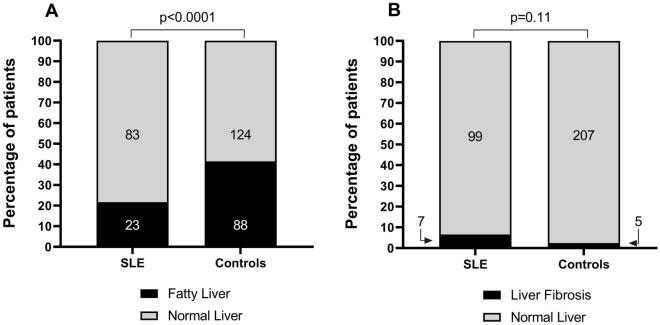
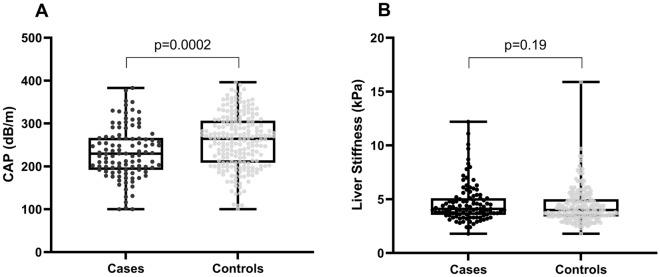
Patients with immune-mediated inflammatory diseases are prone to steatotic liver disease (SLD), which has been observed in patients with psoriasis and hidradenitis suppurativa. We aimed to assess whether systemic lupus erythematosus (SLE) was associated with SLD and to define factors associated with SLD in SLE. This was a cross-sectional study, we included 106 consecutive patients with SLE who were seen in the rheumatology clinic between June 2021 and March 2022 and we chose two sex-paired controls for each SLE. All the participants underwent FibroScan and anthropometric assessments. SLD was defined as a controlled attenuation parameter ≥ 275dB/m. Prevalence of SLD was lower in patients with SLE (21.7% vs 41.5%, p < 0.001). Patients with SLE and SLD had a lower frequency of hydroxychloroquine use (65% vs 84%, p = 0.04), and higher C3 levels [123mg/dl (IQR 102-136) vs 99mg/dl (IQR 78-121), p = 0.004]. Factors associated with SLD in SLE were body mass index (BMI), waist circumference, glucose, and C3; hydroxychloroquine use was a protective factor. On univariate analysis, SLE was associated with a reduced risk of SLD (OR 0.39, 95%CI 0.23-0.67); however, after adjusting for age, BMI, waist, glucose, triglycerides, high-density cholesterol, low-density cholesterol, leukocytes, and hydroxychloroquine, it was no longer associated (OR 0.43, 95%CI 0.10-1.91). In conclusion, the prevalence of SLD in patients with SLE was not higher than that in the general population, and SLE was not associated with SLD. The factors associated with SLD were anthropometric data, glucose, hydroxychloroquine, and C3 levels.
患有免疫介导的炎症性疾病的患者容易发生脂肪性肝病(SLD),这种情况在银屑病和化脓性汗腺炎患者中已经观察到。我们旨在评估系统性红斑狼疮(SLE)是否与 SLD 相关,并确定 SLE 患者发生 SLD 的相关因素。这是一项横断面研究,共纳入了 2021 年 6 月至 2022 年 3 月期间在风湿病科就诊的 106 例连续 SLE 患者,并为每位 SLE 患者选择了两名性别匹配的对照者。所有参与者均接受了 FibroScan 和人体测量评估。SLD 的定义为受控衰减参数≥275dB/m。SLE 患者的 SLD 患病率较低(21.7%比 41.5%,p<0.001)。患有 SLE 和 SLD 的患者羟氯喹使用率较低(65%比 84%,p=0.04),C3 水平较高[123mg/dl(IQR 102-136)比 99mg/dl(IQR 78-121),p=0.004]。SLE 患者发生 SLD 的相关因素有体重指数(BMI)、腰围、血糖和 C3;羟氯喹的使用是一种保护因素。单因素分析显示,SLE 与 SLD 的发生风险降低相关(OR 0.39,95%CI 0.23-0.67);然而,在调整年龄、BMI、腰围、血糖、甘油三酯、高密度胆固醇、低密度胆固醇、白细胞和羟氯喹后,这种相关性不再存在(OR 0.43,95%CI 0.10-1.91)。总之,SLE 患者的 SLD 患病率并不高于普通人群,且 SLE 与 SLD 无关。与 SLD 相关的因素有人体测量数据、血糖、羟氯喹和 C3 水平。
 Zotero 插件