
欧盟成员国癌症领域的遗传咨询立法与实践。
Genetic counselling legislation and practice in cancer in EU Member States.
作者信息
McCrary J Matt, Van Valckenborgh Els, Poirel Hélène A, de Putter Robin, van Rooij Jeroen, Horgan Denis, Dierks Marie-Luise, Antonova Olga, Brunet Joan, Chirita-Emandi Adela, Colas Chrystelle, Dalmas Miriam, Ehrencrona Hans, Grima Claire, Janavičius Ramūnas, Klink Barbara, Koczok Katalin, Krajc Mateja, Lace Baiba, Leitsalu Liis, Mistrik Martin, Paneque Milena, Primorac Dragan, Roetzer Katharina M, Ronez Joelle, Slámová Lucie, Spanou Elena, Stamatopoulos Kostas, Stoklosa Tomasz, Strang-Karlsson Sonja, Szakszon Katalin, Szczałuba Krzysztof, Turner Jacqueline, van Dooren Marieke F, van Zelst-Stams Wendy A G, Vassallo Loredana-Maria, Wadt Karin A W, Žigman Tamara, Ripperger Tim, Genuardi Maurizio, Van den Bulcke Marc, Bergmann Anke Katharina
机构信息
Department of Human Genetics, Hannover Medical School, Hannover, Germany.
Cancer Centre, , Department of Epidemiology and Public Health, Sciensano, Brussels, Belgium.
出版信息
Eur J Public Health. 2024 Aug 1;34(4):666-675. doi: 10.1093/eurpub/ckae093.
BACKGROUND
Somatic and germline genetic alterations are significant drivers of cancer. Increasing integration of new technologies which profile these alterations requires timely, equitable and high-quality genetic counselling to facilitate accurate diagnoses and informed decision-making by patients and their families in preventive and clinical settings. This article aims to provide an overview of genetic counselling legislation and practice across European Union (EU) Member States to serve as a foundation for future European recommendations and action.
METHODS
National legislative databases of all 27 Member States were searched using terms relevant to genetic counselling, translated as appropriate. Interviews with relevant experts from each Member State were conducted to validate legislative search results and provide detailed insights into genetic counselling practice in each country.
RESULTS
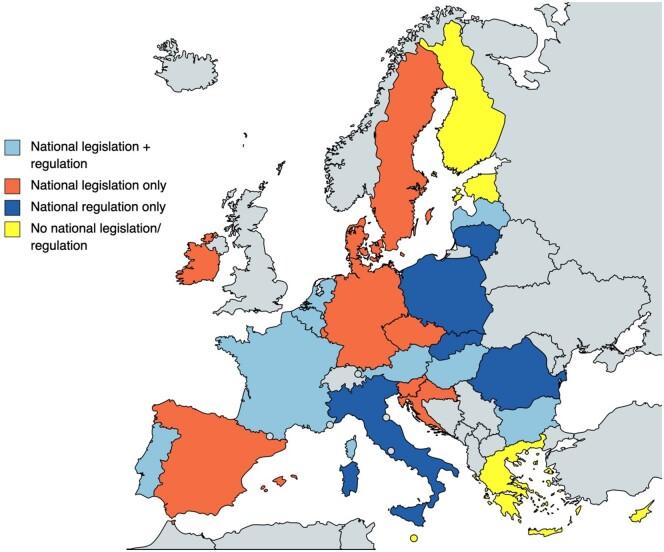
Genetic counselling is included in national legislative documents of 22 of 27 Member States, with substantial variation in legal mechanisms and prescribed details (i.e. the 'who, what, when and where' of counselling). Practice is similarly varied. Workforce capacity (25 of 27 Member States) and genetic literacy (all Member States) were common reported barriers. Recognition and/or better integration of genetic counsellors and updated legislation and were most commonly noted as the 'most important change' which would improve practice.
CONCLUSIONS
This review highlights substantial variability in genetic counselling across EU Member States, as well as common barriers notwithstanding this variation. Future recommendations and action should focus on addressing literacy and capacity challenges through legislative, regulatory and/or strategic approaches at EU, national, regional and/or local levels.
背景
体细胞和生殖系基因改变是癌症的重要驱动因素。对这些改变进行分析的新技术整合日益增加,这就需要及时、公平且高质量的基因咨询,以便在预防和临床环境中帮助患者及其家属做出准确诊断和明智决策。本文旨在概述欧盟成员国的基因咨询立法和实践情况,为未来的欧洲建议和行动奠定基础。
方法
使用与基因咨询相关的术语搜索了所有27个成员国的国家立法数据库,并进行了适当翻译。对每个成员国的相关专家进行了访谈,以验证立法搜索结果,并深入了解每个国家的基因咨询实践。
结果
27个成员国中有22个将基因咨询纳入国家立法文件,法律机制和规定细节(即咨询的“对象、内容、时间和地点”)存在很大差异。实践情况也同样各不相同。劳动力能力(27个成员国中的25个)和基因知识水平(所有成员国)是常见的报告障碍。基因咨询师的认可和/或更好的整合以及更新立法最常被视为会改善实践的“最重要变化”。
结论
本综述强调了欧盟成员国基因咨询存在很大差异,尽管存在这种差异,但也有共同的障碍。未来的建议和行动应侧重于通过欧盟、国家、地区和/或地方层面的立法、监管和/或战略方法来应对知识水平和能力方面的挑战。
 Zotero 插件