
采样时间对阿尔茨海默病生物标志物的脑脊液和血浆水平的影响。
Effects of time of the day at sampling on CSF and plasma levels of Alzheimer' disease biomarkers.
机构信息
Clinical Memory Research Unit, Department of Clinical Sciences Malmö, Faculty of Medicine, Lund University, Sölvegatan 19, BMC B11, Lund, 221 84, Sweden.
Memory Clinic, Skåne University Hospital, S:t Johannesgatan 8, Malmö, SE-20502, Sweden.
出版信息
Alzheimers Res Ther. 2024 Jun 22;16(1):132. doi: 10.1186/s13195-024-01503-x.
BACKGROUND
Studies suggest that cerebrospinal fluid (CSF) levels of amyloid-β (Aβ)42 and Aβ40 present a circadian rhythm. However sustained sampling of large volumes of CSF with indwelling intrathecal catheters used in most of these studies might have affected CSF dynamics and thereby confounded the observed fluctuations in the biomarker levels.
METHODS
We included 38 individuals with either normal (N = 20) or abnormal (N = 18) CSF Aβ42/Aβ40 levels at baseline. CSF and plasma were collected at two visits separated by an average of 53 days with lumbar punctures and venipunctures performed either in the morning or evening. At the first visit, sample collection was performed in the morning for 17 participants and the order was reversed for the remaining 21 participants. CSF and plasma samples were analyzed for Alzheimer' disease (AD) biomarkers, including Aβ42, Aβ40, GFAP, NfL p-tau181, p-tau217, p-tau231 and t-tau. CSF samples were also tested using mass spectrometry for 22 synaptic and endo-lysosomal proteins.
RESULTS
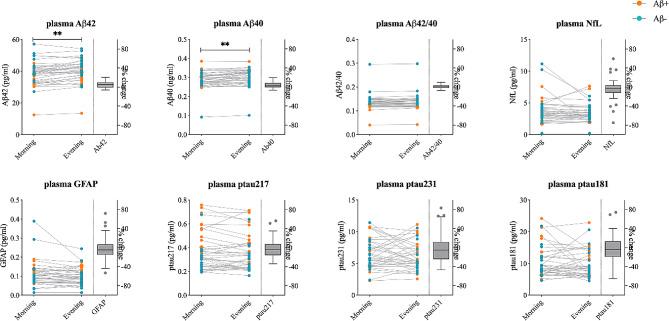
CSF Aβ42 (mean difference [MD], 0.21 ng/mL; p = 0.038), CSF Aβ40 (MD, 1.85 ng/mL; p < 0.001), plasma Aβ42 (MD, 1.65 pg/mL; p = 0.002) and plasma Aβ40 (MD, 0.01 ng/mL, p = 0.002) were increased by 4.2-17.0% in evening compared with morning samples. Further, CSF levels of 14 synaptic and endo-lysosomal proteins, including neurogranin and neuronal pentraxin-1, were increased by 4.5-13.3% in the evening samples (MD, 0.02-0.56 fmol/µl; p < 0.042). However, no significant differences were found between morning and evening levels for the Aβ42/Aβ40 ratio, different p-tau variants, GFAP and NfL. There were no significant interaction between sampling time and Aβ status for any of the biomarkers, except that CSF t-tau was increased (by 5.74%) in the evening samples compared to the morning samples in Aβ-positive (MD, 16.46 ng/ml; p = 0.009) but not Aβ-negative participants (MD, 1.89 ng/ml; p = 0.47). There were no significant interactions between sampling time and order in which samples were obtained.
DISCUSSION
Our findings provide evidence for diurnal fluctuations in Aβ peptide levels, both in CSF and plasma, while CSF and plasma p-tau, GFAP and NfL were unaffected. Importantly, Aβ42/Aβ40 ratio remained unaltered, suggesting that it is more suitable for implementation in clinical workup than individual Aβ peptides. Additionally, we show that CSF levels of many synaptic and endo-lysosomal proteins presented a diurnal rhythm, implying a build-up of neuronal activity markers during the day. These results will guide the development of unified sample collection procedures to avoid effects of diurnal variation for future implementation of AD biomarkers in clinical practice and drug trials.
背景
研究表明,脑脊液(CSF)中的淀粉样蛋白-β(Aβ)42 和 Aβ40 水平呈现昼夜节律。然而,大多数研究中使用的留置鞘内导管对大量 CSF 进行持续采样可能会影响 CSF 动力学,从而混淆观察到的生物标志物水平波动。
方法
我们纳入了基线时 CSF Aβ42/Aβ40 水平正常(N=20)或异常(N=18)的 38 名个体。在两次就诊期间通过腰椎穿刺和静脉穿刺采集 CSF 和血浆,两次就诊的平均间隔为 53 天。在第一次就诊时,17 名参与者进行了清晨采样,其余 21 名参与者的顺序相反。使用酶联免疫吸附试验(ELISA)分析 CSF 和血浆样本中的阿尔茨海默病(AD)生物标志物,包括 Aβ42、Aβ40、GFAP、NfL p-tau181、p-tau217、p-tau231 和 t-tau。CSF 样本还使用质谱法检测了 22 种突触和内溶酶体蛋白。
结果
与清晨样本相比,傍晚时 CSF Aβ42(平均差异 [MD],0.21ng/mL;p=0.038)、CSF Aβ40(MD,1.85ng/mL;p<0.001)、血浆 Aβ42(MD,1.65pg/mL;p=0.002)和血浆 Aβ40(MD,0.01ng/mL;p=0.002)增加了 4.2-17.0%。此外,14 种突触和内溶酶体蛋白(包括神经颗粒蛋白和神经元五聚素-1)的 CSF 水平在傍晚样本中增加了 4.5-13.3%(MD,0.02-0.56fmol/µl;p<0.042)。然而,Aβ42/Aβ40 比值、不同的 p-tau 变体、GFAP 和 NfL 的清晨和傍晚水平之间没有显著差异。除了 Aβ 阳性参与者(MD,16.46ng/ml;p=0.009),而不是 Aβ 阴性参与者(MD,1.89ng/ml;p=0.47)中 CSF t-tau 在傍晚样本中增加(增加 5.74%)外,生物标志物的清晨和傍晚采样时间之间没有显著的交互作用。
讨论
我们的研究结果为 CSF 和血浆中 Aβ 肽水平的昼夜波动提供了证据,而 CSF 和血浆中的 p-tau、GFAP 和 NfL 不受影响。重要的是,Aβ42/Aβ40 比值保持不变,这表明它比单个 Aβ 肽更适合用于临床评估。此外,我们还表明,许多突触和内溶酶体蛋白的 CSF 水平呈现昼夜节律,这意味着白天神经元活动标志物的积累。这些结果将指导开发统一的样本采集程序,以避免昼夜变化的影响,为未来 AD 生物标志物在临床实践和药物试验中的实施提供依据。

 Zotero 插件