
柚皮素通过激活肝癌中的AMPK-PGC1α信号轴减弱有氧糖酵解,从而增强铁死亡诱导剂的疗效。
Naringenin enhances the efficacy of ferroptosis inducers by attenuating aerobic glycolysis by activating the AMPK-PGC1α signalling axis in liver cancer.
作者信息
Li Yong-Zhuo, Deng Jing, Zhang Xiao-Dong, Li Dong-Yang, Su Li-Xi, Li Shan, Pan Jian-Min, Lu Lan, Ya Jia-Qi, Yang Nuo, Zhou Jing, Yang Li-Hui
机构信息
Department of Physiology, School of Preclinical Medicine, Guangxi Medical University, Nanning, Guangxi, China.
Academic Affairs Office, School of Nursing, Guangxi Medical University, Nanning, Guangxi, China.
出版信息
Heliyon. 2024 May 31;10(11):e32288. doi: 10.1016/j.heliyon.2024.e32288. eCollection 2024 Jun 15.
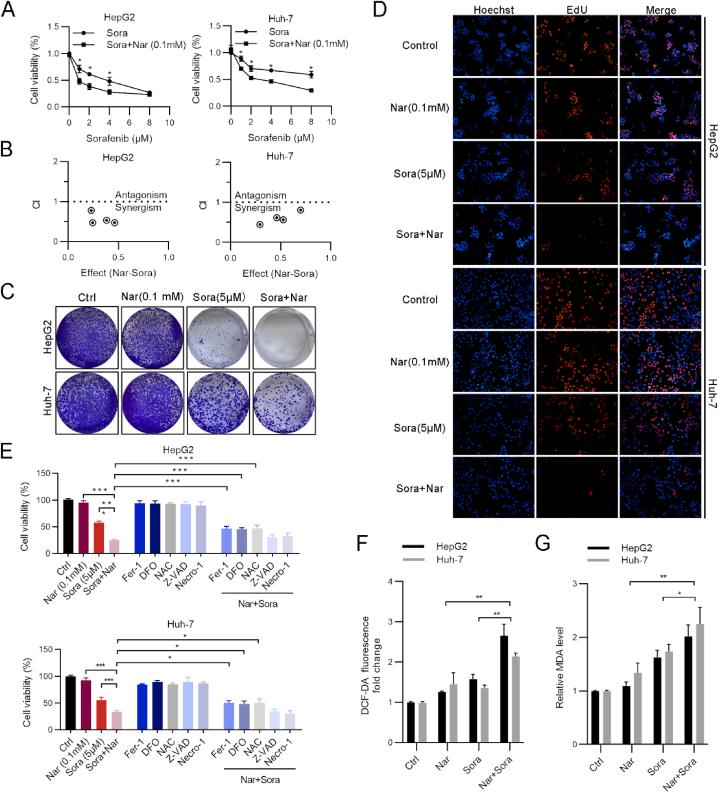
Liver cancer is a heterogeneous disease characterized by poor responses to standard therapies and therefore unfavourable clinical outcomes. Understanding the characteristics of liver cancer and developing novel therapeutic strategies are imperative. Ferroptosis, a type of programmed cell death induced by lipid peroxidation, has emerged as a potential target for treatment. Naringenin, a natural compound that modulates lipid metabolism by targeting AMPK, shows promise in enhancing the efficacy of ferroptosis inducers. In this study, we utilized liver cancer cell lines and xenograft mice to explore the synergistic effects of naringenin in combination with ferroptosis inducers, examining both phenotypic outcomes and molecular mechanisms. Our study results indicate that the use of naringenin at non-toxic doses to hepatocytes can significantly enhance the anticancer effects of ferroptosis inducers (erastin, RSL3, and sorafenib). The combination index method confirmed a synergistic effect between naringenin and ferroptosis inducers. In comparison to naringenin or ferroptosis inducers alone, the combined therapy caused more robust lipid peroxidation and hence more severe ferroptotic damage to cancer cells. The inhibition of aerobic glycolysis mediated by the AMPK-PGC1α signalling axis is the key to naringenin's effect on reducing ferroptosis resistance in liver cancer, and the synergistic cytotoxic effect of naringenin and ferroptosis inducers on cancer cells was reversed after pretreatment with an AMPK inhibitor or a PGC1α inhibitor. Taken together, these findings suggest that naringenin could boost cancer cell sensitivity to ferroptosis inducers, which has potential clinical translational value.
肝癌是一种异质性疾病,其特征是对标准疗法反应不佳,因此临床结果不理想。了解肝癌的特征并开发新的治疗策略势在必行。铁死亡是一种由脂质过氧化诱导的程序性细胞死亡,已成为一种潜在的治疗靶点。柚皮素是一种通过靶向AMPK调节脂质代谢的天然化合物,在增强铁死亡诱导剂的疗效方面显示出前景。在本研究中,我们利用肝癌细胞系和异种移植小鼠来探索柚皮素与铁死亡诱导剂联合使用的协同作用,同时研究表型结果和分子机制。我们的研究结果表明,以对肝细胞无毒的剂量使用柚皮素可以显著增强铁死亡诱导剂(埃拉司亭、RSL3和索拉非尼)的抗癌效果。联合指数法证实了柚皮素与铁死亡诱导剂之间的协同作用。与单独使用柚皮素或铁死亡诱导剂相比,联合治疗导致更强的脂质过氧化,从而对癌细胞造成更严重的铁死亡损伤。AMPK-PGC1α信号轴介导的有氧糖酵解抑制是柚皮素降低肝癌铁死亡抗性作用的关键,用AMPK抑制剂或PGC1α抑制剂预处理后,柚皮素与铁死亡诱导剂对癌细胞的协同细胞毒性作用被逆转。综上所述,这些发现表明柚皮素可以提高癌细胞对铁死亡诱导剂的敏感性,具有潜在的临床转化价值。



 Zotero 插件