
对 -(1,3-二甲基丁基)-'-苯基--对苯二胺(6PPD)及其衍生物 6PPD-醌在环境中的综述。
A Review of -(1,3-Dimethylbutyl)-'-phenyl--Phenylenediamine (6PPD) and Its Derivative 6PPD-Quinone in the Environment.
作者信息
Li Yi, Zeng Jingjing, Liang Yongjin, Zhao Yanlong, Zhang Shujun, Chen Zhongyan, Zhang Jiawen, Shen Xingze, Wang Jiabin, Zhang Ying, Sun Yuxin
机构信息
Eco-Environmental Monitoring and Research Center, Pearl River Valley and South China Sea Ecology and Environment Administration, Ministry of Ecology and Environment, Guangzhou 510611, China.
Guangdong Provincial Key Laboratory of Chemical Pollution and Environmental Safety & MOE Key Laboratory of Environmental Theoretical Chemistry, School of Environment, South China Normal University, Guangzhou 510006, China.
出版信息
Toxics. 2024 May 28;12(6):394. doi: 10.3390/toxics12060394.
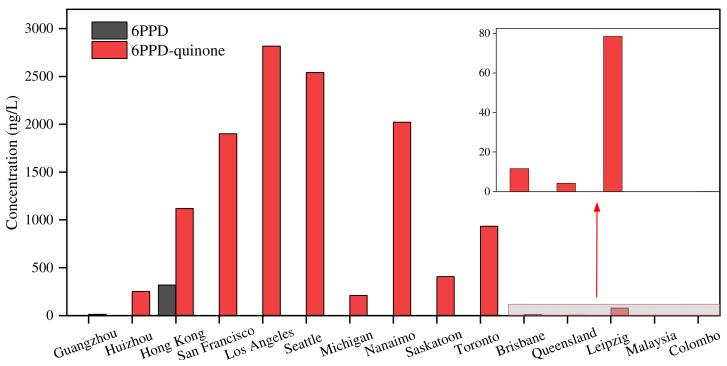
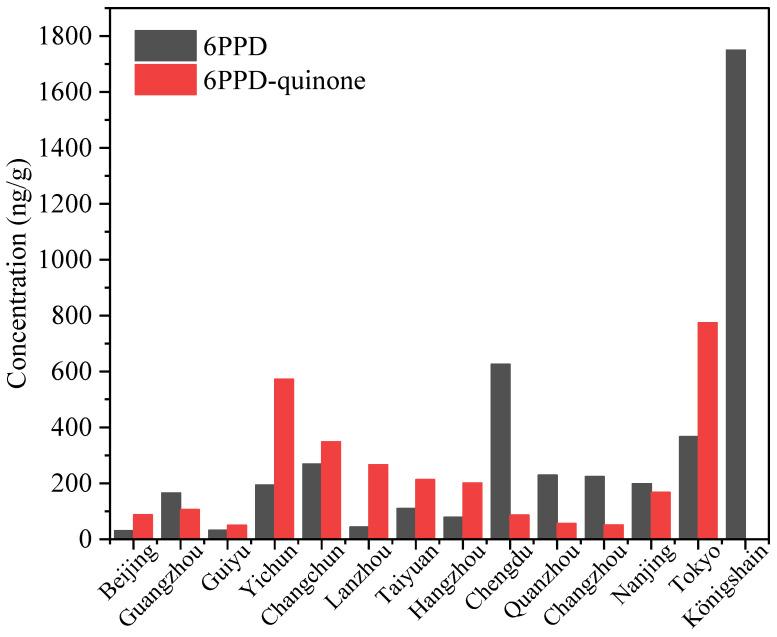
As an antioxidant and antiozonant, -(1,3-Dimethylbutyl)-'-phenyl--phenylenediamine (6PPD) is predominantly used in the rubber industry to prevent degradation. However, 6PPD can be ozonated to generate a highly toxic transformation product called -(1,3-Dimethylbutyl)-'-phenyl--phenylenediamine quinone (6PPD-quinone), which is toxic to aquatic and terrestrial organisms. Thus, 6PPD and 6PPD-quinone, two emerging contaminants, have attracted extensive attention recently. This review discussed the levels and distribution of 6PPD and 6PPD-quinone in the environment and investigated their toxic effects on a series of organisms. 6PPD and 6PPD-quinone have been widely found in air, water, and dust, while data on soil, sediment, and biota are scarce. 6PPD-quinone can cause teratogenic, developmental, reproductive, neuronal, and genetic toxicity for organisms, at environmentally relevant concentrations. Future research should pay more attention to the bioaccumulation, biomagnification, transformation, and toxic mechanisms of 6PPD and 6PPD-quinone.
作为一种抗氧化剂和抗臭氧剂,-(1,3-二甲基丁基)-'-苯基--苯二胺(6PPD)主要用于橡胶工业以防止降解。然而,6PPD可被臭氧氧化生成一种名为-(1,3-二甲基丁基)-'-苯基--苯二胺醌(6PPD-醌)的剧毒转化产物,它对水生生物和陆地生物有毒。因此,6PPD和6PPD-醌这两种新兴污染物最近引起了广泛关注。本综述讨论了6PPD和6PPD-醌在环境中的水平和分布,并研究了它们对一系列生物的毒性作用。6PPD和6PPD-醌已在空气、水和灰尘中广泛发现,而关于土壤、沉积物和生物群的数据却很稀少。在环境相关浓度下,6PPD-醌可对生物造成致畸、发育、生殖、神经和遗传毒性。未来的研究应更多地关注6PPD和6PPD-醌的生物累积、生物放大、转化和毒性机制。

 Zotero 插件