
内分泌干扰与男性生殖紊乱:未解之题。
Endocrine disruption and male reproductive disorders: unanswered questions.
机构信息
Centre for Reproductive Health, Institute for Regeneration & Repair, The University of Edinburgh, Edinburgh, UK.
出版信息
Hum Reprod. 2024 Sep 1;39(9):1879-1888. doi: 10.1093/humrep/deae143.
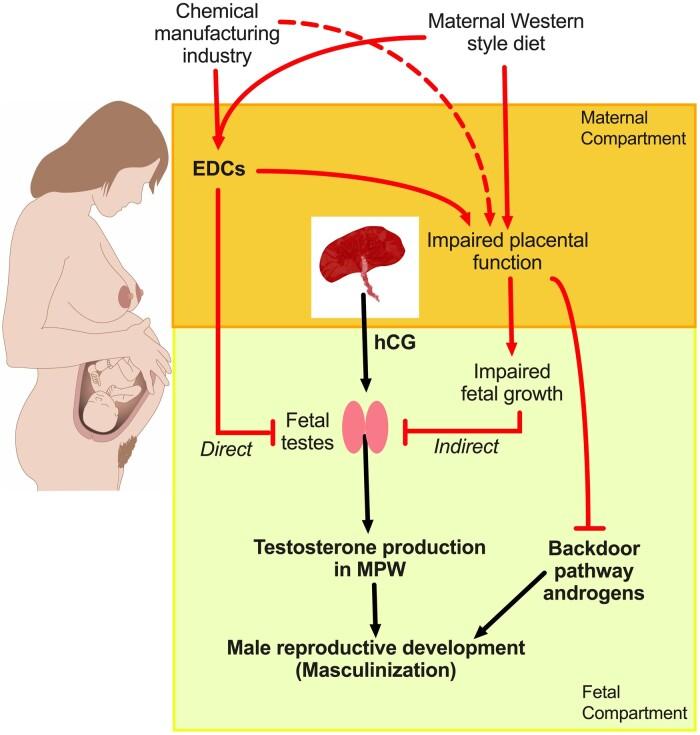
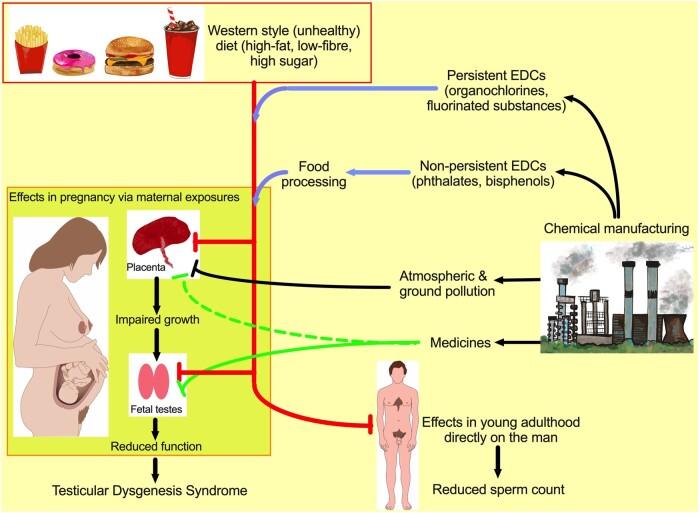
Maternal exposure to endocrine-disrupting chemicals (EDCs) in human pregnancy is widely considered as an important cause of adverse changes in male reproductive health due to impaired foetal androgen production/action. However, the epidemiological evidence supporting this view is equivocal, except for certain phthalates, notably diethyl hexyl phthalate (DEHP). Maternal phthalate exposure levels associated with adverse reproductive changes in epidemiological studies are several thousand-fold lower than those needed to suppress foetal androgen production in rats, and direct studies using human foetal testis tissue show no effect of high phthalate exposure on androgen production. This conundrum is unexplained and raises fundamental questions. Human DEHP exposure is predominantly via food with highest exposure associated with consumption of a Western style (unhealthy) diet. This diet is also associated with increased exposure to the most common EDCs, whether persistent (chlorinated or fluorinated chemicals) or non-persistent (phthalates, bisphenols) compounds, which are found at highest levels in fatty and processed foods. Consequently, epidemiological studies associating EDC exposure and male reproductive health disorders are confounded by potential dietary effects, and vice versa. A Western diet/lifestyle in young adulthood is also associated with low sperm counts. Disentangling EDC and dietary effects in epidemiological studies is challenging. In pregnancy, a Western diet, EDC exposure, and maternal living in proximity to industrial sites are all associated with impaired foetal growth/development due to placental dysfunction, which predisposes to congenital male reproductive disorders (cryptorchidism, hypospadias). While the latter are considered to reflect impaired foetal androgen production, effects resulting from foetal growth impairment (FGI) are likely indirect. As FGI has numerous life-long health consequences, and is affected by maternal lifestyle, research into the origins of male reproductive disorders should take more account of this. Additionally, potential effects on foetal growth/foetal testis from the increasing use of medications in pregnancy deserves more research attention.
母体在妊娠期间暴露于内分泌干扰化学物质(EDCs)被广泛认为是男性生殖健康不良变化的一个重要原因,因为它会损害胎儿雄激素的产生/作用。然而,除了某些邻苯二甲酸酯,特别是邻苯二甲酸二(2-乙基己基)酯(DEHP)之外,支持这种观点的流行病学证据是有争议的。流行病学研究中与生殖不良变化相关的母体邻苯二甲酸酯暴露水平比抑制大鼠胎儿雄激素产生所需的水平低几千倍,并且使用人胎儿睾丸组织的直接研究表明,高邻苯二甲酸酯暴露对雄激素产生没有影响。这个难题尚未得到解释,引发了一些基本问题。人类 DEHP 暴露主要通过食物,而最高的暴露与食用西方(不健康)饮食有关。这种饮食也与接触最常见的 EDC 有关,无论是持久性(氯化或氟化化学物质)还是非持久性(邻苯二甲酸酯、双酚)化合物,这些化合物在高脂肪和加工食品中含量最高。因此,将 EDC 暴露与男性生殖健康障碍相关联的流行病学研究受到潜在饮食效应的干扰,反之亦然。在年轻成年期,西方饮食/生活方式也与精子计数低有关。在流行病学研究中,区分 EDC 和饮食效应是具有挑战性的。在怀孕期间,西方饮食、EDC 暴露以及母亲居住在靠近工业场所的地方,都与胎盘功能障碍导致的胎儿生长/发育受损有关,这会导致先天性男性生殖障碍(隐睾、尿道下裂)。虽然后者被认为反映了胎儿雄激素产生受损,但由于胎儿生长受损(FGI)的影响可能是间接的。由于 FGI 对许多终生健康都有影响,并且受到母亲生活方式的影响,因此对男性生殖障碍起源的研究应该更多地考虑这一点。此外,越来越多的孕妇在怀孕期间使用药物,这可能会对胎儿生长/胎儿睾丸产生潜在影响,值得更多的研究关注。
 Zotero 插件