
绿色小部队:利用植物和纳米技术抗击疟疾
Tiny Green Army: Fighting Malaria with Plants and Nanotechnology.
作者信息
Moraes-de-Souza Isabelle, de Moraes Bianca P T, Silva Adriana R, Ferrarini Stela R, Gonçalves-de-Albuquerque Cassiano F
机构信息
Immunopharmacology Laboratory, Department of Physiological Sciences, Federal University of the State of Rio de Janeiro-UNIRIO, Rio de Janeiro 20211-010, Brazil.
Immunopharmacology Laboratory, Oswaldo Cruz Foundation, FIOCRUZ, Rio de Janeiro 21040-361, Brazil.
出版信息
Pharmaceutics. 2024 May 23;16(6):699. doi: 10.3390/pharmaceutics16060699.
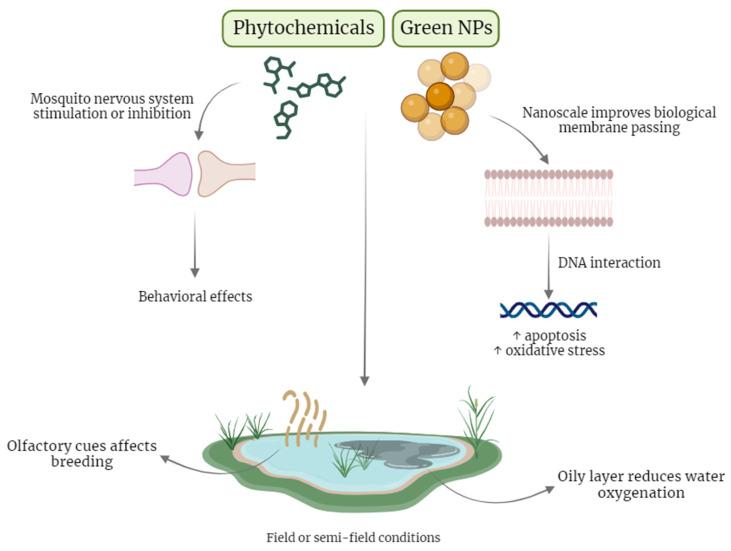
Malaria poses a global threat to human health, with millions of cases and thousands of deaths each year, mainly affecting developing countries in tropical and subtropical regions. Malaria's causative agent is species, generally transmitted in the hematophagous act of female sp. mosquitoes. The main approaches to fighting malaria are eliminating the parasite through drug treatments and preventing transmission with vector control. However, vector and parasite resistance to current strategies set a challenge. In response to the loss of drug efficacy and the environmental impact of pesticides, the focus shifted to the search for biocompatible products that could be antimalarial. Plant derivatives have a millennial application in traditional medicine, including the treatment of malaria, and show toxic effects towards the parasite and the mosquito, aside from being accessible and affordable. Its disadvantage lies in the type of administration because green chemical compounds rapidly degrade. The nanoformulation of these compounds can improve bioavailability, solubility, and efficacy. Thus, the nanotechnology-based development of plant products represents a relevant tool in the fight against malaria. We aim to review the effects of nanoparticles synthesized with plant extracts on and while outlining the nanotechnology green synthesis and current malaria prevention strategies.
疟疾对全球人类健康构成威胁,每年有数百万人感染,数千人死亡,主要影响热带和亚热带地区的发展中国家。疟疾的病原体是疟原虫,通常通过雌性疟蚊的吸血行为传播。抗击疟疾的主要方法是通过药物治疗消除寄生虫,并通过病媒控制防止传播。然而,病媒和寄生虫对当前策略产生抗性带来了挑战。为应对药物疗效丧失和杀虫剂对环境的影响,重点转向寻找具有抗疟作用的生物相容性产品。植物衍生物在传统医学中已有千年应用历史,包括治疗疟疾,并且除了易于获取和价格低廉外,还对寄生虫和蚊子显示出毒性作用。其缺点在于给药方式,因为绿色化合物会迅速降解。这些化合物的纳米制剂可以提高生物利用度、溶解度和疗效。因此,基于纳米技术开发植物产品是抗击疟疾的一种相关工具。我们旨在综述用植物提取物合成的纳米颗粒对疟原虫和蚊子的影响,同时概述纳米技术绿色合成方法和当前的疟疾预防策略。


 Zotero 插件