
2019 - 2023年在美洲维持消除麻疹、风疹和先天性风疹综合征:从挑战到机遇
Sustaining the Elimination of Measles, Rubella and Congenital Rubella Syndrome in the Americas, 2019-2023: From Challenges to Opportunities.
作者信息
Rey-Benito Gloria, Pastor Desirée, Whittembury Alvaro, Durón Regina, Pacis-Tirso Carmelita, Bravo-Alcántara Pamela, Ortiz Claudia, Andrus Jon
机构信息
Comprehensive Immunization Program, Pan American Health Organization, 525 23rd Street, NW, Washington, DC 20037, USA.
Department of Global Health, Milken Institute School of Public Health, George Washington University, Washington, DC 20037, USA.
出版信息
Vaccines (Basel). 2024 Jun 20;12(6):690. doi: 10.3390/vaccines12060690.
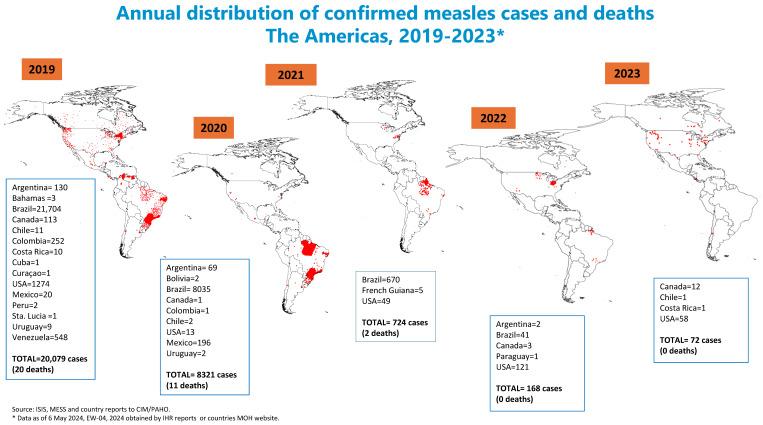
This report reviews national data from all Member States on measles, rubella, and congenital rubella syndrome (CRS) elimination in the Region of the Americas during 2019-2023. It includes an analysis of compliance with vaccination coverage, surveillance indicators, and measles outbreaks, as well as an analysis of the response capacity of the laboratory network and a country case study that meets all indicators. The sources of information were the integrated epidemiological surveillance system for measles and rubella of the Pan American Health Organization (PAHO)/World Health Organization (WHO) and the Joint Reporting Form (eJRF), among others. From 2020 to 2022, regional coverage with first (MMR-1) and second doses (MMR-2) decreased to rates below 90%. The regional suspected case notification rate was maintained above the minimum expected 2.0 suspect cases per 100,000 population, except in 2021. During 2019 to 2023, 18 countries experienced outbreaks, with two of the outbreaks resulting in re-established endemic transmission. In conclusion, two countries in the Americas have not maintained measles elimination, but by the end of 2023 no country showed endemic measles transmission. One of the countries that lost its certification of elimination in 2018 managed to be reverified in 2023; the other is pending reverification. All countries maintained rubella elimination. Despite these challenges, the sustainability of the elimination of these diseases remains a health priority in the Region.
本报告回顾了2019 - 2023年期间美洲区域所有成员国关于麻疹、风疹和先天性风疹综合征(CRS)消除工作的国家数据。它包括对疫苗接种覆盖率、监测指标和麻疹疫情的合规性分析,以及对实验室网络应对能力的分析和一个符合所有指标的国家案例研究。信息来源包括泛美卫生组织(PAHO)/世界卫生组织(WHO)的麻疹和风疹综合流行病学监测系统以及联合报告表(eJRF)等。从2020年到2022年,第一剂(MMR - 1)和第二剂(MMR - 2)的区域覆盖率降至90%以下。除2021年外,区域疑似病例报告率保持在每10万人口至少2.0例疑似病例的预期最低水平之上。在2019年至2023年期间,18个国家发生了疫情,其中两起疫情导致地方性传播重新出现。总之,美洲有两个国家未能维持麻疹消除状态,但到2023年底,没有国家出现麻疹地方性传播。2018年失去消除认证的国家之一在2023年成功重新获得验证;另一个国家正在等待重新验证。所有国家都维持了风疹消除状态。尽管存在这些挑战,但消除这些疾病的可持续性仍是该区域的一项卫生优先事项。
 Zotero 插件