
治疗性癌症疫苗与肿瘤微环境之间的双向串扰:超越肿瘤抗原
Bidirectional crosstalk between therapeutic cancer vaccines and the tumor microenvironment: Beyond tumor antigens.
作者信息
Zhang Si-Wei, Wang Han, Ding Xiao-Hong, Xiao Yu-Ling, Shao Zhi-Ming, You Chao, Gu Ya-Jia, Jiang Yi-Zhou
机构信息
Key Laboratory of Breast Cancer in Shanghai, Department of Breast Surgery, Fudan University Shanghai Cancer Center, Shanghai 200032, China.
Department of Oncology, Shanghai Medical College, Fudan University, Shanghai 200032, China.
出版信息
Fundam Res. 2022 Mar 26;3(6):1005-1024. doi: 10.1016/j.fmre.2022.03.009. eCollection 2023 Nov.
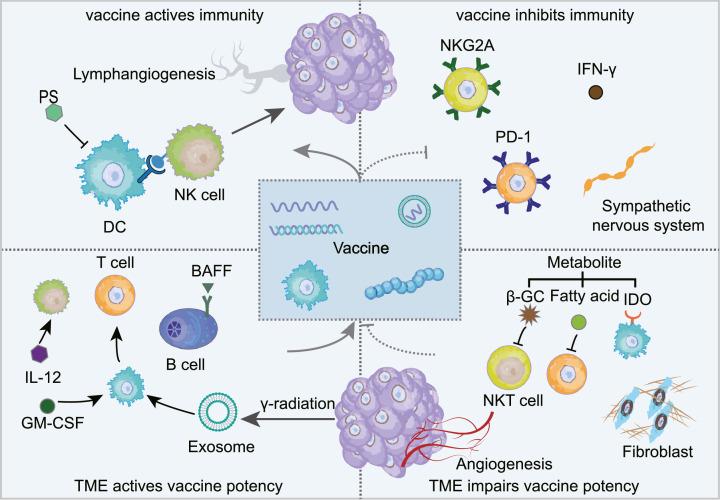
Immunotherapy has rejuvenated cancer therapy, especially after anti-PD-(L)1 came onto the scene. Among the many therapeutic options, therapeutic cancer vaccines are one of the most essential players. Although great progress has been made in research on tumor antigen vaccines, few phase III trials have shown clinical benefits. One of the reasons lies in obstruction from the tumor microenvironment (TME). Meanwhile, the therapeutic cancer vaccine reshapes the TME in an ambivalent way, leading to immune stimulation or immune escape. In this review, we summarize recent progress on the interaction between therapeutic cancer vaccines and the TME. With respect to vaccine resistance, innate immunosuppressive TME components and acquired resistance caused by vaccination are both involved. Understanding the underlying mechanism of this crosstalk provides insight into the treatment of cancer by directly targeting the TME or synergizing with other therapeutics.
免疫疗法为癌症治疗带来了新的活力,尤其是在抗PD-(L)1疗法出现之后。在众多治疗选择中,治疗性癌症疫苗是最重要的参与者之一。尽管肿瘤抗原疫苗的研究取得了很大进展,但很少有III期试验显示出临床益处。原因之一在于肿瘤微环境(TME)的阻碍。与此同时,治疗性癌症疫苗以一种矛盾的方式重塑TME,导致免疫刺激或免疫逃逸。在这篇综述中,我们总结了治疗性癌症疫苗与TME之间相互作用的最新进展。关于疫苗抗性,先天性免疫抑制性TME成分和由疫苗接种引起的获得性抗性都有涉及。了解这种相互作用的潜在机制有助于通过直接靶向TME或与其他疗法协同作用来深入了解癌症治疗。



 Zotero 插件