
人工细胞中的竞争性蛋白质募集。
Competitive protein recruitment in artificial cells.
作者信息
van Veldhuisen Thijs W, Verwiel Madelief A M, Novosedlik Sebastian, Brunsveld Luc, van Hest Jan C M
机构信息
Laboratory of Chemical Biology, Department of Biomedical Engineering and Institute for Complex Molecular Systems, Eindhoven University of Technology, Eindhoven, The Netherlands.
出版信息
Commun Chem. 2024 Jun 28;7(1):148. doi: 10.1038/s42004-024-01229-9.
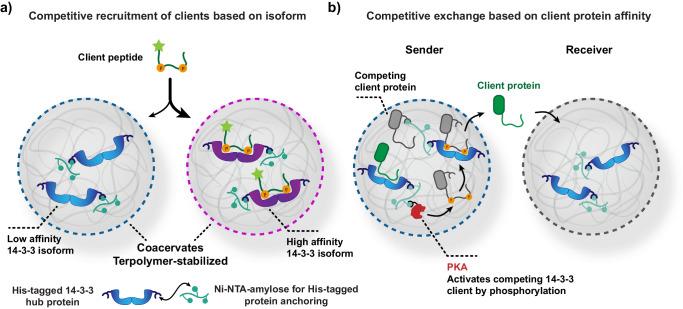
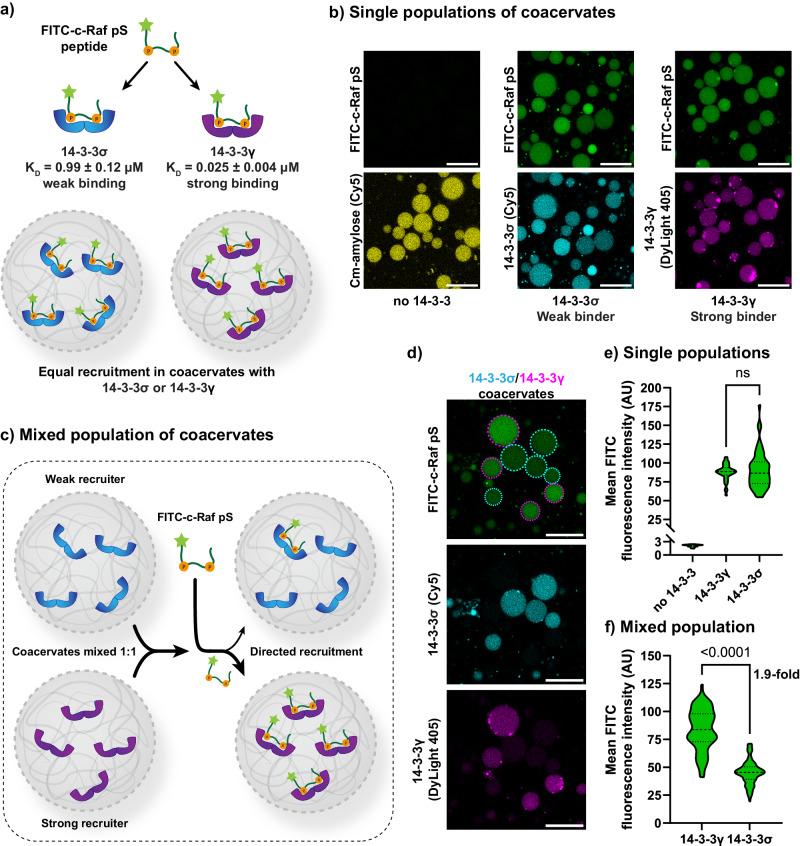
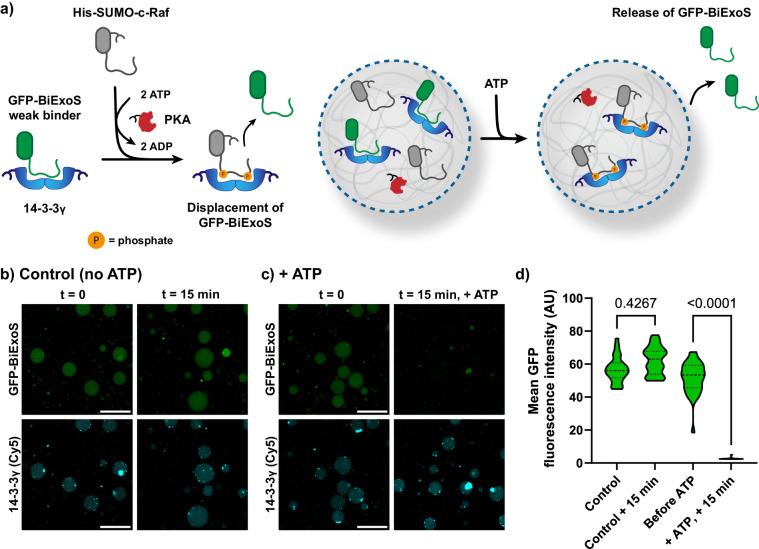
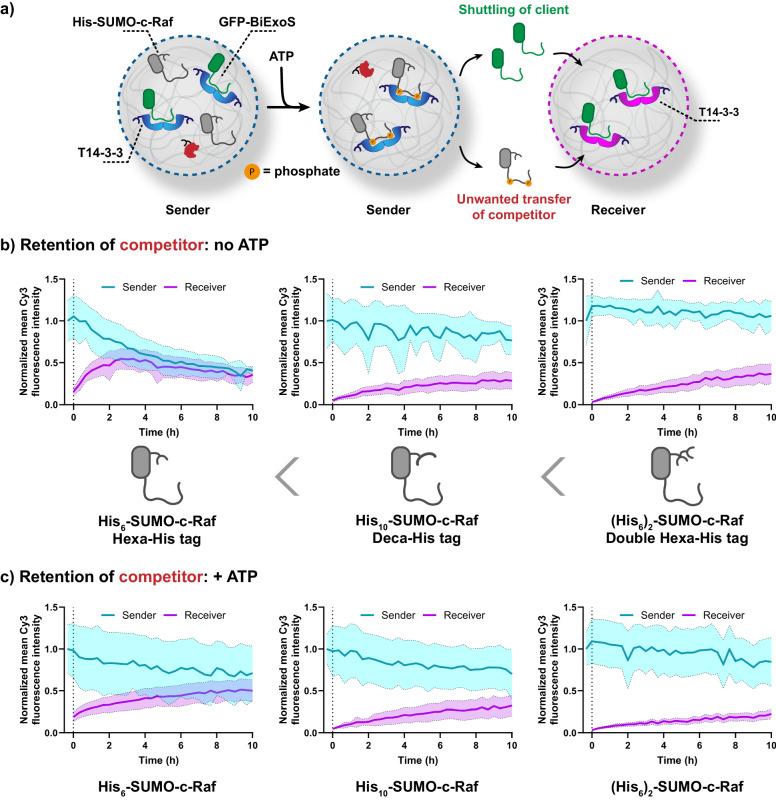
Living cells can modulate their response to environmental cues by changing their sensitivities for molecular signals. Artificial cells are promising model platforms to study intercellular communication, but populations with such differentiated behavior remain underexplored. Here, we show the affinity-regulated exchange of proteins in distinct populations of coacervate-based artificial cells via protein-protein interactions (PPI) of the hub protein 14-3-3. By loading different coacervates with different isoforms of 14-3-3, featuring varying PPI affinities, a client peptide is directed to the more strongly recruiting coacervates. By switching affinity of client proteins through phosphorylation, weaker binding partners can be outcompeted for their 14-3-3 binding, inducing their release from artificial cells. Combined, a communication system between coacervates is constructed, which leads to the transport of client proteins from strongly recruiting coacervates to weakly recruiting ones. The results demonstrate that affinity engineering and competitive binding can provide directed protein uptake and exchange between artificial cells.
活细胞可以通过改变对分子信号的敏感性来调节其对环境线索的反应。人工细胞是研究细胞间通讯的有前景的模型平台,但具有这种分化行为的群体仍未得到充分探索。在这里,我们展示了基于凝聚物的人工细胞不同群体中蛋白质通过枢纽蛋白14-3-3的蛋白质-蛋白质相互作用(PPI)进行的亲和力调节交换。通过用具有不同PPI亲和力的14-3-3不同异构体加载不同的凝聚物,一种客户肽被导向更强烈招募的凝聚物。通过磷酸化改变客户蛋白的亲和力,较弱的结合伙伴在其与14-3-3的结合中会被竞争胜出,从而诱导它们从人工细胞中释放出来。综合起来,构建了一个凝聚物之间的通讯系统,该系统导致客户蛋白从强烈招募的凝聚物运输到弱招募的凝聚物。结果表明,亲和力工程和竞争性结合可以在人工细胞之间提供定向的蛋白质摄取和交换。

 Zotero 插件