
细颗粒物 2.5 与肥胖及其相关指标之间的因果关系:欧洲血统的孟德尔随机研究。
A causal relationship between particulate matter 2.5 and obesity and its related indicators: a Mendelian randomization study of European ancestry.
机构信息
Department of First Clinical Medical College, Heilongjiang University of Chinese Medicine, Harbin, China.
Department of Endocrinology, The First Affiliated Hospital of Heilongjiang University of Chinese Medicine, Harbin, China.
出版信息
Front Public Health. 2024 Jun 14;12:1366838. doi: 10.3389/fpubh.2024.1366838. eCollection 2024.
BACKGROUND
In recent years, the prevalence of obesity has continued to increase as a global health concern. Numerous epidemiological studies have confirmed the long-term effects of exposure to ambient air pollutant particulate matter 2.5 (PM) on obesity, but their relationship remains ambiguous.
METHODS
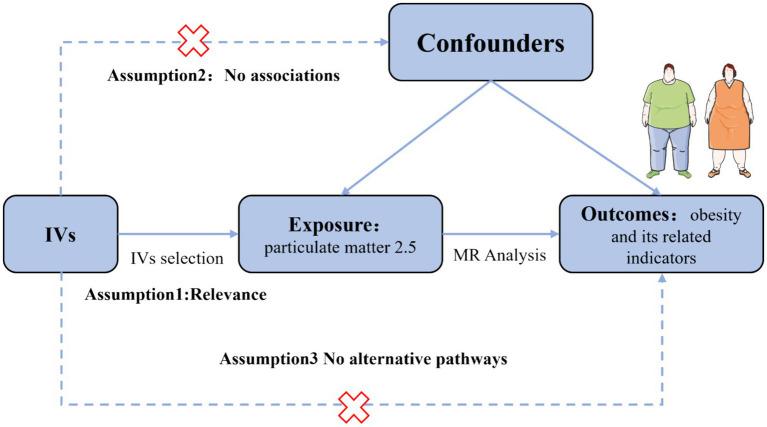
Utilizing large-scale publicly available genome-wide association studies (GWAS), we conducted univariate and multivariate Mendelian randomization (MR) analyses to assess the causal effect of PM exposure on obesity and its related indicators. The primary outcome given for both univariate MR (UVMR) and multivariate MR (MVMR) is the estimation utilizing the inverse variance weighted (IVW) method. The weighted median, MR-Egger, and maximum likelihood techniques were employed for UVMR, while the MVMR-Lasso method was applied for MVMR in the supplementary analyses. In addition, we conducted a series of thorough sensitivity studies to determine the accuracy of our MR findings.
RESULTS
The UVMR analysis demonstrated a significant association between PM exposure and an increased risk of obesity, as indicated by the IVW model (odds ratio [OR]: 6.427; 95% confidence interval [CI]: 1.881-21.968; = 0.005). Additionally, PM concentrations were positively associated with fat distribution metrics, including visceral adipose tissue (VAT) (OR: 1.861; 95% CI: 1.244-2.776; = 0.004), particularly pancreatic fat (OR: 3.499; 95% CI: 2.092-5.855; PFDR =1.28E-05), and abdominal subcutaneous adipose tissue (ASAT) volume (OR: 1.773; 95% CI: 1.106-2.841; = 0.019). Furthermore, PM exposure correlated positively with markers of glucose and lipid metabolism, specifically triglycerides (TG) (OR: 19.959; 95% CI: 1.269-3.022; = 0.004) and glycated hemoglobin (HbA1c) (OR: 2.462; 95% CI: 1.34-4.649; = 0.007). Finally, a significant negative association was observed between PM concentrations and levels of the novel obesity-related biomarker fibroblast growth factor 21 (FGF-21) (OR: 0.148; 95% CI: 0.025-0.89; = 0.037). After adjusting for confounding factors, including external smoke exposure, physical activity, educational attainment (EA), participation in sports clubs or gym leisure activities, and Townsend deprivation index at recruitment (TDI), the MVMR analysis revealed that PM levels maintained significant associations with pancreatic fat, HbA1c, and FGF-21.
CONCLUSION
Our MR study demonstrates conclusively that higher PM concentrations are associated with an increased risk of obesity-related indicators such as pancreatic fat content, HbA1c, and FGF-21. The potential mechanisms require additional investigation.
背景
近年来,肥胖症的流行率持续上升,成为全球关注的健康问题。大量的流行病学研究已经证实,长期暴露于环境空气污染物细颗粒物 2.5(PM)会对肥胖产生影响,但它们之间的关系仍不明确。
方法
利用大规模的公开全基因组关联研究(GWAS),我们进行了单变量和多变量孟德尔随机化(MR)分析,以评估 PM 暴露对肥胖及其相关指标的因果影响。单变量 MR(UVMR)和多变量 MR(MVMR)的主要结果均采用逆方差加权(IVW)方法进行估计。加权中位数、MR-Egger 和最大似然技术用于 UVMR,而 MVMR-Lasso 方法用于补充分析中的 MVMR。此外,我们进行了一系列彻底的敏感性研究,以确定我们的 MR 发现的准确性。
结果
UVMR 分析表明,PM 暴露与肥胖风险增加之间存在显著关联,IVW 模型显示(比值比 [OR]:6.427;95%置信区间 [CI]:1.881-21.968; = 0.005)。此外,PM 浓度与脂肪分布指标呈正相关,包括内脏脂肪组织(VAT)(OR:1.861;95% CI:1.244-2.776; = 0.004),尤其是胰腺脂肪(OR:3.499;95% CI:2.092-5.855;PFDR =1.28E-05)和腹部皮下脂肪组织(ASAT)体积(OR:1.773;95% CI:1.106-2.841; = 0.019)。此外,PM 暴露与葡萄糖和脂质代谢标志物呈正相关,具体为甘油三酯(TG)(OR:19.959;95% CI:1.269-3.022; = 0.004)和糖化血红蛋白(HbA1c)(OR:2.462;95% CI:1.34-4.649; = 0.007)。最后,PM 浓度与新型肥胖相关生物标志物成纤维细胞生长因子 21(FGF-21)水平呈显著负相关(OR:0.148;95% CI:0.025-0.89; = 0.037)。在校正了包括外部吸烟暴露、体育活动、教育程度(EA)、参加体育俱乐部或健身房休闲活动以及招募时的汤森剥夺指数(TDI)在内的混杂因素后,MVMR 分析表明,PM 水平与胰腺脂肪、HbA1c 和 FGF-21 之间仍保持显著关联。
结论
我们的 MR 研究明确表明,较高的 PM 浓度与肥胖相关指标的风险增加有关,如胰腺脂肪含量、HbA1c 和 FGF-21。潜在的机制需要进一步研究。



 Zotero 插件