
PSMA-PET 随访评估未接受 PSMA 治疗患者的反应:疾病定位之外是否有价值?
PSMA-PET follow-up to assess response in patients not receiving PSMA therapy: Is there value beyond localization of disease?
机构信息
Department of Nuclear Medicine and German Cancer Consortium (DKTK), University Hospital Essen, University of Duisburg-Essen, Essen, Germany.
Department of Nuclear Medicine, University Hospital Bern, University of Bern, Bern, Switzerland.
出版信息
Theranostics. 2024 Jun 11;14(9):3623-3633. doi: 10.7150/thno.96738. eCollection 2024.
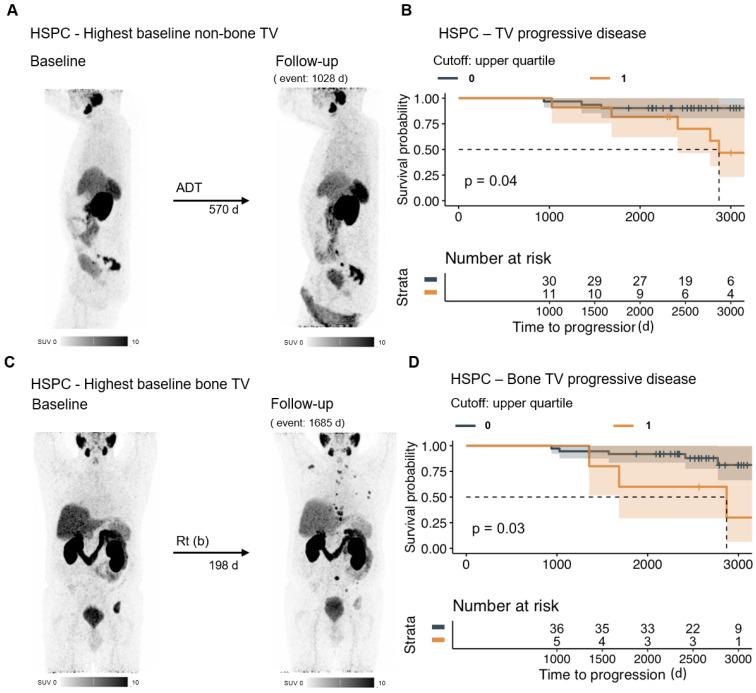
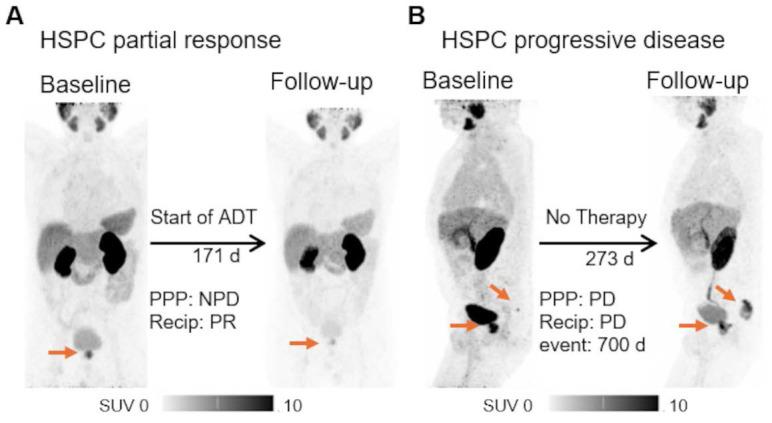
Prostate Specific Membrane Antigen Positron Emission Tomography (PSMA-PET) is routinely used for the staging of patients with prostate cancer, but data on response assessment are sparse and primarily stem from metastatic castration-resistant prostate cancer (mCRPC) patients treated with PSMA radioligand therapy. Still, follow-up PSMA-PET is employed in earlier disease stages in case of clinical suspicion of disease persistence, recurrence or progression to decide if localized or systemic treatment is indicated. Therefore, the prognostic value of PSMA-PET derived tumor volumes in earlier disease stages (i.e., hormone-sensitive prostate cancer (HSPC) and non-[Lu]Lu-PSMA-617 (LuPSMA) therapy castration resistant prostate cancer (CRPC)) are evaluated in this manuscript. A total number of 73 patients (6 primary staging, 42 HSPC, 25 CRPC) underwent two (i.e., baseline and follow-up, median interval: 379 days) whole-body [Ga]Ga-PSMA-11 PET/CT scans between Nov 2014 and Dec 2018. Analysis was restricted to non-LuPSMA therapy patients. PSMA-PETs were retrospectively analyzed and primary tumor, lymph node-, visceral-, and bone metastases were segmented. Body weight-adjusted organ-specific and total tumor volumes (PSMAvol: sum of PET volumes of all lesions) were measured for baseline and follow-up. PSMAvol response was calculated as the absolute difference of whole-body tumor volumes. High metastatic burden (>5 metastases), RECIP 1.0 and PSMA-PET Progression Criteria (PPP) were determined. Survival data were sourced from the cancer registry. The average number of tumor lesions per patient on the initial PET examination was 10.3 (SD 28.4). At baseline, PSMAvol was strongly associated with OS (HR 3.92, p <0.001; n = 73). Likewise, response in PSMAvol was significantly associated with OS (HR 10.48, p < 0.005; n = 73). PPP achieved significance as well (HR 2.19, p <0.05, n = 73). Patients with hormone sensitive disease and poor PSMAvol response (upper quartile of PSMAvol change) in follow-up had shorter outcome (p < 0.05; n = 42). PSMAvol in bones was the most relevant parameter for OS prognostication at baseline and for response assessment (HR 31.11 p < 0.001; HR 32.27, p < 0.001; n = 73). PPP and response in PSMAvol were significantly associated with OS in the present heterogeneous cohort. Bone tumor volume was the relevant miTNM region for OS prognostication. Future prospective evaluation of the performance of organ specific PSMAvol in more homogeneous cohorts seems warranted.
前列腺特异性膜抗原正电子发射断层扫描(PSMA-PET)常用于前列腺癌患者的分期,但关于反应评估的数据很少,主要来自接受 PSMA 放射性配体治疗的转移性去势抵抗性前列腺癌(mCRPC)患者。尽管如此,在临床怀疑疾病持续存在、复发或进展为局部或全身治疗的情况下,仍会在早期疾病阶段进行后续 PSMA-PET 检查。因此,本文评估了在早期疾病阶段(即激素敏感前列腺癌(HSPC)和非-[Lu]Lu-PSMA-617(LuPSMA)治疗去势抵抗性前列腺癌(CRPC))中,PSMA-PET 衍生肿瘤体积的预后价值。本研究共纳入 73 例患者(6 例为原发分期,42 例为 HSPC,25 例为 CRPC),于 2014 年 11 月至 2018 年 12 月间接受了两次全身[Ga]Ga-PSMA-11 PET/CT 扫描(基线和随访,中位间隔:379 天)。分析仅限于未接受 LuPSMA 治疗的患者。对 PSMA-PET 进行回顾性分析,并对原发肿瘤、淋巴结、内脏和骨转移进行分割。测量基线和随访时的体重校正器官特异性和总肿瘤体积(PSMAvol:所有病变的 PET 体积总和)。PSMAvol 反应计算为全身肿瘤体积的绝对差值。确定高转移性负担(>5 个转移灶)、RECIP 1.0 和 PSMA-PET 进展标准(PPP)。生存数据来自癌症登记处。初始 PET 检查中每位患者的平均肿瘤病灶数为 10.3(SD 28.4)。在基线时,PSMAvol 与 OS 密切相关(HR 3.92,p <0.001;n = 73)。同样,PSMAvol 的反应与 OS 显著相关(HR 10.48,p < 0.005;n = 73)。PPP 也有意义(HR 2.19,p <0.05,n = 73)。在随访中,激素敏感疾病和 PSMAvol 反应不良(PSMAvol 变化的上四分位数)的患者结局更差(p <0.05;n = 42)。PSMAvol 基线时和反应评估时骨骼是 OS 预后预测最相关的参数(HR 31.11,p <0.001;HR 32.27,p <0.001;n = 73)。在本研究中,PPP 和 PSMAvol 的反应与 OS 显著相关。骨骼肿瘤体积是 OS 预后预测的相关 miTNM 区域。未来在更同质的队列中评估器官特异性 PSMAvol 的性能似乎是合理的。

 Zotero 插件