
提高精准度:使用定量 Ga-DOTATATE PET 和临床病理生物标志物预测神经内分泌肿瘤 Lu-DOTATATE 治疗反应的模型。
Enhancing precision: A predictive model for Lu-DOTATATE treatment response in neuroendocrine tumors using quantitative Ga-DOTATATE PET and clinicopathological biomarkers.
机构信息
Department of Radiology, University of Michigan, Ann Arbor, MI, USA.
Division of Hematology and Oncology, Department of Internal Medicine, University of Michigan, Ann Arbor, MI, USA.
出版信息
Theranostics. 2024 Jun 11;14(9):3708-3718. doi: 10.7150/thno.98053. eCollection 2024.
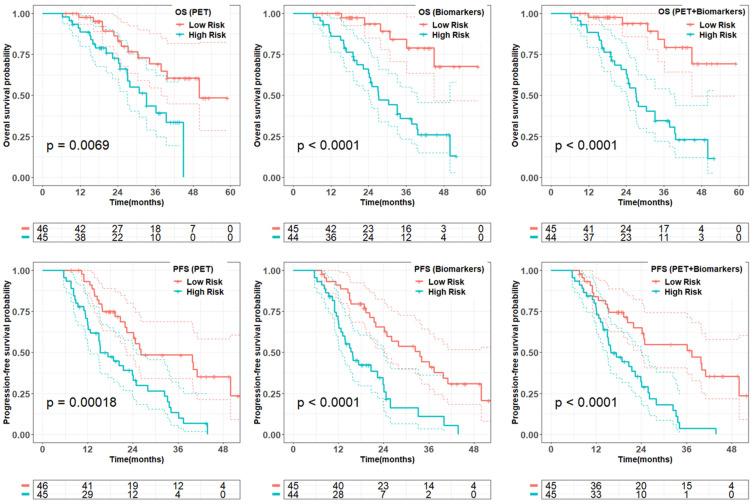
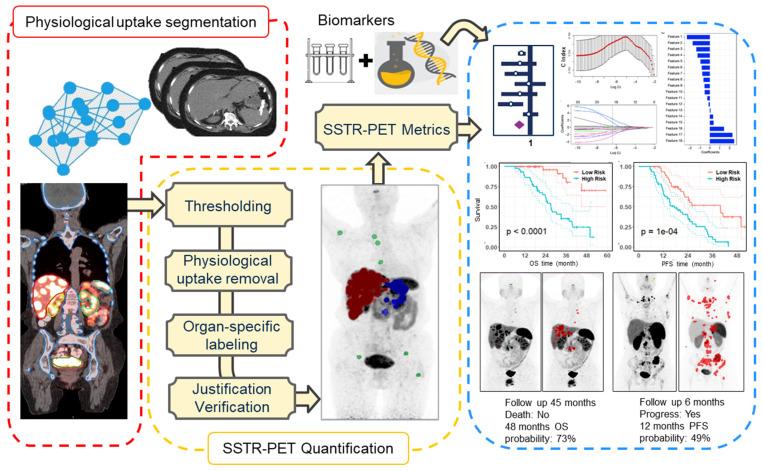
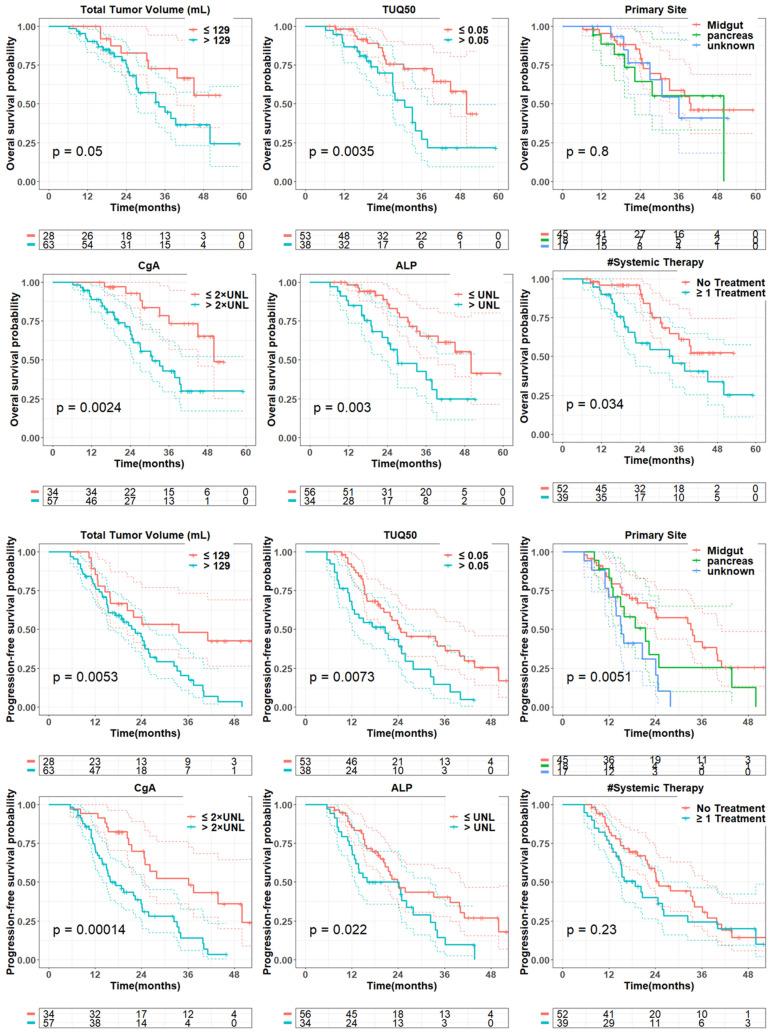
This study aims to elucidate the role of quantitative SSTR-PET metrics and clinicopathological biomarkers in the progression-free survival (PFS) and overall survival (OS) of neuroendocrine tumors (NETs) treated with peptide receptor radionuclide therapy (PRRT). A retrospective analysis including 91 NET patients (M47/F44; age 66 years, range 34-90 years) who completed four cycles of standard Lu-DOTATATE was conducted. SSTR-avid tumors were segmented from pretherapy SSTR-PET images using a semiautomatic workflow with the tumors labeled based on the anatomical regions. Multiple image-based features including total and organ-specific tumor volume and SSTR density along with clinicopathological biomarkers including Ki-67, chromogranin A (CgA) and alkaline phosphatase (ALP) were analyzed with respect to the PRRT response. The median OS was 39.4 months (95% CI: 33.1-NA months), while the median PFS was 23.9 months (95% CI: 19.3-32.4 months). Total SSTR-avid tumor volume (HR = 3.6; P = 0.07) and bone tumor volume (HR = 1.5; P = 0.003) were associated with shorter OS. Also, total tumor volume (HR = 4.3; P = 0.01), liver tumor volume (HR = 1.8; P = 0.05) and bone tumor volume (HR = 1.4; P = 0.01) were associated with shorter PFS. Furthermore, the presence of large lesion volume with low SSTR uptake was correlated with worse OS (HR = 1.4; P = 0.03) and PFS (HR = 1.5; P = 0.003). Among the biomarkers, elevated baseline CgA and ALP showed a negative association with both OS (CgA: HR = 4.9; P = 0.003, ALP: HR = 52.6; P = 0.004) and PFS (CgA: HR = 4.2; P = 0.002, ALP: HR = 9.4; P = 0.06). Similarly, number of prior systemic treatments was associated with shorter OS (HR = 1.4; P = 0.003) and PFS (HR = 1.2; P = 0.05). Additionally, tumors originating from the midgut primary site demonstrated longer PFS, compared to the pancreas (HR = 1.6; P = 0.16), and those categorized as unknown primary (HR = 3.0; P = 0.002). Image-based features such as SSTR-avid tumor volume, bone tumor involvement, and the presence of large tumors with low SSTR expression demonstrated significant predictive value for PFS, suggesting potential clinical utility in NETs management. Moreover, elevated CgA and ALP, along with an increased number of prior systemic treatments, emerged as significant factors associated with worse PRRT outcomes.
本研究旨在阐明定量 SSTR-PET 指标和临床病理生物标志物在肽受体放射性核素治疗 (PRRT) 治疗的神经内分泌肿瘤 (NET) 无进展生存期 (PFS) 和总生存期 (OS) 中的作用。对 91 例接受 4 个周期标准 Lu-DOTATATE 治疗的 NET 患者(M47/F44;年龄 66 岁,范围 34-90 岁)进行了回顾性分析。使用半自动工作流程从 SSTR-PET 图像中分割 SSTR 阳性肿瘤,根据解剖区域对肿瘤进行标记。分析了与 PRRT 反应相关的多种基于图像的特征,包括总肿瘤体积和特定于器官的肿瘤体积以及 SSTR 密度,以及临床病理生物标志物,包括 Ki-67、嗜铬粒蛋白 A (CgA) 和碱性磷酸酶 (ALP)。中位 OS 为 39.4 个月(95%CI:33.1-NA 个月),中位 PFS 为 23.9 个月(95%CI:19.3-32.4 个月)。总 SSTR 阳性肿瘤体积(HR=3.6;P=0.07)和骨肿瘤体积(HR=1.5;P=0.003)与 OS 较短有关。此外,总肿瘤体积(HR=4.3;P=0.01)、肝肿瘤体积(HR=1.8;P=0.05)和骨肿瘤体积(HR=1.4;P=0.01)与较短的 PFS 相关。此外,具有低 SSTR 摄取的大病变体积的存在与较差的 OS(HR=1.4;P=0.03)和 PFS(HR=1.5;P=0.003)相关。在生物标志物中,基线 CgA 和 ALP 升高与 OS(CgA:HR=4.9;P=0.003,ALP:HR=52.6;P=0.004)和 PFS(CgA:HR=4.2;P=0.002,ALP:HR=9.4;P=0.06)均呈负相关。同样,先前的系统治疗次数与 OS(HR=1.4;P=0.003)和 PFS(HR=1.2;P=0.05)较短有关。此外,与胰腺(HR=1.6;P=0.16)相比,起源于中肠的肿瘤具有更长的 PFS,而那些被归类为未知原发灶的肿瘤(HR=3.0;P=0.002)。SSTR-阳性肿瘤体积、骨肿瘤受累和大肿瘤伴低 SSTR 表达等基于图像的特征对 PFS 具有显著的预测价值,表明其在 NET 管理中具有潜在的临床应用价值。此外,CgA 和 ALP 升高以及先前系统治疗次数增加是与 PRRT 预后较差相关的显著因素。
 Zotero 插件