
胰高血糖素样肽-1受体激动剂和钠-葡萄糖协同转运蛋白2抑制剂,心力衰竭和认知障碍中的抗糖尿病药物:保护作用的潜在机制
Glucagon-like peptide-1 receptor agonists and sodium-glucose cotransporter 2 inhibitors, anti-diabetic drugs in heart failure and cognitive impairment: potential mechanisms of the protective effects.
作者信息
Riemma Maria Antonietta, Mele Elena, Donniacuo Maria, Telesca Marialucia, Bellocchio Gabriella, Castaldo Giuseppe, Rossi Francesco, De Angelis Antonella, Cappetta Donato, Urbanek Konrad, Berrino Liberato
机构信息
Department of Experimental Medicine, University of Campania "Luigi Vanvitelli", Naples, Italy.
Department of Biological and Environmental Sciences and Technologies, University of Salento, Lecce, Italy.
出版信息
Front Pharmacol. 2024 Jun 14;15:1422740. doi: 10.3389/fphar.2024.1422740. eCollection 2024.
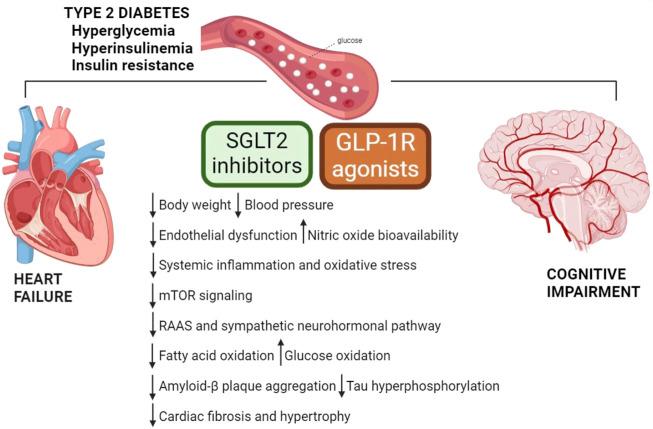
Heart failure and cognitive impairment emerge as public health problems that need to be addressed due to the aging global population. The conditions that often coexist are strongly related to advancing age and multimorbidity. Epidemiological evidence indicates that cardiovascular disease and neurodegenerative processes shares similar aspects, in term of prevalence, age distribution, and mortality. Type 2 diabetes increasingly represents a risk factor associated not only to cardiometabolic pathologies but also to neurological conditions. The pathophysiological features of type 2 diabetes and its metabolic complications (hyperglycemia, hyperinsulinemia, and insulin resistance) play a crucial role in the development and progression of both heart failure and cognitive dysfunction. This connection has opened to a potential new strategy, in which new classes of anti-diabetic medications, such as glucagon-like peptide-1 receptor (GLP-1R) agonists and sodium-glucose cotransporter 2 (SGLT2) inhibitors, are able to reduce the overall risk of cardiovascular events and neuronal damage, showing additional protective effects beyond glycemic control. The pleiotropic effects of GLP-1R agonists and SGLT2 inhibitors have been extensively investigated. They exert direct and indirect cardioprotective and neuroprotective actions, by reducing inflammation, oxidative stress, ions overload, and restoring insulin signaling. Nonetheless, the specificity of pathways and their contribution has not been fully elucidated, and this underlines the urgency for more comprehensive research.
由于全球人口老龄化,心力衰竭和认知障碍已成为需要解决的公共卫生问题。这些常常并存的病症与年龄增长和多种疾病并存密切相关。流行病学证据表明,心血管疾病和神经退行性病变在患病率、年龄分布和死亡率方面具有相似之处。2型糖尿病越来越成为一种不仅与心脏代谢疾病相关,而且与神经疾病相关的风险因素。2型糖尿病及其代谢并发症(高血糖、高胰岛素血症和胰岛素抵抗)的病理生理特征在心力衰竭和认知功能障碍的发生和发展中起着关键作用。这种联系开启了一种潜在的新策略,即新型抗糖尿病药物,如胰高血糖素样肽-1受体(GLP-1R)激动剂和钠-葡萄糖协同转运蛋白2(SGLT2)抑制剂,能够降低心血管事件和神经元损伤的总体风险,显示出超出血糖控制的额外保护作用。GLP-1R激动剂和SGLT2抑制剂的多效性作用已得到广泛研究。它们通过减轻炎症、氧化应激、离子过载和恢复胰岛素信号传导,发挥直接和间接的心脏保护和神经保护作用。尽管如此,这些途径的特异性及其作用尚未完全阐明,这凸显了进行更全面研究的紧迫性。
 Zotero 插件