
石榴皮鞣质对甲型流感病毒的抗病毒活性评估
An antiviral evaluation of punicalagin toward influenza A virus.
作者信息
Javadi-Farsani Fatemeh, Karimi Ali, Razavi Nikoo Hadi, Moradi Mohammad-Taghi, Tabarraei Alijan
机构信息
Student Research Committee, School of Medicine, Golestan University of Medical Sciences, Gorgan, Iran.
Cellular and Molecular Research Center, Basic Health Sciences Institute, Shahrekord University of Medical Sciences, Shahrekord, Iran.
出版信息
Avicenna J Phytomed. 2024 Jul-Aug;14(4):496-504. doi: 10.22038/AJP.2023.23389.
OBJECTIVE
Influenza complications are mild to serious, and can cause death in some cases. A great deal of attention has been paid in recent years to the development and use of new antiviral compounds to overcome drug resistance in certain strains of the influenza virus and treat the clinical implications. This study aimed to investigate the antiviral effect of punicalagin and its associated mechanism against influenza A (H1N1) virus .
MATERIALS AND METHODS
the ant-influenza activity of punicalagin was studied in Madin-Darby Canine Kidney (MDCK) cells using influenza virus A/Puerto Rico/8/34 (H1N1) (PR8) using Hemagglutinin assay (HA) and 50% tissue culture infective dose (TCID). Then, the inhibition of haemagglutination, virucidal activity, inhibitory effect at different times, replication of viral RNA and expression of viral genes were investigated.
RESULTS
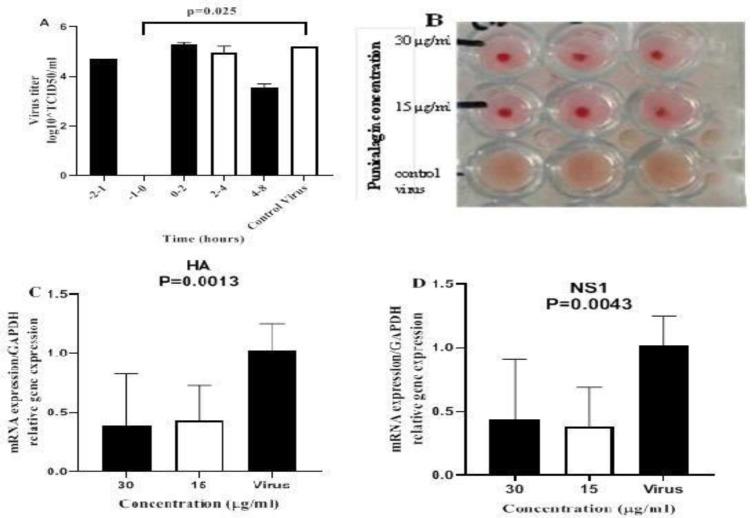
Punicalagin could inhibit influenza virus infection with 50% inhibitory concentration (IC) of 3.98 μg/ml and selectivity index (SI) value of 6.1. Punicalagin decreased virus titers with an inhibitory effect on virus hemagglutination (p<0.05). Punicalagin also inhibited viral adsorption. The results of virus RNA replication and viral mRNA (NS1 and HA) expression after treatment with punicalagin showed significant suppression of viral mRNA expression but no effect on replication of viral RNA.
CONCLUSION
The results of the present study indicated that punicalagin was effective against influenza infection most probably via inhibition of haemagglutination activity and virus binding.
目的
流感并发症有轻有重,在某些情况下可导致死亡。近年来,人们对开发和使用新型抗病毒化合物给予了极大关注,以克服某些流感病毒株的耐药性并应对临床问题。本研究旨在探讨石榴皮苷对甲型流感病毒(H1N1)的抗病毒作用及其相关机制。
材料与方法
使用甲型流感病毒A/波多黎各/8/34(H1N1)(PR8),通过血凝试验(HA)和50%组织培养感染剂量(TCID),在麦迪逊-达比犬肾(MDCK)细胞中研究石榴皮苷的抗流感活性。然后,研究了其对血凝的抑制作用、杀病毒活性、不同时间的抑制效果、病毒RNA复制及病毒基因表达。
结果
石榴皮苷可抑制流感病毒感染,50%抑制浓度(IC)为3.98μg/ml,选择性指数(SI)值为6.1。石榴皮苷降低了病毒滴度,对病毒血凝有抑制作用(p<0.05)。石榴皮苷还抑制病毒吸附。用石榴皮苷处理后病毒RNA复制和病毒mRNA(NS1和HA)表达的结果显示,病毒mRNA表达受到显著抑制,但对病毒RNA复制无影响。
结论
本研究结果表明,石榴皮苷对流感感染有效,最可能是通过抑制血凝活性和病毒结合来实现的。

 Zotero 插件