
传统组和集群组配置的晨练对下午爆发力表现的比较。
A comparison of morning priming exercise using traditional-set and cluster-set configurations on afternoon explosive performance.
作者信息
Wang Zhe, Yan Bing, Wang Yang, Zhang Conghui, Chen Feng, Girard Olivier
机构信息
China Institute of Sport and Health Science, Beijing Sport University, Beijing, China.
School of Human Sciences (Exercise and Sports Science), The University of Western Australia, Perth, Western Australia, Australia.
出版信息
Biol Sport. 2024 Jul;41(3):129-135. doi: 10.5114/biolsport.2024.133003. Epub 2024 Jan 2.
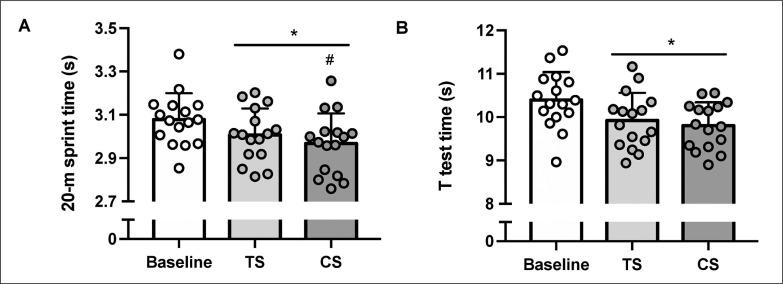
The impact of two priming exercise protocols using traditional (TS) or cluster-set (CS) arrangements on explosive performance 6 hours later were examined. Sixteen male collegiate athletes performed three testing sessions (one baseline without any prior exercise in the morning and two experimental sessions) separated by 72 hours. Participants completed two morning (9-11 am) priming protocols in a randomized order, either using a TS (no rest between repetitions) or CS (30 seconds of rest between repetitions) configuration. The protocols consisted of 3 sets × 3 repetitions of barbell back squat at 85% of 1 repetition maximum, with 4 minutes of rest between sets. In the afternoon (3-5 pm) of each trial, after a 6-hour rest period, a physical test battery was conducted that replicated baseline testing, including countermovement jump, 20-meter straight-line sprint, and T-test abilities. Across both conditions, participants exhibited increased countermovement jump height, 20-meter sprint time and T-test time compared to baseline (P < 0.05). Improvements in countermovement jump height (+4.4 ± 5.4%; P = 0.008) and 20-meter sprint time (+1.3 ± 1.7%; P = 0.022), but not T-test time (+1.1 ± 3.3%; P = 0.585), were significantly greater for CS than TS. In conclusion, compared to a traditional set arrangement, a morning-based priming protocol using a cluster-set configuration led to superior explosive performance benefits in the afternoon.
研究了使用传统(TS)或成组训练(CS)安排的两种准备训练方案对6小时后爆发力表现的影响。16名男性大学生运动员进行了三次测试(一次是早上的无任何预先训练的基线测试,两次是实验测试),间隔72小时。参与者以随机顺序完成两个早上(上午9点至11点)的准备训练方案,要么采用TS(重复之间无休息)要么采用CS(重复之间休息30秒)配置。方案包括以1次最大重复量的85%进行3组×3次杠铃后深蹲,组间休息4分钟。在每次试验的下午(下午3点至5点),经过6小时的休息期后,进行了一组复制基线测试的体能测试,包括反向纵跳、20米直线冲刺和T型测试能力。在两种情况下,与基线相比,参与者的反向纵跳高度增加、20米冲刺时间和T型测试时间增加(P<0.05)。与TS相比,CS的反向纵跳高度(+4.4±5.4%;P = 0.008)和20米冲刺时间(+1.3±1.7%;P = 0.022)的改善显著更大,但T型测试时间(+1.1±3.3%;P = 0.585)并非如此。总之,与传统的组安排相比,使用成组训练配置的基于早上的准备训练方案在下午产生了更好的爆发力表现益处。


 Zotero 插件