
免疫检查点抑制剂诱导的小肠结肠炎从发病到缓解过程中肠道微生物群的变化:病例报告
Gut microbiota shifts from onset to remission in immune checkpoint inhibitor-induced enterocolitis: a case report.
作者信息
Hirata Yuki, Tanaka Yoshiki, Yokota Haruka, Ohno Hiroshi, Nishida Koji, Shimizu Hikaru, Mizuta Noboru, Nakazawa Kei, Koshiba Ryoji, Kakimoto Kazuki, Miyazaki Takako, Nakamura Shiro, Nishikawa Hiroki
机构信息
Second Department of Internal Medicine, Osaka Medical and Pharmaceutical University, 2-7 Daigakumachi, Takatsuki, Osaka, 569-8686, Japan.
Biofermin Pharmaceutical Co., Ltd., Kobe, Japan.
出版信息
Gut Pathog. 2024 Jul 4;16(1):33. doi: 10.1186/s13099-024-00630-y.
BACKGROUND
Immune checkpoint inhibitors (ICIs) are crucial in cancer treatment; however, they carry the risk of immune-related adverse events (irAEs), such as enteritis.
CASE PRESENTATION
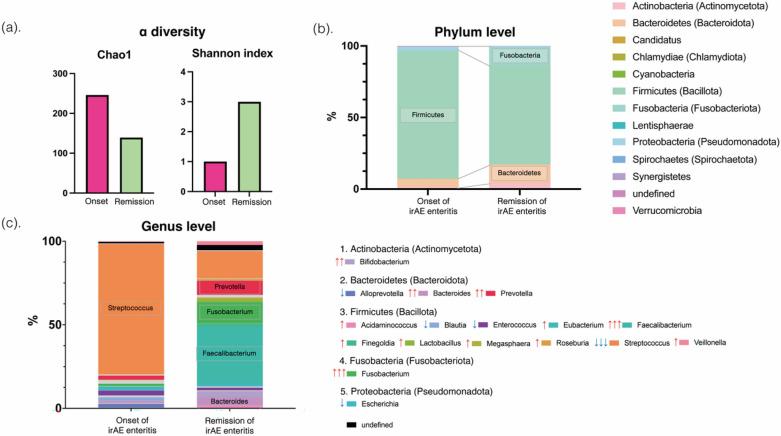
This study investigated the role of the gut microbiota during the onset and remission of irAE enteritis in a patient with stage IV melanoma undergoing anti-PD-1 and anti-CTLA-4 therapy. Following commencement of ICI treatment, the patient developed severe diarrhea and was diagnosed with grade 3 irAE enteritis. Steroid and probiotic treatments provided swift symptom relief and remission, as confirmed by reduced fecal calprotectin levels and gastrointestinal imaging. Microbiota diversity analysis conducted via 16S rRNA gene sequencing identified a decrease in Streptococcus prevalence with improvement in enteritis symptoms. Conversely, genera Fusobacterium, Faecalibacterium, Bacteroides, Prevotella, and Bifidobacterium showed increased representation after remission. These genera are associated with anti-inflammatory properties and fibrous substrate degradation, aiding gut health. Immunological assessment demonstrated fluctuations in cytokine expression and the modulation of costimulatory molecules, aligning with therapeutic interventions and microbiota alterations.
CONCLUSIONS
Our findings indicate a significant correlation between gut microbiota and immune responses in irAE enteritis. This underscores the potential utility of microbiome profiling in predicting irAE occurrence and in providing treatment strategies, thereby promoting a more comprehensive approach to managing the adverse effects of ICIs.
背景
免疫检查点抑制剂(ICIs)在癌症治疗中至关重要;然而,它们存在免疫相关不良事件(irAEs)的风险,如肠炎。
病例介绍
本研究调查了肠道微生物群在一名接受抗PD-1和抗CTLA-4治疗的IV期黑色素瘤患者irAE肠炎发作和缓解过程中的作用。ICI治疗开始后,患者出现严重腹泻,被诊断为3级irAE肠炎。类固醇和益生菌治疗迅速缓解了症状并实现了缓解,粪便钙卫蛋白水平降低和胃肠道成像证实了这一点。通过16S rRNA基因测序进行的微生物群多样性分析发现,随着肠炎症状的改善,链球菌的患病率降低。相反,在缓解后,梭杆菌属、粪杆菌属、拟杆菌属、普雷沃菌属和双歧杆菌属的代表性增加。这些属与抗炎特性和纤维底物降解有关,有助于肠道健康。免疫学评估显示细胞因子表达波动和共刺激分子的调节,这与治疗干预和微生物群改变一致。
结论
我们的研究结果表明肠道微生物群与irAE肠炎中的免疫反应之间存在显著相关性。这强调了微生物组分析在预测irAE发生和提供治疗策略方面的潜在效用,从而促进了一种更全面的方法来管理ICIs的不良反应。

 Zotero 插件