
综述:疾病中氧化应激性细胞死亡的研究与进展
Mini-review: research and progress of oxeiptosis in diseases.
作者信息
Chen Ke-Qian, Wang Shu-Zhi, Lei Hai-Bo, Liu Xiang
机构信息
Department of Clinical Pharmacy, Xiangtan Central Hospital, Xiangtan, China.
Institute of Pharmacy and Pharmacology, School of Pharmaceutical Sciences, Hengyang Medical School, University of South China, Hengyang, China.
出版信息
Front Cell Dev Biol. 2024 Jun 20;12:1428250. doi: 10.3389/fcell.2024.1428250. eCollection 2024.
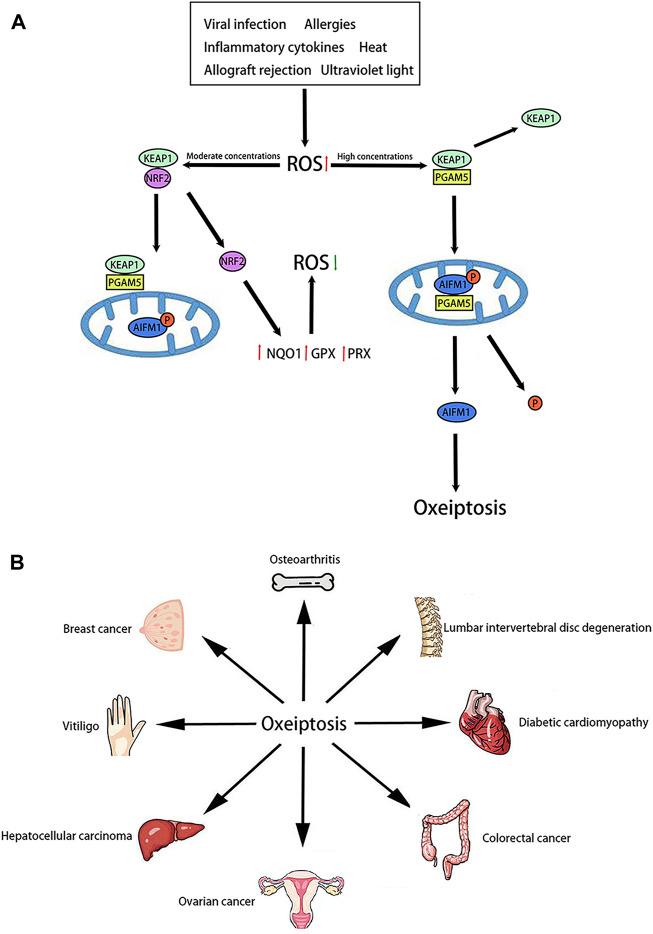
Oxeiptosis is a novel cell death pathway that was introduced in 2018. As a form of regulated cell death, it operates independently of caspases and is induced by ROS. Distinguished from other cell death pathways such as apoptosis, necroptosis, pyroptosis, and ferroptosis, oxeiptosis features unique damage causes pivotal genes, and signaling pathways (KEAP1/PGAM5/AIFM1). Emerging studies indicate that oxeiptosis plays a significant role in the progression of various diseases and its regulation could serve as a promising therapeutic target. However, the precise molecular mechanisms underlying oxeiptosis remain to be fully elucidated. In this mini-review, we systematically summarize the latest developments in oxeiptosis-related diseases while detailing the molecular mechanisms and regulatory networks of oxeiptosis. These insights offer a foundation for a deeper understanding of oxeiptosis.
氧化还原依赖性凋亡是2018年提出的一种新型细胞死亡途径。作为一种程序性细胞死亡形式,它独立于半胱天冬酶发挥作用,并由活性氧诱导。与凋亡、坏死性凋亡、焦亡和铁死亡等其他细胞死亡途径不同,氧化还原依赖性凋亡具有独特的损伤原因、关键基因和信号通路(KEAP1/PGAM5/AIFM1)。新兴研究表明,氧化还原依赖性凋亡在各种疾病的进展中起重要作用,其调节可能成为一个有前景的治疗靶点。然而,氧化还原依赖性凋亡的确切分子机制仍有待充分阐明。在本综述中,我们系统地总结了氧化还原依赖性凋亡相关疾病的最新进展,同时详细阐述了氧化还原依赖性凋亡的分子机制和调控网络。这些见解为更深入理解氧化还原依赖性凋亡提供了基础。
 Zotero 插件