
用于系统性红斑狼疮大鼠诊断的分子标志物组合的功能分析。
Functional analysis of a panel of molecular markers for diagnosis of systemic lupus erythematosus in rats.
机构信息
Department of Biochemistry, Faculty of Pharmacy, Cairo University, 11562, Cairo, Egypt.
Department of Biochemistry, School of Pharmacy, Newgiza University (NGU), Newgiza, Km 22 Cairo-Alexandria Desert Road, 12577, Giza, Egypt.
出版信息
Biosci Rep. 2024 Jul 31;44(7). doi: 10.1042/BSR20240318.
INTRODUCTION
Systemic lupus erythematosus (SLE) is a diverse autoimmune disease that arises from a combination of complex genetic factors and environmental influences. While circRNAs and miRNAs have recently been identified as promising biomarkers for disease diagnosis, their specific expression patterns, and clinical implications in SLE are not yet fully understood.
AIM OF THE WORK
The aim of the present study was to determine the role of a panel of noncoding-RNAs specifically circRNAs (circ-TubD1, circ-CDC27, and circ-Med14), along with miRNA (rno-miR-146a-5p) and mRNA (TRAF6), as novel minimally invasive diagnostic biomarkers for experimentally induced SLE. Additionally, the study involved an insilico bioinformatics analysis to explore potential pathways involved in the pathogenesis of SLE, aiming to enhance our understanding of the disease, enable early diagnosis, and facilitate improved treatment strategies.
MATERIALS AND METHODS
SLE was induced in rats using single IP injection of incomplete Freund's adjuvant (IFA). The Induction was confirmed by assessing the ANA and anti-ds DNA levels using ELSA technique. qPCR analysis was conducted to assess the expression of selected RNAs in sera collected from a group of 10 rats with induced SLE and a control group of 10 rats. In addition, bioinformatics and functional analysis were used to construct a circRNA-miRNA-mRNA network and to determine the potential function of these differentially expressed circRNAs.
RESULTS
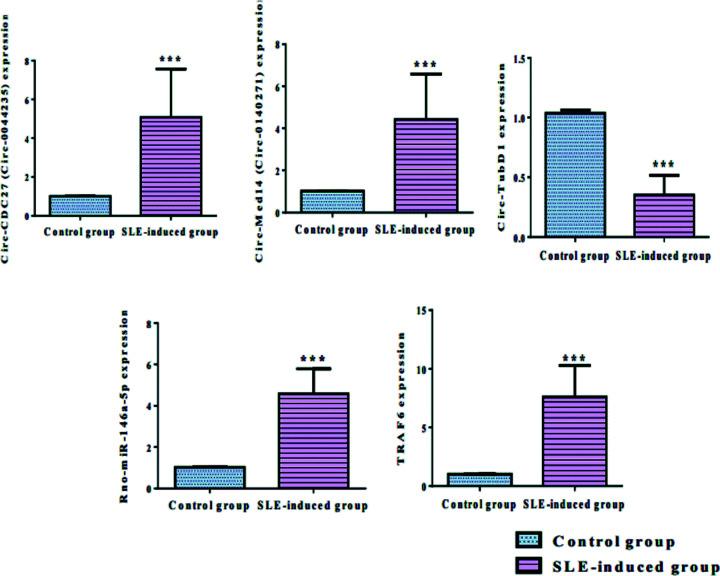
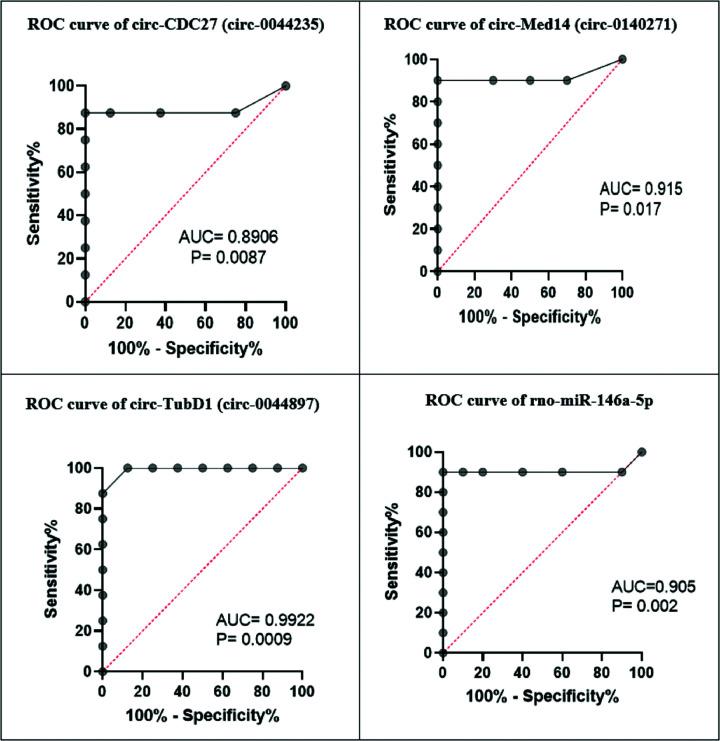
SLE rats demonstrated significantly higher expression levels of circ-CDC27, circ-Med14, and rno-miR-146a-5p as well as TRAF6, with lower expression level of circ-TubD1 in sera of SLE rats relative to controls. ROC curve analysis indicated that all the selected non-coding RNAs could serve as potential early diagnostic markers for SLE. In addition, the expression level of circ-TubD1 was negatively correlated with rno-miR-146a-5p, however, rno-miR-146a-5p was positively correlated with TRAF6. Bioinformatic analysis revealed the incorporation of the circRNAs targeted genes in various immune system and neurodegeneration pathways.
CONCLUSIONS
Therefore, circRNAs; circ-TubD1, circ-CDC27, and circ-Med14, in addition to the miRNA (rno-miR-146a-5p) and mRNA (TRAF6) may be involved in the development of SLE and may have promising roles for future diagnosis and targeted therapy.
简介
系统性红斑狼疮(SLE)是一种复杂的自身免疫性疾病,由多种复杂的遗传因素和环境影响共同作用产生。虽然 circRNAs 和 miRNAs 最近被鉴定为疾病诊断有前途的生物标志物,但它们在 SLE 中的具体表达模式和临床意义尚未完全了解。
工作目的
本研究的目的是确定一组非编码 RNA(circ-TubD1、circ-CDC27 和 circ-Med14)、miRNA(rno-miR-146a-5p)和 mRNA(TRAF6)作为实验性诱导 SLE 的新型微创诊断生物标志物的作用。此外,该研究还进行了基于生物信息学的分析,以探索 SLE 发病机制中涉及的潜在途径,旨在提高我们对疾病的认识,实现早期诊断,并促进改进的治疗策略。
材料和方法
使用不完全弗氏佐剂(IFA)单次腹腔注射诱导大鼠 SLE。通过 ELISA 技术评估抗核抗体(ANA)和抗 dsDNA 水平来确认诱导。对来自 10 只诱导 SLE 大鼠和 10 只对照大鼠的血清进行 qPCR 分析,以评估所选 RNA 的表达。此外,还使用生物信息学和功能分析构建了 circRNA-miRNA-mRNA 网络,并确定了这些差异表达 circRNA 的潜在功能。
结果
与对照组相比,SLE 大鼠的血清中 circ-CDC27、circ-Med14 和 rno-miR-146a-5p 以及 TRAF6 的表达水平显著升高,而 circ-TubD1 的表达水平降低。ROC 曲线分析表明,所有选定的非编码 RNA 都可以作为 SLE 的潜在早期诊断标志物。此外,circ-TubD1 的表达水平与 rno-miR-146a-5p 呈负相关,而 rno-miR-146a-5p 与 TRAF6 呈正相关。生物信息学分析显示 circRNAs 靶向基因参与了各种免疫系统和神经退行性变途径。
结论
因此,circRNAs;circ-TubD1、circ-CDC27 和 circ-Med14 以及 miRNA(rno-miR-146a-5p)和 mRNA(TRAF6)可能参与了 SLE 的发展,并且可能在未来的诊断和靶向治疗中具有重要作用。




 Zotero 插件