
中国 10 年回顾性单中心研究:子宫肉瘤的临床病理特征与预后。
Clinicopathological characteristics and prognosis of uterine sarcoma: a 10-year retrospective single-center study in China.
机构信息
Department of Obstetrics and Gynecology, the First Affiliated Hospital of Xi'an Jiaotong University, 277 Yanta West Road, Xi'an, 710061, Shaanxi, China.
Medical Records Room, the First Affiliated Hospital of Xi'an Jiaotong University, 277 Yanta West Road, Xi'an, 710061, Shaanxi, China.
出版信息
Diagn Pathol. 2024 Jul 5;19(1):94. doi: 10.1186/s13000-024-01517-x.
BACKGROUND
Uterine sarcoma is a rare and heterogeneous gynecological malignancy characterized by aggressive progression and poor prognosis. The current study aimed to investigate the relationship between clinicopathological characteristics and the prognosis of uterine sarcoma in Chinese patients.
METHODS
In this single-center retrospective study, we reviewed the medical records of 75 patients with histologically verified uterine sarcoma treated at the First Affiliated Hospital of Xi'an Jiaotong University between 2011 and 2020. Information on clinical characteristics, treatments, pathology and survival was collected. Progression-free survival (PFS) and overall survival (OS) were visualized in Kaplan-Meier curves. Prognostic factors were identified using the log-rank test for univariate analysis and Cox-proportional hazards regression models for multivariate analysis.
RESULTS
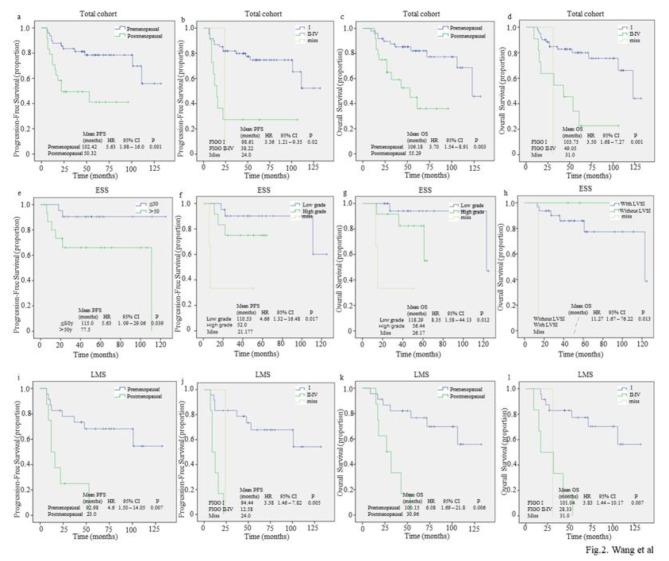
The histopathological types included 36 endometrial stromal sarcomas (ESS,48%), 33 leiomyosarcomas (LMS,44%) and 6 adenosarcomas (8%). The mean age at diagnosis was 50.2 ± 10.7 years. Stage I and low-grade accounted for the majority. There were 26 recurrences and 25 deaths at the last follow-up. The mean PFS and OS were 89.41 (95% CI: 76.07-102.75) and 94.03 (95% CI: 81.67-106.38) months, respectively. Univariate analysis showed that > 50 years, post-menopause, advanced stage, ≥ 1/2 myometrial invasion, lymphovascular space invasion and high grade were associated with shorter survival (P < 0.05). Color Doppler flow imaging positive signals were associated with shorter PFS in the LMS group (P = 0.046). The ESS group had longer PFS than that of the LMS group (99.56 vs. 76.05 months, P = 0.043). The multivariate analysis showed that post-menopause and advanced stage were independent risk factors of both PFS and OS in the total cohort and LMS group. In the ESS group, diagnosis age > 50 years and high-grade were independent risk factors of PFS, while high-grade and lymphovascular space invasion were independent risk factors of OS.
CONCLUSION
In Chinese patients with uterine sarcoma, post-menopause and advanced stage were associated with a significantly poorer prognosis. The prognosis of ESS was better than that of LMS. Color Doppler flow imaging positive signals of the tumor helped to identify LMS, which needs to be further tested in a larger sample in the future.
背景
子宫肉瘤是一种罕见的、异质性的妇科恶性肿瘤,其特点是侵袭性进展和预后不良。本研究旨在探讨中国患者子宫肉瘤的临床病理特征与预后的关系。
方法
在这项单中心回顾性研究中,我们对 2011 年至 2020 年在西安交通大学第一附属医院接受组织学证实的 75 例子宫肉瘤患者的病历进行了回顾。收集了临床特征、治疗、病理和生存信息。采用 Kaplan-Meier 曲线可视化无进展生存期(PFS)和总生存期(OS)。使用对数秩检验进行单因素分析,Cox 比例风险回归模型进行多因素分析,确定预后因素。
结果
组织病理学类型包括 36 例子宫内膜间质肉瘤(ESS,48%)、33 例平滑肌肉瘤(LMS,44%)和 6 例腺肉瘤(8%)。诊断时的平均年龄为 50.2±10.7 岁。大多数患者处于Ⅰ期和低级别。末次随访时,有 26 例复发,25 例死亡。平均 PFS 和 OS 分别为 89.41(95%CI:76.07-102.75)和 94.03(95%CI:81.67-106.38)个月。单因素分析显示,年龄>50 岁、绝经后、晚期、≥1/2 肌层浸润、脉管侵犯和高级别与生存时间较短相关(P<0.05)。LMS 组彩色多普勒血流成像阳性信号与较短的 PFS 相关(P=0.046)。与 LMS 组相比,ESS 组的 PFS 更长(99.56 比 76.05 个月,P=0.043)。多因素分析显示,绝经后和晚期是总队列和 LMS 组 PFS 和 OS 的独立危险因素。在 ESS 组中,年龄>50 岁和高级别是 PFS 的独立危险因素,而高级别和脉管侵犯是 OS 的独立危险因素。
结论
在中国子宫肉瘤患者中,绝经后和晚期与预后显著较差相关。与 LMS 相比,ESS 的预后较好。肿瘤的彩色多普勒血流成像阳性信号有助于识别 LMS,这需要在未来更大的样本中进一步验证。

 Zotero 插件