
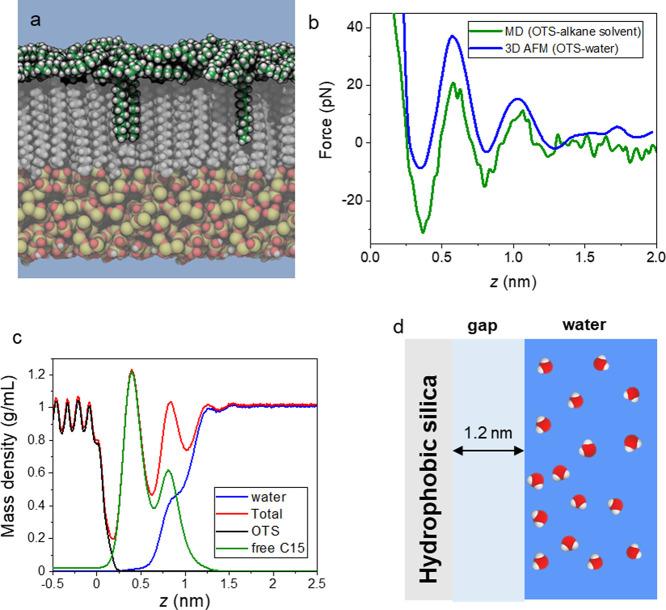
界面水与疏水二氧化硅表面之间被一个1.2纳米的间隙隔开。
Interfacial Water Is Separated from a Hydrophobic Silica Surface by a Gap of 1.2 nm.
作者信息
Arvelo Diana M, Comer Jeffrey, Schmit Jeremy, Garcia Ricardo
机构信息
Instituto de Ciencia de Materiales de Madrid, CSIC, Madrid 28049, Spain.
Department of Anatomy and Physiology, Kansas State University, Manhattan, Kansas 66506, United States.
出版信息
ACS Nano. 2024 Jul 16;18(28):18683-18692. doi: 10.1021/acsnano.4c05689. Epub 2024 Jul 8.
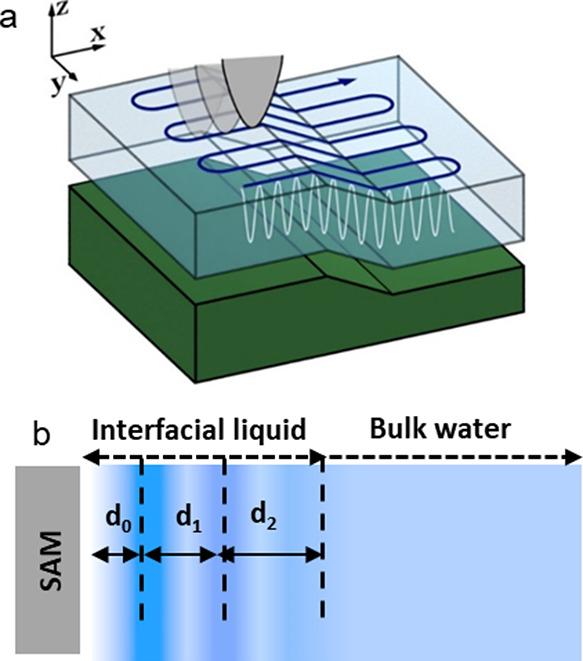
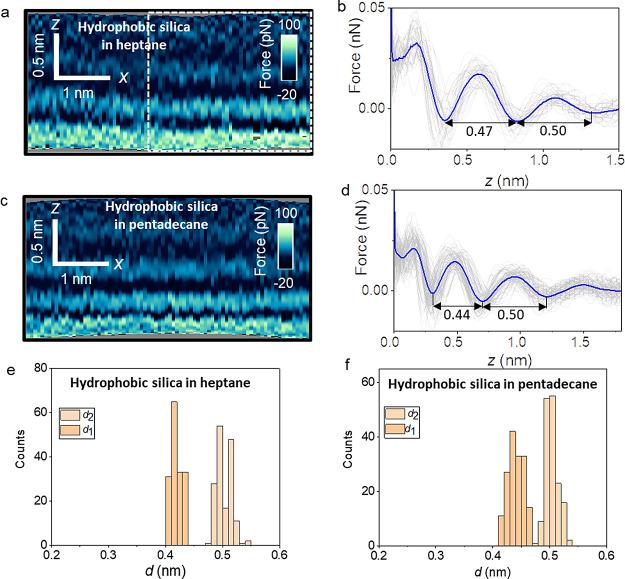
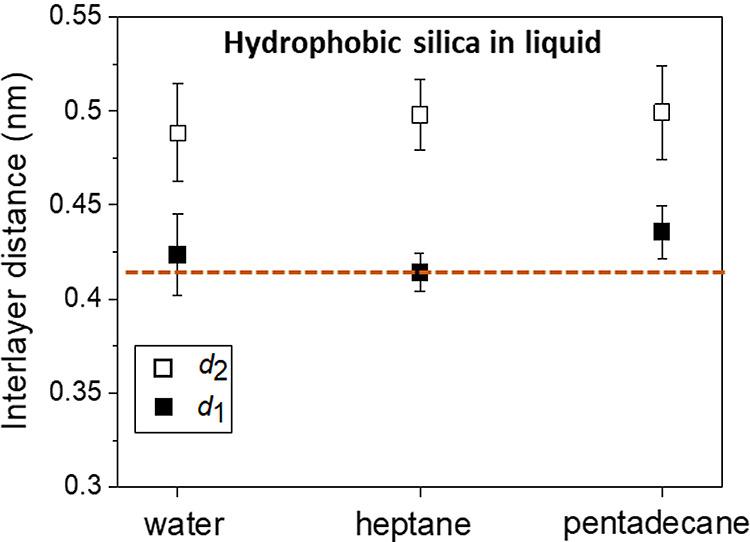
The interaction of liquid water with hydrophobic surfaces is ubiquitous in life and technology. Yet, the molecular structure of interfacial liquid water on these surfaces is not known. By using a 3D atomic force microscope, we characterize with angstrom resolution the structure of interfacial liquid water on hydrophobic and hydrophilic silica surfaces. The combination of 3D AFM images and molecular dynamics simulations reveals that next to a hydrophobic silica surface, there is a 1.2 nm region characterized by a very low density of water. In contrast, the 3D AFM images obtained of a hydrophilic silica surface reveal the presence of hydration layers next to the surface. The gap observed on hydrophobic silica surfaces is filled with two-to-three layers of straight-chain alkanes. We developed a 2D Ising model that explains the formation of a continuous hydrocarbon layer on hydrophobic silica surfaces.
液态水与疏水表面的相互作用在生活和技术中无处不在。然而,这些表面上界面液态水的分子结构尚不清楚。通过使用三维原子力显微镜,我们以埃分辨率表征了疏水和亲水二氧化硅表面上界面液态水的结构。三维原子力显微镜图像与分子动力学模拟相结合表明,在疏水二氧化硅表面附近,存在一个水密度极低的1.2纳米区域。相比之下,从亲水二氧化硅表面获得的三维原子力显微镜图像显示表面附近存在水化层。在疏水二氧化硅表面观察到的间隙被两到三层直链烷烃填满。我们开发了一个二维伊辛模型来解释疏水二氧化硅表面上连续烃层的形成。


 Zotero 插件