
基于具有仿生催化放大作用的核壳型金属有机框架纳米复合材料的胱抑素C高效光电化学检测
Highly Efficient Photoelectrochemical Detection of Cystatin C Based on a Core-Shell MOF Nanocomposite with Biomimetic-Catalysis Amplification.
作者信息
Xia Mengshi, Yang Pan, Zhu Chuiyu, Hu Yue, Fang Lichao, Zheng Junsong, Wang Xiaolong, Li Yan
机构信息
Emergency Department, Second Affiliated Hospital of Chongqing Medical University, Chongqing 400010, China.
Department of Clinical and Military Laboratory Medicine, College of Pharmacy and Laboratory Medicine, Army Medical University (Third Military Medical University), Chongqing 400038, China.
出版信息
ACS Omega. 2024 Jun 14;9(26):28228-28236. doi: 10.1021/acsomega.4c01644. eCollection 2024 Jul 2.
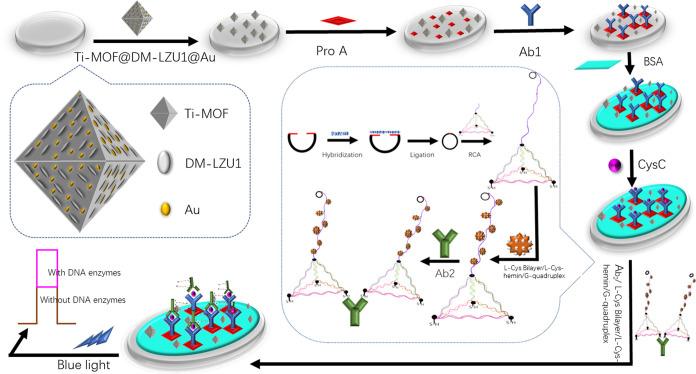
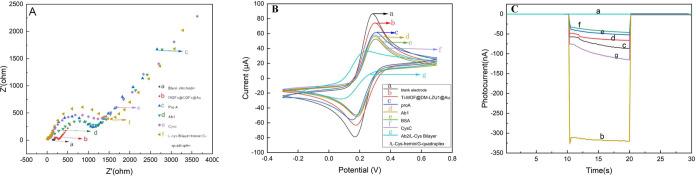
Cystatin C (CysC) has been proven to be used to diagnose acute kidney injury (AKI) rapidly and sensitively early. Therefore, it is urgent to develop a sensitive, novel, and rapid method for detecting CysC. In this work, a novel photoelectrochemical (PEC) biosensor was designed for ultrasensitive CysC detection. Ti-MOF@DM-LZU1@Au as a photosensitive material was first modified on the ITO electrode surface. Then, Ab and CysC were assembled on the electrode the specific immunoresponse of an antigen and antibody. Lastly, the conjugate Ab/l-Cys bilayer/l-Cys-hemin/G-quadruplex with self-catalytic enzyme performance, as a signal amplification approach, could further react with CysC and Ab, which resulted in a stronger photocurrent. As expected, the constructed PEC sensor realized the ultrasensitive detection of CysC, with a detection range of 10 pg/mL to 16 μg/mL and a lower limit of 8.023 pg/mL. The biosensor had excellent repeatability, selectivity, and stability. Moreover, it can provide a new method for the sensitive and rapid detection of other protein molecules in clinical practice.
胱抑素C(CysC)已被证明可用于早期快速、灵敏地诊断急性肾损伤(AKI)。因此,迫切需要开发一种灵敏、新颖且快速的检测CysC的方法。在这项工作中,设计了一种新型光电化学(PEC)生物传感器用于超灵敏检测CysC。首先将Ti-MOF@DM-LZU1@Au作为光敏材料修饰在ITO电极表面。然后,通过抗原与抗体的特异性免疫反应将抗体和CysC组装在电极上。最后,具有自催化酶性能的共轭抗体/l-半胱氨酸双层/l-半胱氨酸-血红素/G-四链体作为信号放大方法,可进一步与CysC和抗体反应,从而产生更强的光电流。正如预期的那样,构建的PEC传感器实现了对CysC的超灵敏检测,检测范围为10 pg/mL至16 μg/mL,下限为8.023 pg/mL。该生物传感器具有出色的重复性、选择性和稳定性。此外,它可为临床实践中其他蛋白质分子的灵敏快速检测提供一种新方法。


 Zotero 插件