
一种用于细菌包含体单细胞红外吸收光谱学的端到端方法:从原子力显微镜-红外测量到大量样本数据集的数据解释。
An end-to-end approach for single-cell infrared absorption spectroscopy of bacterial inclusion bodies: from AFM-IR measurement to data interpretation of large sample sets.
机构信息
Switch Laboratory, VIB-KU Leuven Center for Brain and Disease Research, Herestraat 49, Leuven, 3000, Belgium.
Switch Laboratory, Department of Cellular and Molecular Medicine, KU Leuven, Herestraat 49, Leuven, 3000, Belgium.
出版信息
J Nanobiotechnology. 2024 Jul 10;22(1):406. doi: 10.1186/s12951-024-02674-3.
BACKGROUND
Inclusion bodies (IBs) are well-known subcellular structures in bacteria where protein aggregates are collected. Various methods have probed their structure, but single-cell spectroscopy remains challenging. Atomic Force Microscopy-based Infrared Spectroscopy (AFM-IR) is a novel technology with high potential for the characterisation of biomaterials such as IBs.
RESULTS
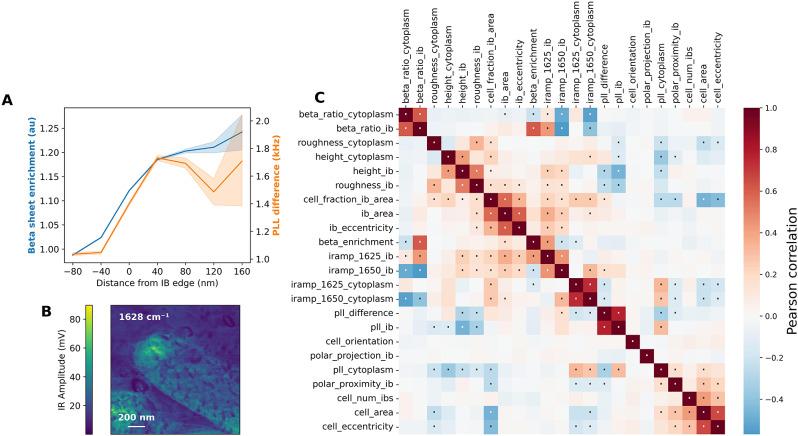
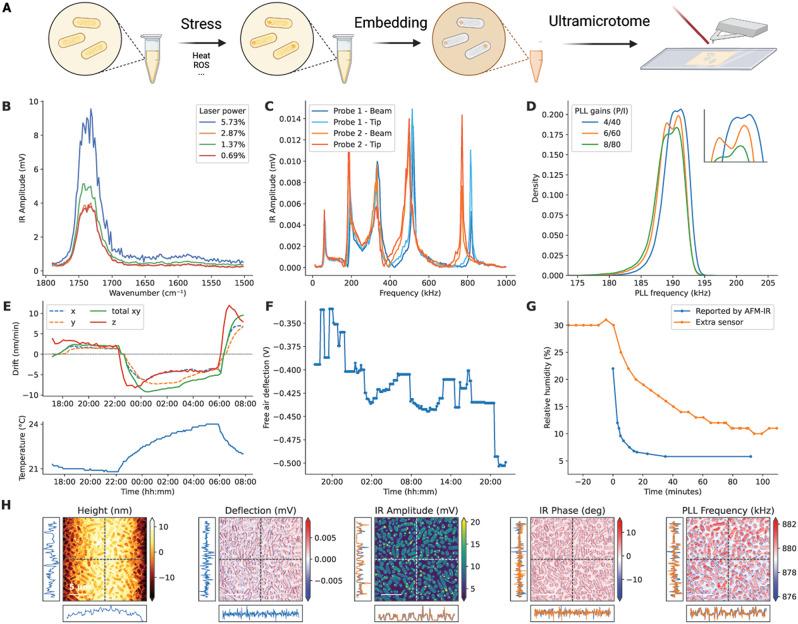
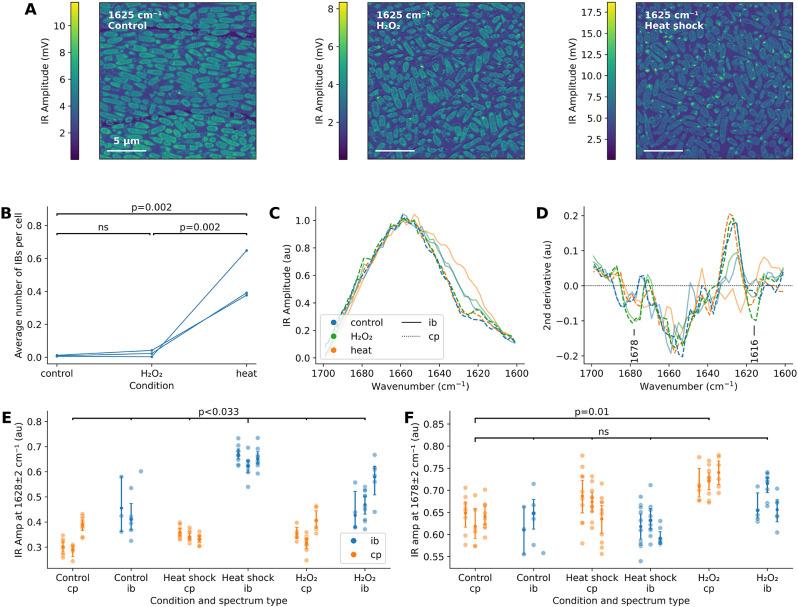
We present a detailed investigation using AFM-IR, revealing the substructure of IBs and their variation at the single-cell level, including a rigorous optimisation of data collection parameters and addressing issues such as laser power, pulse frequency, and sample drift. An analysis pipeline was developed tailored to AFM-IR image data, allowing high-throughput, label-free imaging of more than 3500 IBs in 12,000 bacterial cells. We examined IBs generated in Escherichia coli under different stress conditions. Dimensionality reduction analysis of the resulting spectra suggested distinct clustering of stress conditions, aligning with the nature and severity of the applied stresses. Correlation analyses revealed intricate relationships between the physical and morphological properties of IBs.
CONCLUSIONS
Our study highlights the power and limitations of AFM-IR, revealing structural heterogeneity within and between IBs. We show that it is possible to perform quantitative analyses of AFM-IR maps over a large collection of different samples and determine how to control for various technical artefacts.
背景
包涵体(IBs)是细菌中众所周知的亚细胞结构,其中蛋白质聚集体被收集。已经有多种方法探测了它们的结构,但单细胞光谱学仍然具有挑战性。基于原子力显微镜的红外光谱(AFM-IR)是一种具有高潜力的新技术,可用于对包涵体等生物材料进行特性分析。
结果
我们使用 AFM-IR 进行了详细的研究,揭示了 IBs 的亚结构及其在单细胞水平上的变化,包括对数据收集参数的严格优化,并解决了激光功率、脉冲频率和样品漂移等问题。开发了一个专门针对 AFM-IR 图像数据的分析管道,能够对超过 3500 个 IBs 在 12000 个细菌细胞中的高通量、无标记成像进行分析。我们研究了在不同胁迫条件下大肠杆菌中产生的 IBs。对所得光谱进行的降维分析表明,胁迫条件存在明显的聚类,与所施加的胁迫的性质和严重程度一致。相关分析揭示了 IBs 的物理和形态特性之间的复杂关系。
结论
我们的研究强调了 AFM-IR 的强大功能和局限性,揭示了 IBs 内部和之间的结构异质性。我们表明,对大量不同样本的 AFM-IR 图谱进行定量分析是可行的,并确定了如何控制各种技术伪影。



 Zotero 插件