
髋部骨折后,与出院时开具抗骨质疏松症药物以应对即将发生的再骨折风险相关的医院组织因素:一项基于记录链接的研究。
Following hip fracture, hospital organizational factors associated with prescription of anti-osteoporosis medication on discharge, to address imminent refracture risk: a record-linkage study.
机构信息
Musculoskeletal Research Unit, Translational Health Sciences, Bristol Medical School, University of Bristol, Bristol, BS10 5NB, United Kingdom.
Nuffield Department of Orthopaedics, Rheumatology and Musculoskeletal Sciences, University of Oxford, Oxford, OX3 7HE, United Kingdom.
出版信息
J Bone Miner Res. 2024 Aug 21;39(8):1071-1082. doi: 10.1093/jbmr/zjae100.
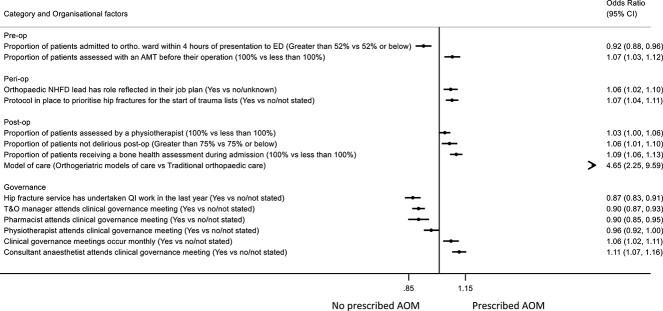
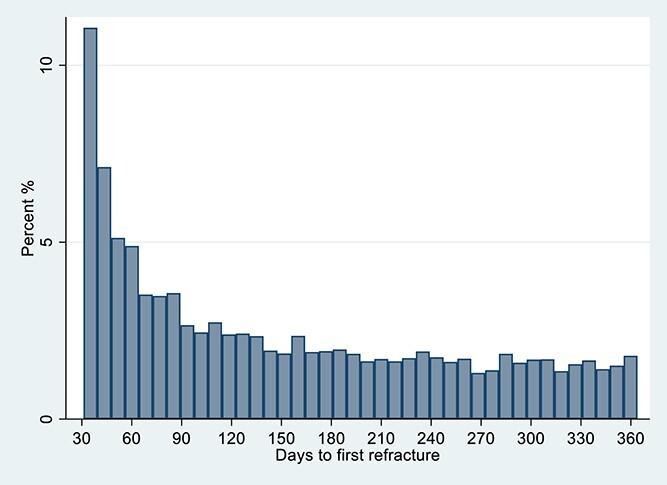
Patients who sustain a hip fracture are known to be at imminent refracture risk. Their complex multidisciplinary rehabilitation needs to include falls prevention and anti-osteoporosis medication (AOM) to prevent such fractures. This study aimed to determine which hospital-level organizational factors predict prescription of post-hip fracture AOM and refracture risk. A cohort of 178 757 patients aged ≥60 yr who sustained a hip fracture in England and Wales (2016-2019) was examined and followed for 1 yr. Patient-level hospital admission datasets from 172 hospitals, the National Hip Fracture Database, and mortality data were linked to 71 metrics extracted from 18 hospital-level organizational reports. Multilevel models determined organizational factors, independent of patient case-mix, associated with (1) AOM prescription and (2) refracture (by ICD10 coding). Patients were mean (SD) 82.7 (8.6) yr old, 71% female, with 18% admitted from care homes. Overall, 101 735 (57%) were prescribed AOM during admission, while 50 354 (28%) died during 1-yr follow-up, 12 240 (7%) refractured. Twelve organizational factors were associated with AOM prescription, for example, orthogeriatrician-led care compared to traditional care models (odds ratio [OR] 4.65 [95% CI, 2.25-9.59]); AOM was 9% (95% CI, 6%-13%) more likely to be prescribed in hospitals providing routine bone health assessment to all patients. Refracture occurred at median 126 d (IQR 59-234). Eight organizational factors were associated with refracture risk; hospitals providing orthogeriatrician assessment to all patients within 72 h of admission had an 18% (95% CI, 2%-31%) lower refracture risk, weekend physiotherapy provision had an 8% (95% CI, 3%-14%) lower risk, and where occupational therapists attended clinical governance meetings, a 7% (95% CI, 2%-12%) lower risk. Delays initiating post-discharge community rehabilitation were associated with a 15% (95% CI, 3%-29%) greater refracture risk. These novel, national findings highlight the importance of orthogeriatrician, physiotherapist, and occupational therapist involvement in secondary fracture prevention post hip fracture; notably, fracture risk reductions were seen within 12 mo of hip fracture.
髋部骨折患者有再次骨折的风险。他们复杂的多学科康复需要包括预防跌倒和抗骨质疏松药物(AOM),以预防此类骨折。本研究旨在确定哪些医院层面的组织因素可预测髋部骨折后的 AOM 处方和再骨折风险。对英格兰和威尔士(2016-2019 年) 178757 名年龄≥60 岁的髋部骨折患者进行了队列研究,并在 1 年内进行了随访。从 172 家医院的患者入院数据集、国家髋部骨折数据库和死亡率数据中提取了 71 项指标,并与 18 项医院层面组织报告中的 71 项指标进行了关联。多水平模型确定了与(1)AOM 处方和(2)再骨折(通过 ICD10 编码)相关的组织因素,这些因素独立于患者病例组合。患者的平均(标准差)年龄为 82.7(8.6)岁,71%为女性,18%从养老院入院。总体而言,101735 名(57%)患者在入院期间开了 AOM 处方,50354 名(28%)患者在 1 年随访期间死亡,12240 名(7%)患者发生再骨折。12 个组织因素与 AOM 处方有关,例如,与传统护理模式相比,骨科老年病医生主导的护理(比值比[OR]4.65[95%置信区间,2.25-9.59]);AOM 处方的可能性增加了 9%(95%置信区间,6%-13%),在为所有患者提供常规骨健康评估的医院中更有可能开 AOM。再骨折中位数发生在 126 天(IQR,59-234)。有 8 个组织因素与再骨折风险相关;入院 72 小时内为所有患者提供骨科老年病医生评估的医院,再骨折风险降低 18%(95%置信区间,2%-31%);提供周末物理治疗的医院,再骨折风险降低 8%(95%置信区间,3%-14%);职业治疗师参加临床治理会议的医院,再骨折风险降低 7%(95%置信区间,2%-12%)。延迟启动出院后社区康复与再骨折风险增加 15%(95%置信区间,3%-29%)相关。这些新颖的全国性发现强调了骨科老年病医生、物理治疗师和职业治疗师在髋部骨折后二级骨折预防中的重要性;值得注意的是,在髋部骨折后 12 个月内观察到骨折风险降低。

 Zotero 插件