
通过多传感器植入式除颤器算法测量的双心室起搏量与心力衰竭状态之间的关联。
Association between amount of biventricular pacing and heart failure status measured by a multisensor implantable defibrillator algorithm.
作者信息
Santini Luca, Calò Leonardo, D'Onofrio Antonio, Manzo Michele, Dello Russo Antonio, Savarese Gianluca, Pecora Domenico, Amellone Claudia, Santobuono Vincenzo Ezio, Calvanese Raimondo, Viscusi Miguel, Pisanò Ennio, Pangallo Antonio, Rapacciuolo Antonio, Bertini Matteo, Lavalle Carlo, Santoro Amato, Campari Monica, Valsecchi Sergio, Boriani Giuseppe
机构信息
Giovan Battista Grassi Hospital, Rome, Italy.
Policlinico Casilino, Rome, Italy.
出版信息
Cardiovasc Digit Health J. 2024 Mar 8;5(3):164-172. doi: 10.1016/j.cvdhj.2024.02.005. eCollection 2024 Jun.
BACKGROUND
Achieving a high biventricular pacing percentage (BiV%) is crucial for optimizing outcomes in cardiac resynchronization therapy (CRT). The HeartLogic index, a multiparametric heart failure (HF) risk score, incorporates implantable cardioverter-defibrillator (ICD)-measured variables and has demonstrated its predictive ability for impending HF decompensation.
OBJECTIVE
This study aimed to investigate the relationship between daily BiV% in CRT ICD patients and their HF status, assessed using the HeartLogic algorithm.
METHODS
The HeartLogic algorithm was activated in 306 patients across 26 centers, with a median follow-up of 26 months (25th-75th percentile: 15-37).
RESULTS
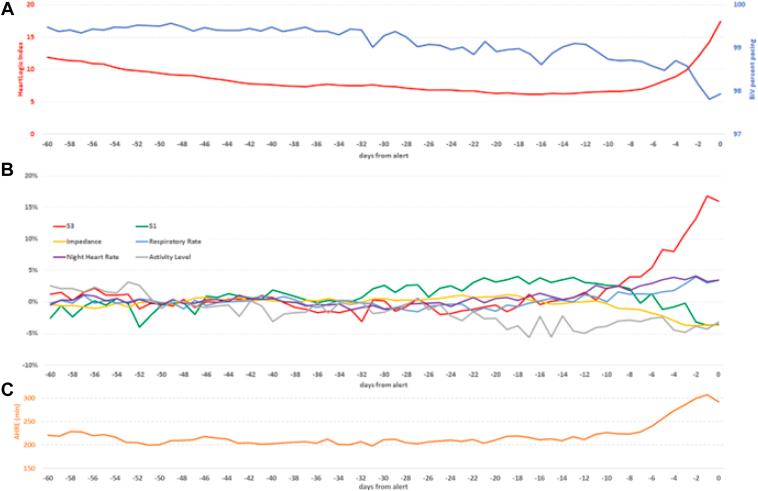
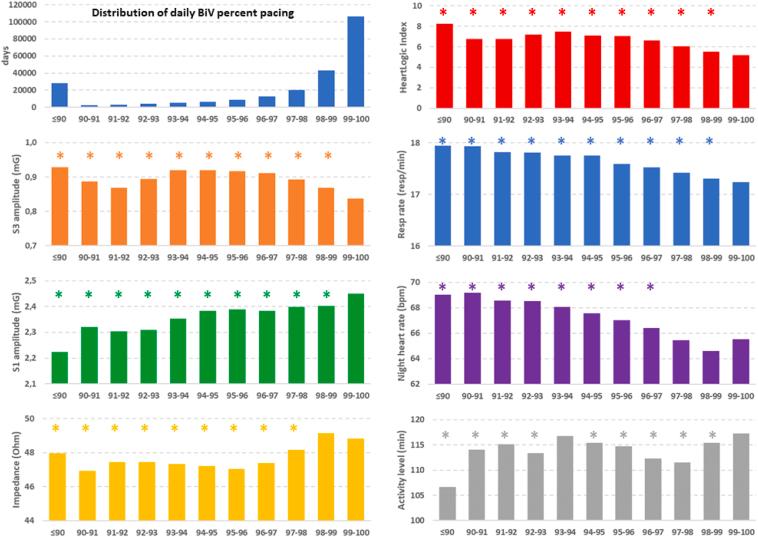
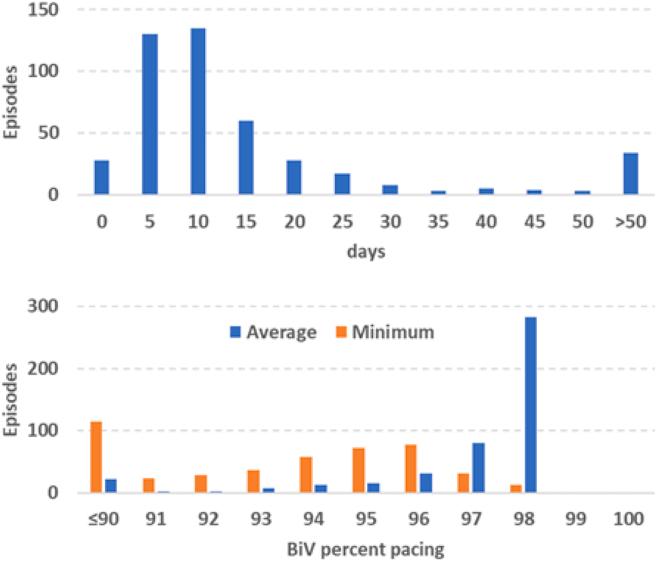
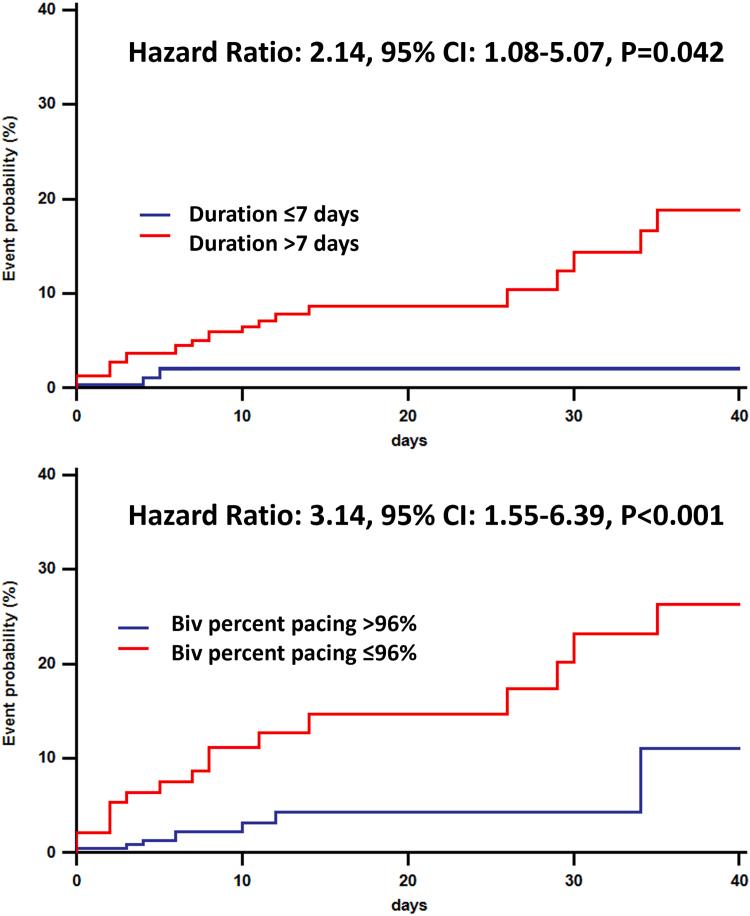
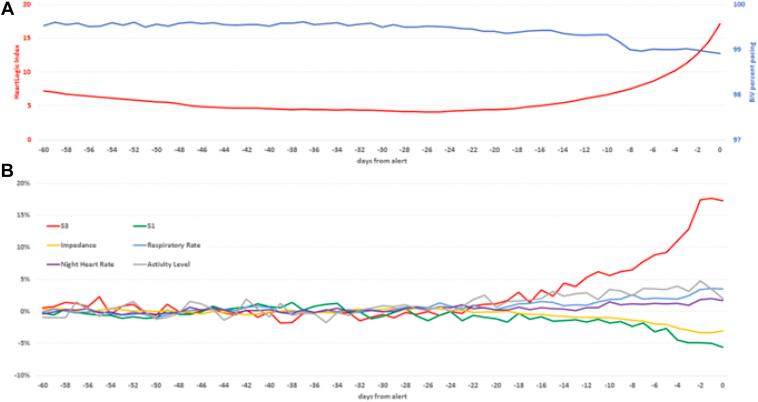
During the follow-up period, 619 HeartLogic alerts were recorded in 186 patients. Overall, daily values associated with the best clinical status (highest first heart sound, intrathoracic impedance, patient activity; lowest combined index, third heart sound, respiration rate, night heart rate) were associated with a BiV% exceeding 99%. We identified 455 instances of BiV% dropping below 98% after consistent pacing periods. Longer episodes of reduced BiV% (hazard ratio: 2.68; 95% CI: 1.02-9.72; = .045) and lower BiV% (hazard ratio: 3.97; 95% CI: 1.74-9.06; =.001) were linked to a higher risk of HeartLogic alerts. BiV% drops exceeding 7 days predicted alerts with 90% sensitivity (95% CI [74%-98%]) and 55% specificity (95% CI [51%-60%]), while BiV% ≤96% predicted alerts with 74% sensitivity (95% CI [55%-88%]) and 81% specificity (95% CI [77%-85%]).
CONCLUSION
A clear correlation was observed between reduced daily BiV% and worsening clinical conditions, as indicated by the HeartLogic index. Importantly, even minor reductions in pacing percentage and duration were associated with an increased risk of HF alerts.
背景
在心脏再同步治疗(CRT)中,实现高双心室起搏百分比(BiV%)对于优化治疗效果至关重要。心脏逻辑指数是一种多参数心力衰竭(HF)风险评分,纳入了植入式心律转复除颤器(ICD)测量的变量,并已证明其对即将发生的HF失代偿的预测能力。
目的
本研究旨在探讨CRT ICD患者每日BiV%与其HF状态之间的关系,采用心脏逻辑算法进行评估。
方法
26个中心的306例患者激活了心脏逻辑算法,中位随访时间为26个月(第25-75百分位数:15-37个月)。
结果
在随访期间,186例患者记录到619次心脏逻辑警报。总体而言,与最佳临床状态(最高第一心音、胸内阻抗、患者活动;最低综合指数、第三心音、呼吸频率、夜间心率)相关的每日值与超过99%的BiV%相关。我们确定了455例在持续起搏期后BiV%降至98%以下的情况。BiV%降低时间较长(风险比:2.68;95%可信区间:1.02-9.72;P = 0.045)和BiV%较低(风险比:3.97;95%可信区间:1.74-9.06;P = 0.001)与更高的心脏逻辑警报风险相关。BiV%下降超过7天预测警报的敏感性为90%(95%可信区间[74%-98%]),特异性为55%(95%可信区间[51%-60%]),而BiV%≤96%预测警报的敏感性为74%(95%可信区间[55%-88%]),特异性为81%(95%可信区间[77%-85%])。
结论
如心脏逻辑指数所示,每日BiV%降低与临床状况恶化之间存在明显相关性。重要的是,即使起搏百分比和持续时间的轻微降低也与HF警报风险增加相关。
 Zotero 插件