
评估口腔卫生指导和数字化口腔健康教育在心脏康复诊所中的影响:一项新颖的、双中心、平行随机对照试验方案。
Evaluating the impact of oral hygiene instruction and digital oral health education within cardiac rehabilitation clinics: A protocol for a novel, dual centre, parallel randomised controlled trial.
机构信息
The University of Sydney Dental School, The University of Sydney, Sydney, New South Wales, Australia.
Westmead Applied Research Centre, The University of Sydney, Westmead, New South Wales, Australia.
出版信息
PLoS One. 2024 Jul 11;19(7):e0306882. doi: 10.1371/journal.pone.0306882. eCollection 2024.
INTRODUCTION
Diseases of the periodontal tissues including gingivitis and periodontitis can affect up to 90% and 50% of the population respectively. These conditions are multifactorial inflammatory conditions involving a dysbiotic biofilm that, if left untreated, can lead to the destruction of the supporting structures of the teeth and have significant systemic implications, specifically on cardiovascular health. The elevation of inflammatory markers, particularly high-sensitive C-reactive protein (hsCRP), are strongly associated with an increased risk of atherosclerosis, a key risk factor for cardiovascular disease (CVD). HsCRP as well as other inflammatory markers can be detected in blood samples as early as 21 days after ceasing toothbrushing, due to the immune response to stagnant oral biofilm. The most effective way to ensure oral biofilm cannot remain on oral tissues, thus preventing periodontitis and reducing inflammatory CVD risk, is with good oral hygiene. The primary aim of this study is to assess whether individualised oral hygiene instruction (OHI) partnered with a digital oral health education (DOHE) package can improve the oral health of patients living with CVD.
METHODS AND ANALYSIS
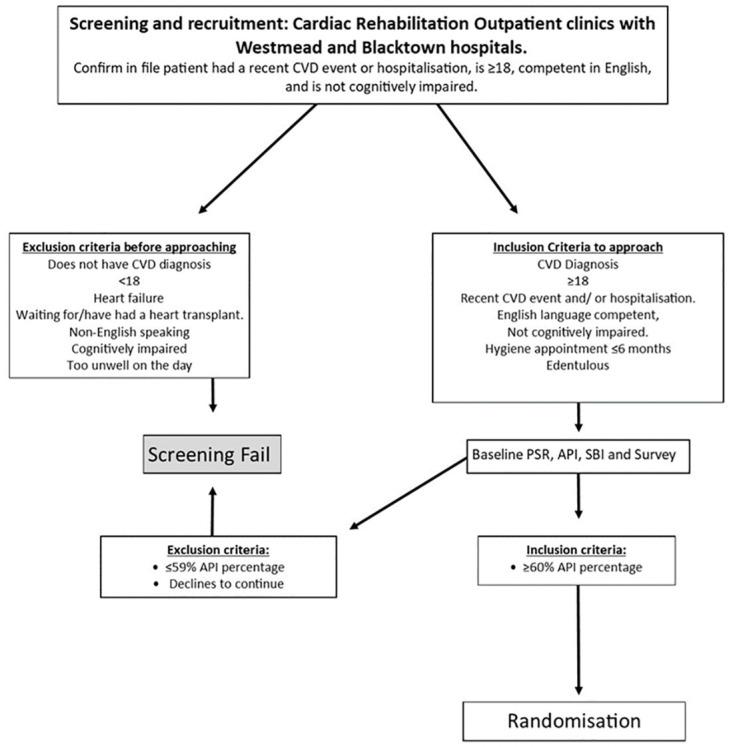
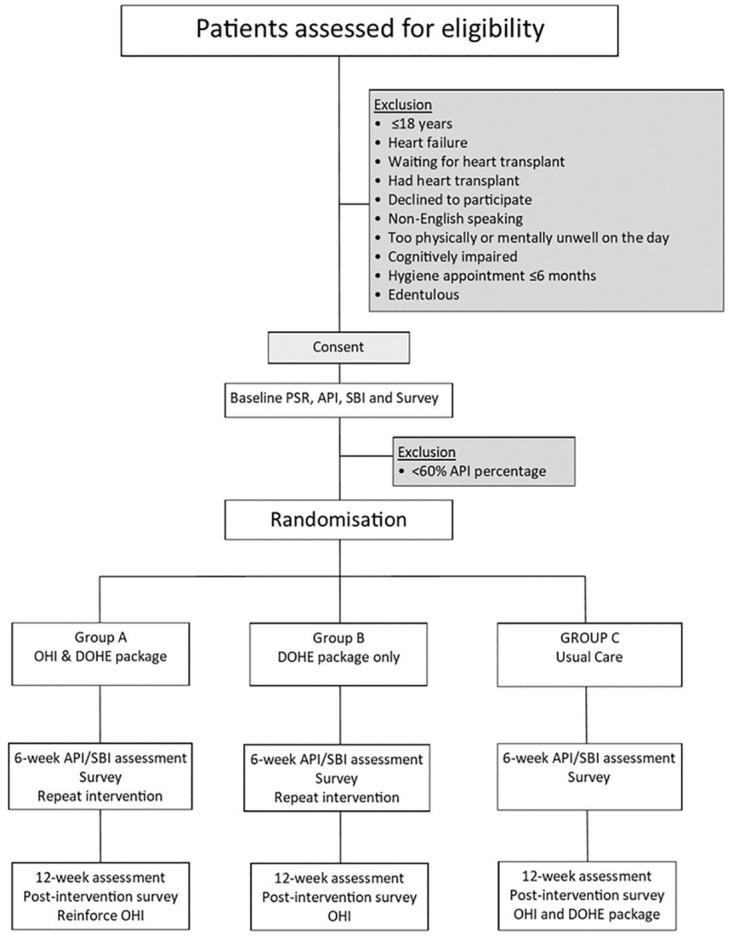
A total of 165 participants will be recruited from the Westmead and Blacktown Mt Druitt cardiac rehabilitation out-patient clinics into this dual centre, single blind, parallel design, randomised controlled trial. A baseline oral health clinical examination will be completed, followed by a self-report questionnaire before they are randomised in a 1:1:1 ratio into one of 3 arms as follows: individualised OHI partnered with DOHE (Group A), (Group B) DOHE only (Group B), and control/usual care (no oral health education) (Group C). Groups will have their intervention repeated at the 6-week follow-up. After completing the 12-week follow-up, Group B and Group C will receive tailored OHI. Group C will also receive the DOHE package. The primary outcome is the change in approximal plaque index score between baseline and 6-week follow up.
ETHICS AND DISSEMINATION
The study has been approved by the Western Sydney Local Health District Human Ethics Committee 2023/ETH00516. Results will be published in peer-reviewed journals and presented at conferences.
TRIAL REGISTRATION NUMBER
ACTRN12623000449639p ANZCTR: https://www.anzctr.org.au/.
简介
牙周组织疾病,包括牙龈炎和牙周炎,分别影响多达 90%和 50%的人群。这些疾病是多因素炎症性疾病,涉及到一种生态失调的生物膜,如果不加以治疗,可能导致牙齿支持结构的破坏,并对心血管健康产生重大影响。炎症标志物,特别是高敏 C 反应蛋白(hsCRP)的升高,与动脉粥样硬化的风险增加密切相关,动脉粥样硬化是心血管疾病(CVD)的一个关键危险因素。由于对停滞的口腔生物膜的免疫反应,hsCRP 以及其他炎症标志物可以在停止刷牙后 21 天内从血液样本中检测到。确保口腔生物膜不能留在口腔组织上的最有效方法是保持良好的口腔卫生,从而预防牙周炎并降低与炎症相关的 CVD 风险。本研究的主要目的是评估个体化口腔卫生指导(OHI)与数字化口腔健康教育(DOHE)包相结合是否可以改善患有 CVD 的患者的口腔健康。
方法和分析
这项双中心、单盲、平行设计、随机对照试验将从 Westmead 和 Blacktown Mt Druitt 心脏康复门诊招募 165 名参与者。在基线时进行口腔健康临床检查,然后在随机分组前进行自我报告问卷调查,随机分为三组,比例为 1:1:1,具体如下:个体化 OHI 与 DOHE 相结合(A 组)、(B 组)仅 DOHE、和对照组/常规护理(无口腔健康教育)(C 组)。三组将在 6 周随访时重复干预。完成 12 周随访后,B 组和 C 组将接受针对性 OHI。C 组还将接受 DOHE 套餐。主要结局是基线和 6 周随访时近中菌斑指数评分的变化。
伦理和传播
该研究已获得西悉尼地方卫生区人类伦理委员会 2023/ETH00516 的批准。研究结果将发表在同行评议的期刊上,并在会议上展示。
试验注册编号
ACTRN12623000449639p,ANZCTR:https://www.anzctr.org.au/。
 Zotero 插件