
真实世界中类风湿关节炎患者使用 Janus 激酶抑制剂的药物保留率的对比研究。
Real-world comparative study of drug retention of Janus kinase inhibitors in patients with rheumatoid arthritis.
机构信息
Department of Rheumatology, Fukushima Medical University School of Medicine, Fukushima, Japan.
Department of Rheumatology, Japanese Red Cross Fukushima Hospital, Fukushima, Japan.
出版信息
PLoS One. 2024 Jul 11;19(7):e0306714. doi: 10.1371/journal.pone.0306714. eCollection 2024.
BACKGROUND
Janus kinase (JAK) inhibitors (JAKis) are effective therapeutic agents against rheumatoid arthritis (RA). However, patients having RA with particular risk factors may have a higher incidence of adverse effects (AEs), including major cardiovascular events (MACE) and infections. In this multicenter cohort study, we aimed to clarify the risk factors affecting the drug retention of JAKis in patients with RA.
METHODS
We retrospectively evaluated patients with RA who received their first JAKi (tofacitinib, baricitinib, upadacitinib, or filgotinib) at our institute. The clinical outcomes, including AEs, were recorded, particularly MACE and serious infections. The drug retention rates were analyzed using the Kaplan-Meier method, and risk factors affecting drug retention rates were determined using a multivariable Cox regression hazards model.
RESULTS
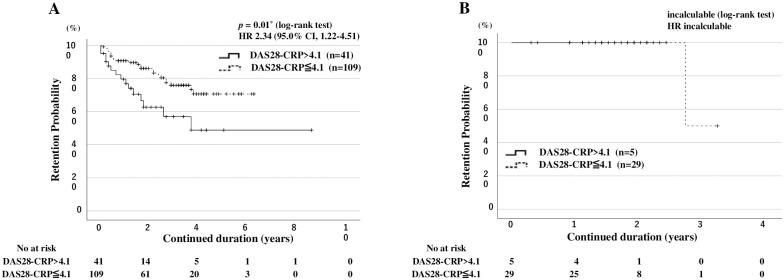
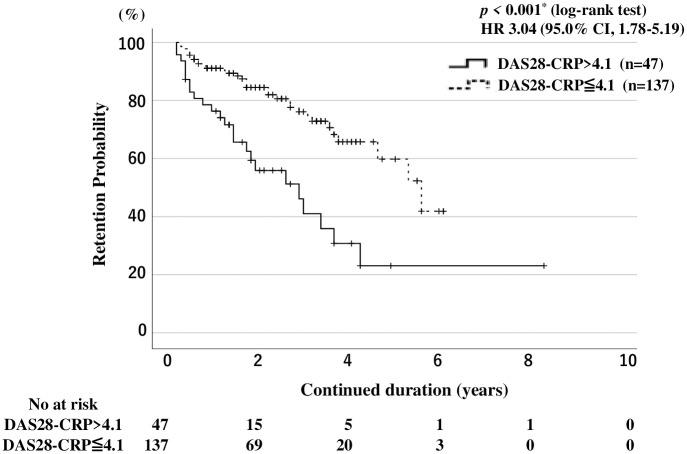
Overall 184 patients with RA receiving their first use of baricitinib (57.6%), tofacitinib (23.9%), upadacitinib (12.0%), or filgotinib (6.5%) were included in this study. Fifty-six (30.4%) patients discontinued JAKi treatment owing to ineffectiveness (9.2%) or AEs, including infections (21.2%). The overall drug retention rates were significantly lower in patients treated with pan-JAKi than in those treated with JAK1 inhibitors (p = 0.03). In the Cox regression model, the presence of baseline high RA disease activity, use of glucocorticoid and treatments with pan-JAKis were associated with reduced drug retention rates of JAKis (p < 0.001, p = 0.01 and 0.04, respectively). Pan-JAKi treated patients with high disease activity had significantly lower drug retention rates (p < 0.001).
CONCLUSIONS
In a real-world setting, the drug retention rates of JAKis were reduced mainly by treatment discontinuation owing to AEs. Treatment with pan-JAKis and high baseline RA disease activity were identified as predictive factors for the discontinuation of JAKis. Lower drug retention rates were found in patients receiving pan-JAKis with high disease activity than in those without high disease activity.
背景
Janus 激酶(JAK)抑制剂(JAKi)是治疗类风湿关节炎(RA)的有效治疗药物。然而,具有特定危险因素的 RA 患者可能会出现更高的不良反应(AE)发生率,包括主要心血管事件(MACE)和感染。在这项多中心队列研究中,我们旨在阐明影响 JAKi 在 RA 患者中药物保留率的危险因素。
方法
我们回顾性评估了在我院接受首次 JAKi(托法替布、巴瑞替尼、乌帕替尼或菲戈替尼)治疗的 RA 患者。记录了包括 AE 在内的临床结局,特别是 MACE 和严重感染。使用 Kaplan-Meier 法分析药物保留率,并使用多变量 Cox 回归风险模型确定影响药物保留率的危险因素。
结果
共有 184 例接受巴瑞替尼(57.6%)、托法替布(23.9%)、乌帕替尼(12.0%)或菲戈替尼(6.5%)首次治疗的 RA 患者纳入本研究。56 例(30.4%)患者因无效(9.2%)或 AE(包括感染[21.2%])停止 JAKi 治疗。与 JAK1 抑制剂相比,接受泛 JAKi 治疗的患者总体药物保留率显著降低(p = 0.03)。在 Cox 回归模型中,基线 RA 疾病活动度高、使用糖皮质激素和接受泛 JAKi 治疗与 JAKi 药物保留率降低相关(p < 0.001、p = 0.01 和 0.04)。基线疾病活动度高的泛 JAKi 治疗患者药物保留率显著降低(p < 0.001)。
结论
在真实世界环境中,JAKi 的药物保留率主要因 AE 导致的治疗中断而降低。泛 JAKi 治疗和基线 RA 疾病活动度高被确定为 JAKi 停药的预测因素。接受高疾病活动度泛 JAKi 治疗的患者药物保留率低于无高疾病活动度的患者。



 Zotero 插件