
丹参酮 IIA 磺酸钠通过抑制 SYK-NLRP3 炎性小体-MMP2/9 通路保护载脂蛋白 E 基因敲除小鼠血管舒张功能。
Sodium tanshinone IIA sulfonate protects vascular relaxation in ApoE-knockout mice by inhibiting the SYK-NLRP3 inflammasome-MMP2/9 pathway.
机构信息
Department of Endocrinology, Heping Hospital Affiliated to Changzhi Medical College, No.110, Yan'an South Road, Changzhi, 046000, Shanxi, China.
Department of Pharmacology, Changzhi Medical College, No.161, Jiefang East Street, Changzhi, 046000, Shanxi, China.
出版信息
BMC Cardiovasc Disord. 2024 Jul 12;24(1):354. doi: 10.1186/s12872-024-03990-0.
BACKGROUND
Hyperlipidemia damages vascular wall and serves as a foundation for diseases such as atherosclerosis, hypertension and stiffness. The NOD-like receptor family pyrin domain-containing 3 (NLRP3) inflammasome is implicated in vascular dysfunction associated with hyperlipidemia-induced vascular injury. Sodium tanshinone IIA sulfonate (STS), a well-established cardiovascular protective drug with recognized anti-inflammatory, antioxidant, and vasodilatory properties, is yet to be thoroughly investigated for its impact on vascular relaxant imbalance induced by hyperlipidemia.
METHODS
In this study, we treated ApoE-knockout (ApoE-/-) mouse with STS and assessed the activation of the NLRP3 inflammasome, expression of MMP2/9, integrity of elastic fibers, and vascular constriction and relaxation.
RESULTS
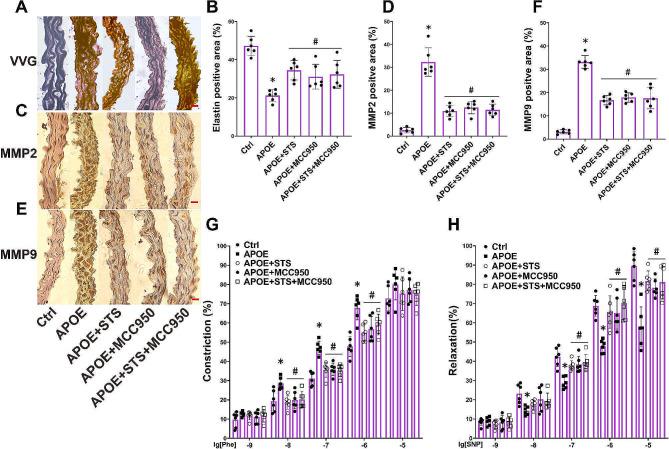
Our findings reveal that STS intervention effectively preserves elastic fibers, significantly restores aortic relaxation function in ApoE-/- mice, and reduces their excessive constriction. Furthermore, STS inhibits the phosphorylation of spleen tyrosine kinase (SYK), suppresses NLRP3 inflammasome activation, and reduces MMP2/9 expression.
CONCLUSIONS
These results demonstrate that STS protects vascular relaxation against hyperlipidemia-induced damage through modulation of the SYK-NLRP3 inflammasome-MMP2/9 pathway. This research provides novel insights into the mechanisms underlying vascular relaxation impairment in a hyperlipidemic environment and uncovers a unique mechanism by which STS preserves vascular relaxation, offering valuable foundational research evidence for its clinical application in promoting vascular health.
背景
高血脂会损伤血管壁,为动脉粥样硬化、高血压和僵硬等疾病奠定基础。NOD 样受体家族含pyrin 结构域蛋白 3(NLRP3)炎症小体与高血脂引起的血管损伤相关的血管功能障碍有关。丹参酮ⅡA 磺酸钠(STS)是一种公认的具有抗炎、抗氧化和血管舒张作用的心血管保护药物,但它对高血脂引起的血管舒张失衡的影响尚未得到充分研究。
方法
本研究采用 STS 处理载脂蛋白 E 基因敲除(ApoE-/-)小鼠,评估 NLRP3 炎症小体的激活、MMP2/9 的表达、弹性纤维的完整性以及血管收缩和舒张。
结果
我们的研究结果表明,STS 干预可有效保护弹性纤维,显著恢复 ApoE-/- 小鼠主动脉舒张功能,减轻其过度收缩。此外,STS 抑制脾酪氨酸激酶(SYK)的磷酸化,抑制 NLRP3 炎症小体的激活,减少 MMP2/9 的表达。
结论
这些结果表明,STS 通过调节 SYK-NLRP3 炎症小体-MMP2/9 通路来保护血管舒张免受高血脂损伤。这项研究为高血脂环境中血管舒张受损的机制提供了新的见解,并揭示了 STS 保护血管舒张的独特机制,为其在促进血管健康方面的临床应用提供了有价值的基础研究证据。


 Zotero 插件