
不同剂量氢吗啡酮缓释镇痛在老年患者腰椎融合术中的临床应用
Clinical Application of Different Doses of Hydromorphone Slow-Release Analgesia in Lumbar Fusion in Elderly Patients.
作者信息
Jin Xianwei, Deng Ruiming, Weng Qiaoling, Yang Qiao, Zhong Weibo
机构信息
Department of Medicine, Graduate School, Nanchang University, Nanchang, Jiangxi Province, China.
Department of Anesthesiology, The People's Hospital of Ganzhou, No. 16, Meiguan Avenue, Zhanggong District, Ganzhou, 341000, Jiangxi Province, China.
出版信息
Pain Ther. 2024 Oct;13(5):1219-1233. doi: 10.1007/s40122-024-00632-3. Epub 2024 Jul 12.
INTRODUCTION
The aim of this study is to examine the analgesic efficacy of varying doses of hydromorphone hydrochloride in conjunction with absorbable gelatin sponge for postoperative pain management in elderly individuals undergoing lumbar fusion surgery. Additionally, the study aims to assess the sustained release analgesic properties of this combination and to determine the optimal dosage of hydromorphone hydrochloride for effective pain relief.
METHODS
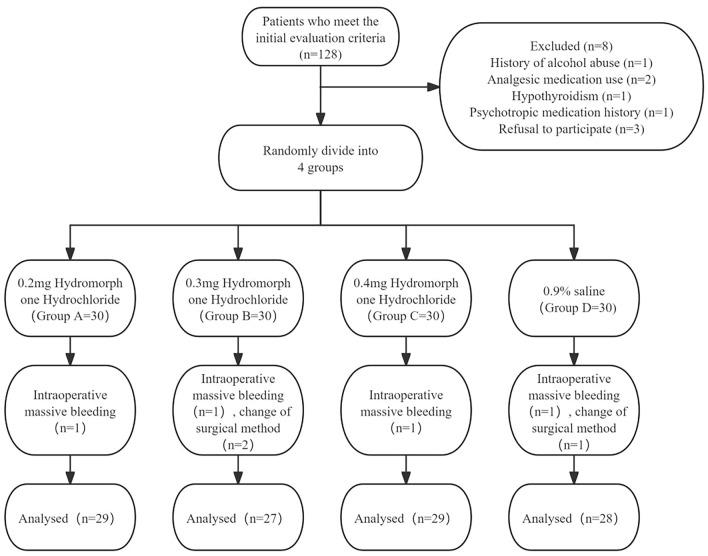
A total of 113 elderly patients (aged ≥ 65 years old) meeting the criteria for 1-2-level posterior lumbar fusion surgery at Ganzhou City People's Hospital between July 2022 and August 2023 were randomly assigned to four groups: group A (0.2 mg hydromorphone hydrochloride 1 ml), group B (0.3 mg hydromorphone hydrochloride 1.5 ml), group C (0.4 mg hydromorphone hydrochloride 2 ml), and group D (0.9% normal saline 2 ml) for standard anesthesia induction and maintenance. Prior to suturing the incision, gelfoam was utilized to administer epidural analgesia to each group. Following the surgical procedure, an intravenous analgesia pump was utilized for pain management. The baseline infusion rate was set at 0.5 ml/h. Patient-controlled analgesia (PCA) was administered at a dose of 2 ml, with a lockout interval of 20 min, allowing the patient to self-administer as needed. Pain relief was assessed using the visual analogue scale (VAS) prior to surgery, as well as at 1 day and 3 days post-operation. The frequency of PCA requests within the initial 48-h postoperative period, the remedial analgesia with dezocine, postoperative adverse reactions, and duration of hospitalization were documented for analysis.
RESULTS
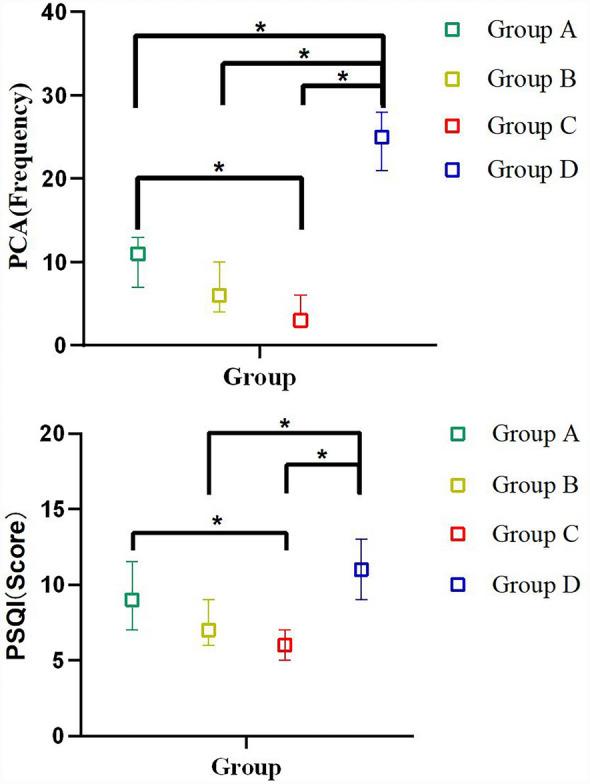
The VAS scores of groups B and C were found to be significantly lower than those of group D 1 day after the operation. Additionally, VAS scores at 3 days post-operation, remedial rate of dezocine and PCA follow-up times at 48 h in groups A, B, and C were significantly lower compared to group D (P < 0.001). There was no statistically significant difference between group B and group C in VAS scores at 1 day and 3 days post-operation, as well as PCA follow-up times at 48 h post-operation (P < 0.001). Furthermore, the VAS scores of groups B and C were lower than those of group A at 1 day and 3 days post-operation (P < 0.05). The PCA frequency of group C was also lower than that of group A at 48 h post-operation (P < 0.05).
CONCLUSION
The combination of hydromorphone hydrochloride and absorbable gelatin sponge epidural analgesia has been shown to enhance postoperative pain management. A dosage of 0.4 mg of hydromorphone hydrochloride may be considered an appropriate analgesic dose, as it can provide effective pain relief without eliciting adverse reactions.
TRIAL REGISTRATION
ChiCTR.org.cn(ChiCTR2200064863). Registered on October 20, 2022.
引言
本研究旨在探讨不同剂量的盐酸氢吗啡酮联合可吸收明胶海绵用于老年腰椎融合手术患者术后疼痛管理的镇痛效果。此外,该研究旨在评估这种联合用药的缓释镇痛特性,并确定有效缓解疼痛的盐酸氢吗啡酮最佳剂量。
方法
2022年7月至2023年8月期间,赣州市人民医院113例符合1-2级后路腰椎融合手术标准的老年患者(年龄≥65岁)被随机分为四组:A组(1毫升含0.2毫克盐酸氢吗啡酮)、B组(1.5毫升含0.3毫克盐酸氢吗啡酮)、C组(2毫升含0.4毫克盐酸氢吗啡酮)和D组(2毫升0.9%生理盐水),进行标准麻醉诱导和维持。在缝合切口前,使用明胶海绵对每组进行硬膜外镇痛给药。手术后,使用静脉镇痛泵进行疼痛管理。基线输注速率设定为0.5毫升/小时。患者自控镇痛(PCA)剂量为2毫升,锁定时间间隔为20分钟,允许患者根据需要自行给药。在手术前、术后1天和3天使用视觉模拟量表(VAS)评估疼痛缓解情况。记录术后最初48小时内PCA请求的频率、地佐辛补救镇痛情况、术后不良反应和住院时间进行分析。
结果
术后1天,发现B组和C组的VAS评分显著低于D组。此外,术后第3天A、B和C组的VAS评分、地佐辛补救率和48小时PCA随访时间均显著低于D组(P<0.001)。术后1天和3天B组和C组的VAS评分以及术后48小时PCA随访时间之间无统计学显著差异(P<0.001)。此外,术后1天和3天B组和C组的VAS评分低于A组(P<0.05)。术后48小时C组的PCA频率也低于A组(P<0.05)。
结论
盐酸氢吗啡酮与可吸收明胶海绵硬膜外镇痛联合应用已被证明可增强术后疼痛管理。0.4毫克盐酸氢吗啡酮的剂量可被认为是合适的镇痛剂量,因为它可以有效缓解疼痛而不引起不良反应。
试验注册
中国临床试验注册中心(ChiCTR.org.cn)(ChiCTR2200064863)。于2022年10月20日注册。

 Zotero 插件