
从cv Miller(坎帕纳安努尔卡苹果)果肉获得的愈伤组织培养物的抗炎、抗氧化和基因保护作用
Anti-Inflammatory, Antioxidant, and Genoprotective Effects of Callus Cultures Obtained from the Pulp of cv Miller (Annurca Campana Apple).
作者信息
Gubitosa Federica, Fraternale Daniele, Benayada Leila, De Bellis Roberta, Gorassini Andrea, Saltarelli Roberta, Donati Zeppa Sabrina, Potenza Lucia
机构信息
Department of Biomolecular Sciences, University of Urbino Carlo Bo, 61029 Urbino, Italy.
Department of Humanities and Cultural Heritage, University of Udine, 33100 Udine, Italy.
出版信息
Foods. 2024 Jun 27;13(13):2036. doi: 10.3390/foods13132036.
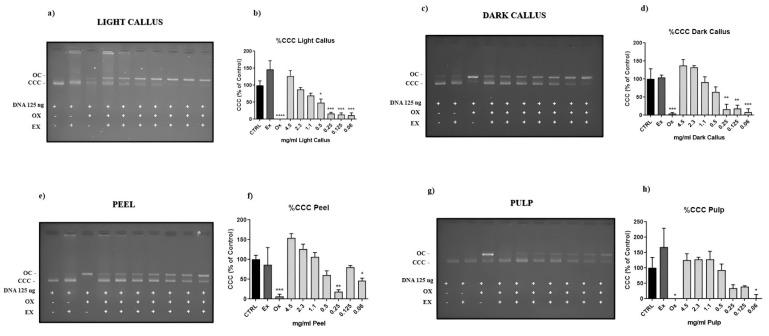
Apples are rich in phytochemicals useful for human health. However, environmental factors can greatly affect the accumulation of these compounds. To face this problem, the callus culture technique was used to obtain large quantities of phytochemicals. Specifically, two callus cultures were obtained from ripe Annurca apple pulp ( cv Miller) and cultivated under different light conditions: darkness and an 18-h photoperiod. The hydro-alcoholic extracts from the calli underwent analysis using GC-MS, GC-FID, and HPLC-DAD-ESI-MS to determine the qualitative and quantitative content of phenolic and triterpenic acids. The study revealed the predominant presence of triterpenic compounds in both calli. Furthermore, we investigated their radical scavenging and antioxidant activities through DPPH, ABTS, ORAC assays, and lipoxygenase inhibition activity. Genoprotection was evaluated via nicking assay, and the anti-inflammatory effect was investigated via Griess assay on LPS-injured murine macrophages. All the analyses performed were compared with peel and pulp hydroalcoholic extracts. The results showed that both calli primarily show anti-inflammatory activity and moderate antioxidant effect and can protect DNA against oxidative stimuli. This data encouraged further research aimed at utilizing callus as a bioreactor to produce secondary metabolites for use in preventive and therapeutic applications to combat acute or chronic age-associated diseases.
苹果富含对人体健康有益的植物化学物质。然而,环境因素会极大地影响这些化合物的积累。为解决这一问题,采用了愈伤组织培养技术来获取大量的植物化学物质。具体而言,从成熟的阿努尔卡苹果果肉(品种为米勒)中获得了两种愈伤组织培养物,并在不同光照条件下培养:黑暗和18小时光周期。对愈伤组织的水醇提取物进行了气相色谱 - 质谱联用(GC-MS)、气相色谱 - 氢火焰离子化检测器(GC-FID)和高效液相色谱 - 二极管阵列检测器 - 电喷雾质谱(HPLC-DAD-ESI-MS)分析,以确定酚酸和三萜酸的定性和定量含量。研究表明,两种愈伤组织中均主要存在三萜类化合物。此外,我们通过二苯基苦味酰基自由基(DPPH)、2,2'-联氮-双-3-乙基苯并噻唑啉-6-磺酸(ABTS)、氧自由基吸收能力(ORAC)测定以及脂氧合酶抑制活性来研究它们的自由基清除和抗氧化活性。通过切口试验评估基因保护作用,并通过对脂多糖(LPS)损伤的小鼠巨噬细胞进行格里斯试验来研究抗炎作用。将所有分析结果与果皮和果肉的水醇提取物进行比较。结果表明,两种愈伤组织均主要表现出抗炎活性和适度的抗氧化作用,并能保护DNA免受氧化刺激。这些数据鼓励了进一步的研究,旨在利用愈伤组织作为生物反应器来生产次生代谢产物,用于预防和治疗应用,以对抗急性或慢性年龄相关疾病。


 Zotero 插件