
日本社区居住老年人主观认知主诉与睡眠障碍之间的关联。
Association between Subjective Cognitive Complaints and Sleep Disturbance among Community-Dwelling Elderly Individuals in Japan.
作者信息
Goda Akio, Nakano Hideki, Kikuchi Yuki, Mori Kohei, Mitsumaru Nozomi, Murata Shin
机构信息
Hokuriku University Well-Being Research Team, Department of Physical Therapy, Faculty of Health and Medical Science, Hokuriku University, Kanazawa 920-1180, Japan.
Department of Physical Therapy, Faculty of Health Sciences, Kyoto Tachibana University, Kyoto 607-8175, Japan.
出版信息
Healthcare (Basel). 2024 Jun 22;12(13):1245. doi: 10.3390/healthcare12131245.
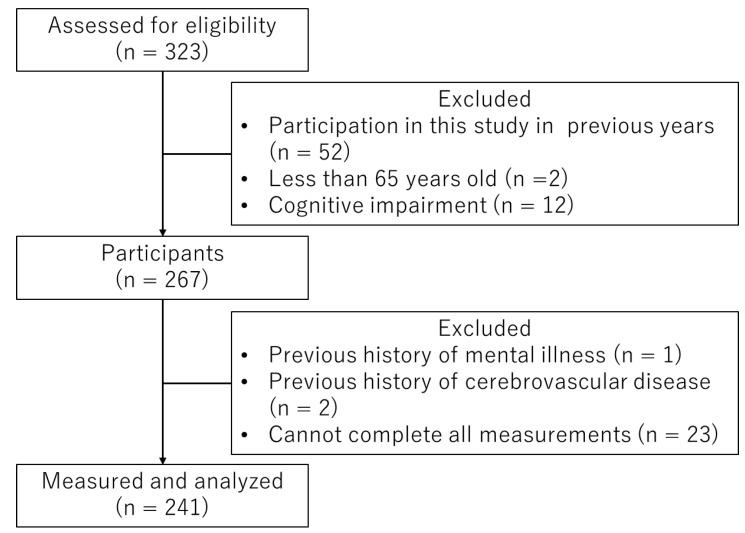
Subjective cognitive complaints (SCCs) are a crucial modifiable risk factor for dementia. There is increasing interest in the association between SCC and sleep disturbance; however, the effects of sleep disturbance on SCC development among community-dwelling elderly individuals in Japan remain unclear. We aimed to cross-sectionally investigate the association between SCC and sleep disturbance, with adjustment for multiple factors related to cognitive decline, among 241 community-dwelling elderly persons without cognitive impairment. The measures were SCCs (Kihon Checklist-Cognitive Function, KCL-CF), sleep disturbance (Japanese version of the Athens Insomnia Scale, AIS-J), general cognitive function (Mini-Mental State Examination), and depressive symptoms (five-item version of the Geriatric Depression Scale [GDS-5]). The following data were collected: sex, age, educational history, whether the participants had visited a medical institution for diseases (hypertension, diabetes, hyperlipidemia, heart disease), and the presence/absence of established risk factors (hearing loss, history of head injury, drinking habits, smoking habits, social isolation, and physical inactivity and activity). Based on the KCL-CF, 96 and 145 participants were considered to have and lack SCCs, respectively. On logistic regression analysis, the AIS-J score and smoking history were significantly associated with SCCs. Our findings suggest that sleep disturbance is associated with SCC development among community-dwelling elderly people in Japan. Evaluating and managing sleep disturbances can be important in preventing SCCs and dementia.
主观认知主诉(SCCs)是痴呆症一个关键的可改变风险因素。人们对SCC与睡眠障碍之间的关联越来越感兴趣;然而,在日本社区居住的老年人中,睡眠障碍对SCC发生发展的影响仍不明确。我们旨在对241名无认知障碍的社区居住老年人进行横断面研究,调查SCC与睡眠障碍之间的关联,并对与认知衰退相关的多个因素进行校正。测量指标包括SCCs(简易认知功能检查表,KCL-CF)、睡眠障碍(雅典失眠量表日语版,AIS-J)、一般认知功能(简易精神状态检查表)和抑郁症状(老年抑郁量表五项版[GDS-5])。收集了以下数据:性别、年龄、教育史、参与者是否因疾病(高血压、糖尿病、高脂血症、心脏病)去过医疗机构,以及是否存在既定风险因素(听力损失、头部受伤史、饮酒习惯、吸烟习惯、社会隔离、身体活动不足及活动情况)。根据KCL-CF,分别有96名和145名参与者被认为有和无SCCs。在逻辑回归分析中,AIS-J评分和吸烟史与SCCs显著相关。我们的研究结果表明,在日本社区居住的老年人中,睡眠障碍与SCC的发生发展有关。评估和管理睡眠障碍对于预防SCCs和痴呆症可能很重要。
 Zotero 插件