
小儿心脏移植受者等待时间、机械循环支持需求及预后的变化
Changes in waiting time, need for mechanical circulatory support and outcomes in paediatric heart transplant recipients.
作者信息
Rosenthal Lisa-Maria, Krauss Annemarie, Miera Oliver, Danne Friederike, Lunze Fatima, Cho Mi-Young, Photiadis Joachim, Berger Felix, Schmitt Katharina
机构信息
Department of Congenital Heart Disease-Pediatric Cardiology, Deutsches Herzzentrum der Charité, Berlin, Germany.
Berlin Institute of Health, Berlin, Germany.
出版信息
ESC Heart Fail. 2024 Dec;11(6):3626-3635. doi: 10.1002/ehf2.14917. Epub 2024 Jul 14.
AIMS
Heart transplantation is a well-established treatment for end-stage heart failure in paediatric patients, demonstrating excellent long-term outcomes.
METHODS
This retrospective study analyses 35 years of data on 244 paediatric recipients (<18 years) at a single institution from 1986 to 2022. The analysis explores changes in diagnoses, survival, waiting times and mechanical circulatory support (MCS) over three decades (1991-2000, 2001-2010 and 2011-2020).
RESULTS
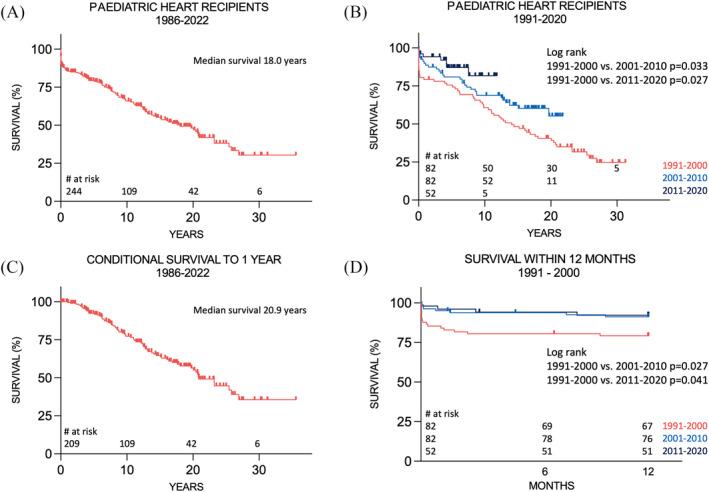
Survival outcomes significantly improved over the study period, with 1-year survival rates increasing from 79.3% (1991-2000) to 92.3% (2011-2020, P = 0.041). The median overall survival was 18.0 years, and median conditional survival to 1 year post-transplant was 20.9 years. Survival differences were noted among age groups, with infants under 1 year of age experiencing higher early mortality, and adolescents (aged 11-17 years) facing increased long-term risks, possibly linked to adult donor characteristics. Waiting times for heart transplantation increased, especially for younger age groups (0-5 and 6-10 years), reflecting the growing demand for donor organs. The use of MCS, including ventricular assist devices (VAD), surged, with 67% of recipients in the most recent decade receiving pre-transplant VAD support. Importantly, despite prolonged waiting times and increased VAD use, overall survival continued to be favourable.
CONCLUSIONS
Early and long-term results after paediatric heart transplantation have been continuously improving over the past decades. Despite an increased demand for donor organs and the growing reliance on VAD as bridge to transplantation, post-transplantation survival is not compromised.
目的
心脏移植是治疗小儿终末期心力衰竭的一种成熟疗法,长期疗效良好。
方法
这项回顾性研究分析了1986年至2022年期间一家机构244名儿科受者(<18岁)35年的数据。该分析探讨了三十年间(1991 - 2000年、2001 - 2010年和2011 - 2020年)诊断、生存率、等待时间和机械循环支持(MCS)的变化。
结果
在研究期间,生存结果显著改善,1年生存率从79.3%(1991 - 2000年)提高到92.3%(2011 - 2020年,P = 0.041)。总体生存中位数为18.0年,移植后1年的条件生存中位数为20.9年。各年龄组之间存在生存差异,1岁以下婴儿早期死亡率较高,青少年(11 - 17岁)面临的长期风险增加,这可能与成年供体特征有关。心脏移植的等待时间增加,尤其是较年轻年龄组(0 - 5岁和6 - 10岁),这反映了对供体器官需求的增长。包括心室辅助装置(VAD)在内的MCS的使用激增,在最近十年中,67%的受者在移植前接受了VAD支持。重要的是,尽管等待时间延长和VAD使用增加,但总体生存仍然良好。
结论
在过去几十年中,小儿心脏移植后的早期和长期结果一直在持续改善。尽管对供体器官的需求增加以及越来越依赖VAD作为移植桥梁,但移植后的生存并未受到影响。



 Zotero 插件