
印度尼西亚巴厘岛登巴萨一家三级转诊医院临床分离株的抗生素分型、随机扩增多态性DNA(RAPD)和肠杆菌基因间重复共有序列(ERIC)-聚合酶链反应(PCR)指纹图谱分析
Antibiotyping, RAPD- and ERIC-PCR fingerprinting of clinical isolates at a tertiary reference hospital in Denpasar, Bali, Indonesia.
作者信息
Dwi Fatmawati Ni Nengah, Aviana Felicia, Maharianto Ronny, Ngurah Rsi Suwardana Gede, Adi Tarini Ni Made, Nengah Sujaya I
机构信息
Department of Clinical Microbiology, Faculty of Medicine, Udayana University, Denpasar, Bali, Indonesia.
Department of Public Health and Preventive Medicine, Faculty of Medicine, Udayana University, Denpasar, Bali, Indonesia.
出版信息
Iran J Microbiol. 2024 Jun;16(3):306-313. doi: 10.18502/ijm.v16i3.15761.
BACKGROUND AND OBJECTIVES
is a healthcare-associated infections agent and could be an extended spectrum β-lactamase (ESBL) producer. Understanding the transmission of this bacterium in a hospital setting needs accurate typing methods. An antibiogram is used to detect the resistance pattern of the isolates. Random Amplified Polymorphic DNA (RAPD) and Enterobacterial Repetitive Intergenic Consensus (ERIC)-PCR are rapid, technically simple, and easy-to-interpret DNA typing methods. This study aimed to evaluate the use of antibiotyping, RAPD-, and ERIC-PCR to investigate the heterogeneity of isolated from clinical specimens.
MATERIALS AND METHODS
The antibiograms of 46 clinical isolates were determined by Vitek® 2 Compact. All isolates underwent RAPD-PCR using AP4 primer and ERIC-PCR using ERIC-2 primer. The dendrogram was generated using the GelJ software and analyzed to determine its similarity. The analysis of antibiogram and the molecular typing diversity index was calculated using the formula of the Simpson's diversity index.
RESULTS
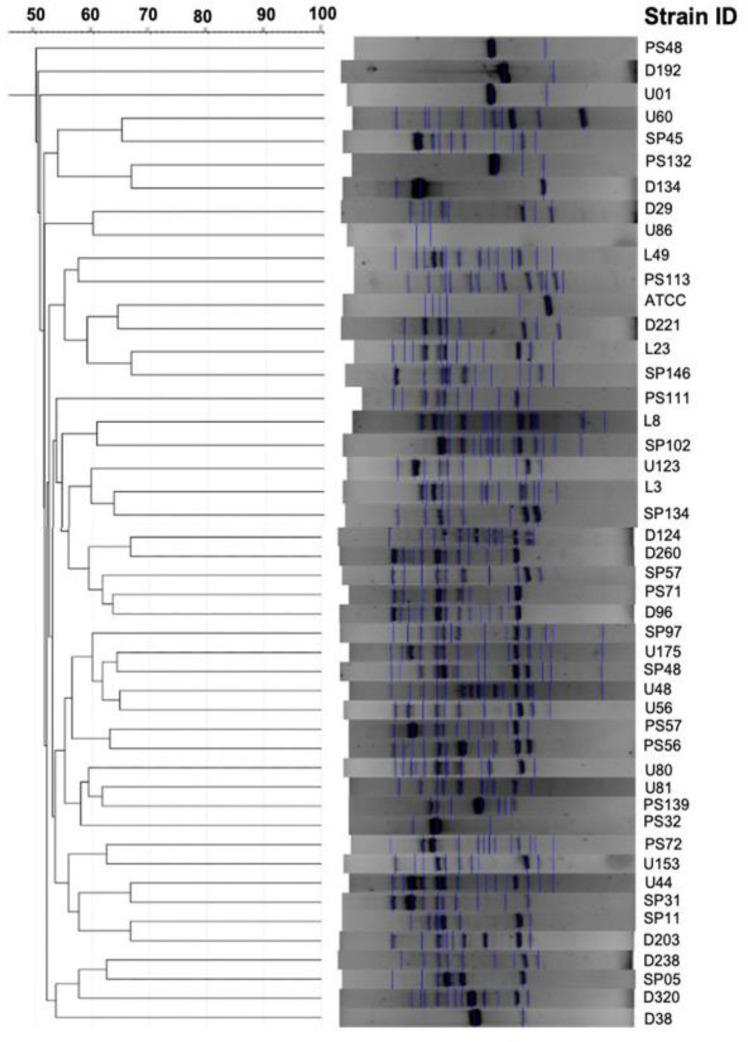
About 71.7% of the isolates were ESBL-producers, and more than 80% of isolates were susceptible to amikacin, ertapenem, and meropenem. The antibiotyping produced 32 diverse types with DI = 0.964. In addition, the RAPD-PCR produced 47 different types with DI = 1, while ERIC-PCR was 46 (DI=0.999).
CONCLUSION
Antibiotyping, RAPD- and ERIC-PCR showed powerful discrimination power among the isolates, supported the diversity of isolates in current study. These combination could be promising tools for clonal relationship determination, including in tracking the transmission of the outbreak's agent in hospital setting.
背景与目的
是一种与医疗保健相关的感染病原体,可能产超广谱β-内酰胺酶(ESBL)。了解这种细菌在医院环境中的传播需要准确的分型方法。抗菌谱用于检测分离株的耐药模式。随机扩增多态性DNA(RAPD)和肠杆菌重复基因间共识序列(ERIC)-PCR是快速、技术简单且易于解读的DNA分型方法。本研究旨在评估抗菌谱分型、RAPD和ERIC-PCR用于研究从临床标本中分离出的[具体细菌名称未给出]的异质性。
材料与方法
使用Vitek® 2 Compact测定46株临床分离株的抗菌谱。所有分离株使用AP4引物进行RAPD-PCR,使用ERIC-2引物进行ERIC-PCR。使用GelJ软件生成树状图并进行分析以确定其相似性。使用辛普森多样性指数公式计算抗菌谱分析和分子分型多样性指数。
结果
约71.7%的分离株产ESBL,超过80%的分离株对阿米卡星、厄他培南和美罗培南敏感。抗菌谱分型产生32种不同类型,DI = 0.964。此外,RAPD-PCR产生47种不同类型,DI = 1,而ERIC-PCR为46种(DI = 0.999)。
结论
抗菌谱分型、RAPD和ERIC-PCR在分离株中显示出强大的鉴别能力,支持了本研究中分离株的多样性。这些组合可能是确定克隆关系的有前景的工具,包括追踪医院环境中暴发病原体的传播。


 Zotero 插件