
首次感染 SARS-CoV-2 的伴有精神障碍的个体中 COVID-19 相关死亡和全因死亡:来自捷克的全国队列研究。
Deaths with COVID-19 and from all-causes following first-ever SARS-CoV-2 infection in individuals with preexisting mental disorders: A national cohort study from Czechia.
机构信息
Department of Public Mental Health, National Institute of Mental Health, Klecany, Czechia.
Department of Psychiatry, University of Cambridge, Cambridge, United Kingdom.
出版信息
PLoS Med. 2024 Jul 15;21(7):e1004422. doi: 10.1371/journal.pmed.1004422. eCollection 2024 Jul.
BACKGROUND
Evidence suggests reduced survival rates following Severe Acute Respiratory Syndrome Coronavirus 2 (SARS-CoV-2) infection in people with preexisting mental disorders, especially psychotic disorders, before the broad introduction of vaccines. It remains unknown whether this elevated mortality risk persisted at later phases of the pandemic and when accounting for the confounding effect of vaccination uptake and clinically recorded physical comorbidities.
METHODS AND FINDINGS
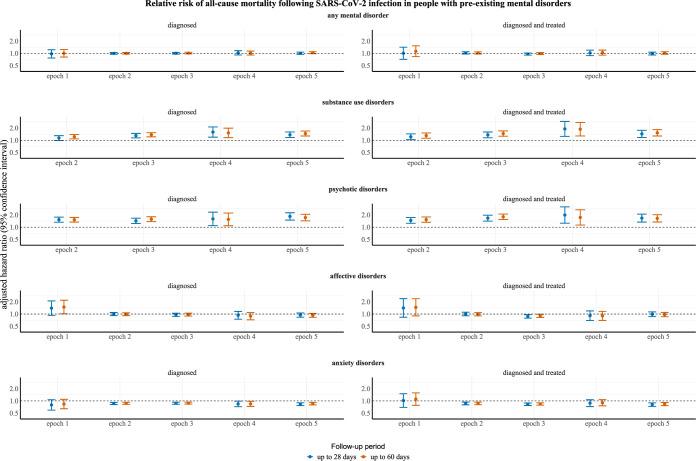
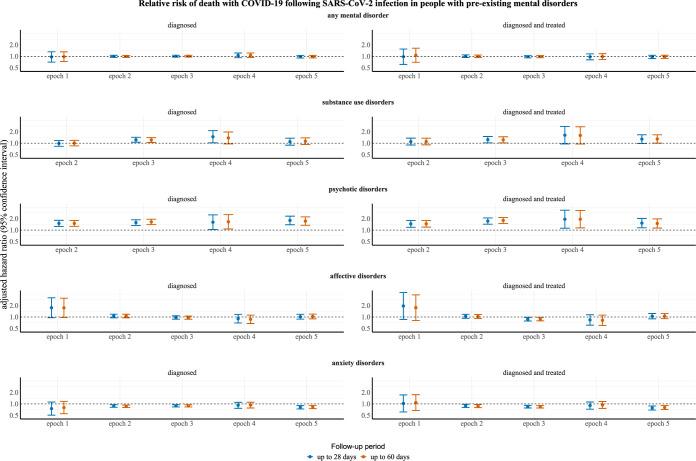
We used data from Czech national health registers to identify first-ever serologically confirmed SARS-CoV-2 infections in 5 epochs related to different phases of the pandemic: 1st March 2020 to 30th September 2020, 1st October 2020 to 26th December 2020, 27th December 2020 to 31st March 2021, 1st April 2021 to 31st October 2021, and 1st November 2021 to 29th February 2022. In these people, we ascertained cases of mental disorders using 2 approaches: (1) per the International Classification of Diseases 10th Revision (ICD-10) diagnostic codes for substance use, psychotic, affective, and anxiety disorders; and (2) per ICD-10 diagnostic codes for the above mental disorders coupled with a prescription for anxiolytics/hypnotics/sedatives, antidepressants, antipsychotics, or stimulants per the Anatomical Therapeutic Chemical (ATC) classification codes. We matched individuals with preexisting mental disorders with counterparts who had no recorded mental disorders on age, sex, month and year of infection, vaccination status, and the Charlson Comorbidity Index (CCI). We assessed deaths with Coronavirus Disease 2019 (COVID-19) and from all-causes in the time period of 28 and 60 days following the infection using stratified Cox proportional hazards models, adjusting for matching variables and additional confounders. The number of individuals in matched-cohorts ranged from 1,328 in epoch 1 to 854,079 in epoch 5. The proportion of females ranged from 34.98% in people diagnosed with substance use disorders in epoch 3 to 71.16% in individuals diagnosed and treated with anxiety disorders in epoch 5. The mean age ranged from 40.97 years (standard deviation [SD] = 15.69 years) in individuals diagnosed with substance use disorders in epoch 5 to 56.04 years (SD = 18.37 years) in people diagnosed with psychotic disorders in epoch 2. People diagnosed with or diagnosed and treated for psychotic disorders had a consistently elevated risk of dying with COVID-19 in epochs 2, 3, 4, and 5, with adjusted hazard ratios (aHRs) ranging from 1.46 [95% confidence intervals (CIs), 1.18, 1.79] to 1.93 [95% CIs, 1.12, 3.32]. This patient group demonstrated also a consistently elevated risk of all-cause mortality in epochs 2, 3, 4, and 5 (aHR from 1.43 [95% CIs, 1.23, 1.66] to 1.99 [95% CIs, 1.25, 3.16]). The models could not be reliably fit for psychotic disorders in epoch 1. People diagnosed with substance use disorders had an increased risk of all-cause mortality 28 days postinfection in epoch 3, 4, and 5 (aHR from 1.30 [95% CIs, 1.14, 1.47] to 1.59 [95% CIs, 1.19, 2.12]) and 60 days postinfection in epoch 2, 3, 4, and 5 (aHR from 1.22 [95% CIs, 1.08, 1.38] to 1.52 [95% CIs, 1.16, 1.98]). Cases ascertained based on diagnosis of substance use disorders and treatment had increased risk of all-cause mortality in epoch 2, 3, 4, and 5 (aHR from 1.22 [95% CIs, 1.03, 1.43] to 1.91 [95% CIs, 1.25, 2.91]). The models could not be reliably fit for substance use disorders in epoch 1. In contrast to these, people diagnosed with anxiety disorders had a decreased risk of death with COVID-19 in epoch 2, 3, and 5 (aHR from 0.78 [95% CIs, 0.69, 0.88] to 0.89 [95% CIs, 0.81, 0.98]) and all-cause mortality in epoch 2, 3, 4, and 5 (aHR from 0.83 [95% CIs, 0.77, 0.90] to 0.88 [95% CIs, 0.83, 0.93]). People diagnosed and treated for affective disorders had a decreased risk of both death with COVID-19 and from all-causes in epoch 3 (aHR from 0.87 [95% CIs, 0.79, 0.96] to 0.90 [95% CIs, 0.83, 0.99]), but demonstrated broadly null effects in other epochs. Given the unavailability of data on a number of potentially influential confounders, particularly body mass index, tobacco smoking status, and socioeconomic status, part of the detected associations might be due to residual confounding.
CONCLUSIONS
People with preexisting psychotic, and, less robustly, substance use disorders demonstrated a persistently elevated risk of death following SARS-CoV-2 infection throughout the pandemic. While it cannot be ruled out that part of the detected associations is due to residual confounding, this excess mortality cannot be fully explained by lower vaccination uptake and more clinically recorded physical comorbidities in these patient groups.
背景
有证据表明,在广泛接种疫苗之前,患有精神障碍(尤其是精神病性障碍)的人群在感染严重急性呼吸综合征冠状病毒 2 (SARS-CoV-2)后生存率降低。目前尚不清楚这种死亡率升高的风险是否在大流行的后期阶段持续存在,以及在考虑疫苗接种率和临床记录的身体合并症的混杂影响时是否持续存在。
方法和发现
我们使用捷克国家健康登记处的数据,确定了与大流行不同阶段相关的 5 个时期的首次经血清学确认的 SARS-CoV-2 感染病例:第 1 阶段(2020 年 3 月 1 日至 2020 年 9 月 30 日),第 2 阶段(2020 年 10 月 1 日至 2020 年 12 月 26 日),第 3 阶段(2020 年 12 月 27 日至 2021 年 3 月 31 日),第 4 阶段(2021 年 4 月 1 日至 2021 年 10 月 31 日)和第 5 阶段(2021 年 11 月 1 日至 2022 年 2 月 29 日)。在这些人中,我们通过以下两种方法确定精神障碍病例:(1)使用国际疾病分类第 10 版(ICD-10)的诊断代码确定物质使用、精神病性、情感和焦虑障碍;(2)使用 ICD-10 诊断代码确定上述精神障碍,并结合精神科药物、抗抑郁药、抗精神病药或兴奋剂、抗焦虑药/催眠药/镇静剂的解剖治疗化学(ATC)分类代码进行诊断。我们根据年龄、性别、感染月份和年份、疫苗接种状况和 Charlson 合并症指数(CCI)将患有预先存在的精神障碍的个体与没有记录的精神障碍的个体相匹配。我们使用分层 Cox 比例风险模型评估了感染后 28 天和 60 天的 COVID-19 相关死亡和全因死亡,调整了匹配变量和其他混杂因素。在匹配队列中,个体人数从第 1 阶段的 1328 人到第 5 阶段的 854079 人不等。女性比例从第 3 阶段诊断为物质使用障碍的个体的 34.98%到第 5 阶段诊断和治疗焦虑障碍的个体的 71.16%不等。平均年龄从第 5 阶段诊断为物质使用障碍的个体的 40.97 岁(标准差 [SD] = 15.69 岁)到第 2 阶段诊断为精神病性障碍的个体的 56.04 岁(SD = 18.37 岁)不等。第 2、3、4 和 5 阶段,患有精神病性或诊断和治疗的精神病性障碍的个体因 COVID-19 死亡的风险始终较高,调整后的危险比(aHR)范围为 1.46 [95%置信区间(CI),1.18,1.79]至 1.93 [95%CI,1.12,3.32]。该患者组在第 2、3、4 和 5 阶段也始终存在全因死亡率升高的风险(aHR 范围为 1.43 [95%CI,1.23,1.66]至 1.99 [95%CI,1.25,3.16])。模型无法可靠地适用于第 1 阶段的精神病性障碍。诊断为物质使用障碍的个体在第 3、4 和 5 阶段感染后 28 天(aHR 为 1.30 [95%CI,1.14,1.47]至 1.59 [95%CI,1.19,2.12])和感染后 60 天(aHR 为 1.22 [95%CI,1.08,1.38]至 1.52 [95%CI,1.16,1.98])全因死亡的风险增加。基于物质使用障碍的诊断和治疗确定的病例在第 2、3、4 和 5 阶段全因死亡的风险增加(aHR 为 1.22 [95%CI,1.03,1.43]至 1.91 [95%CI,1.25,2.91])。模型无法可靠地适用于第 1 阶段的物质使用障碍。相比之下,在第 2、3 和 5 阶段,诊断为焦虑障碍的个体因 COVID-19 死亡的风险降低(aHR 为 0.78 [95%CI,0.69,0.88]至 0.89 [95%CI,0.81,0.98])和全因死亡率(aHR 为 0.83 [95%CI,0.77,0.90]至 0.88 [95%CI,0.83,0.93])。诊断和治疗的情感障碍个体在第 3 阶段因 COVID-19 和全因死亡的风险降低(aHR 为 0.87 [95%CI,0.79,0.96]至 0.90 [95%CI,0.83,0.93]),但在其他阶段表现出广泛的零效应。由于无法获得包括身体质量指数、吸烟状况和社会经济地位在内的许多潜在影响因素的数据,因此部分检测到的关联可能是由于残余混杂造成的。
结论
患有精神病性和物质使用障碍的个体在整个大流行期间,在 SARS-CoV-2 感染后死亡率持续升高。虽然不能排除部分检测到的关联是由于残余混杂造成的,但这些患者群体中较低的疫苗接种率和更多临床记录的身体合并症并不能完全解释这种额外的死亡率。
 Zotero 插件