
2023年埃塞俄比亚阿姆哈拉西北部转诊医院重症监护病房中接受机械通气的成年患者的死亡率及其相关因素。
Mortality and its associated factors among mechanically ventilated adult patients in the intensive care units of referral hospitals in Northwest Amhara, Ethiopia, 2023.
作者信息
Tadesse Eyob Eshete, Tilahun Ambaye Dejen, Yesuf Nurhusein Nuru, Nimani Teshome Demis, Mekuria Tesfaye Ayenew
机构信息
Department of Nursing, College of Health Sciences, Mettu University, Metu, Ethiopia.
Department of Emergency and Critical Care Nursing, School of Nursing, College of Medicine and Health Sciences, University of Gondar, Gondar, Ethiopia.
出版信息
Front Med (Lausanne). 2024 Jul 1;11:1345468. doi: 10.3389/fmed.2024.1345468. eCollection 2024.
BACKGROUND
Worldwide, nearly half of the patients admitted to intensive care units require ventilatory support. Despite advances in intensive care unit patient management and mechanical ventilator utilization, the odds of mortality among mechanically ventilated patients are higher in resource-limited settings. Little is known about the mortality of patients on mechanical ventilation outside the capital of Ethiopia. This study aimed to assess mortality and its associated factors among mechanically ventilated adult patients in intensive care units.
METHOD
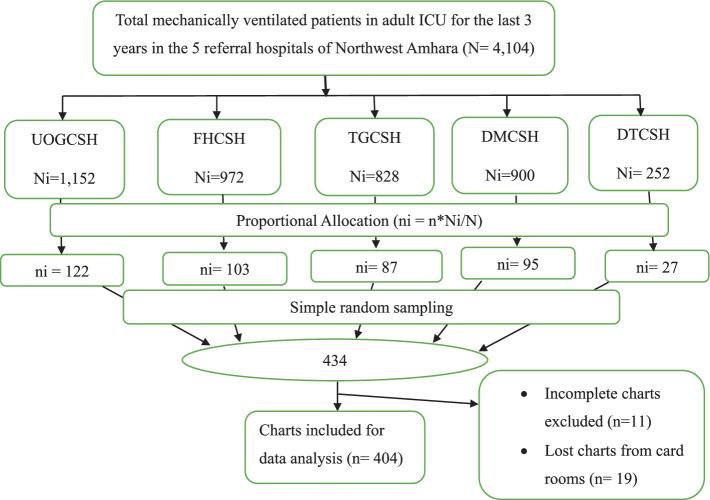
An institutional-based cross-sectional study was conducted on mechanically ventilated patients in intensive care units from 1 February 2020 to 1 March 2023. A simple random sampling technique was used to select 434 patients' charts. A data extraction tool designed on the Kobo toolbox, a smartphone data collection platform, was used to collect the data. The data were exported into Microsoft Excel 2019 and then into Stata 17 for data management and analysis. Descriptive statistics were used to summarize the characteristics of the study participants. A bivariable logistic regression was conducted, and variables with ≤ 0.20 were recruited for multivariable analysis. Statistical significance was declared at < 0.05, and the strength of associations was summarized using an adjusted odds ratio with 95% confidence intervals.
RESULT
A total of 404 charts of mechanically ventilated patients were included, with a completeness rate of 93.1%. The overall proportion of mortality was 62.87%, with a 95% CI of (58.16-67.58). In the multivariable logistic regression, age 41-70 years (AOR: 4.28, 95% CI: 1.89-9.62), sepsis (AOR: 2.43, 95% CI: 1.08-5.46), reintubation (AOR: 2.76, 95% CI: 1.06-7.21), and sedation use (AOR: 0.41, 95% CI: 0.18-0.98) were found to be significant factors associated with the mortality of mechanically ventilated patients in the intensive care unit.
CONCLUSION
The magnitude of mortality among mechanically ventilated patients was high. Factors associated with increased odds of death were advanced age, sepsis, and reintubation. However, sedation use was a factor associated with decreased mortality. Healthcare professionals in intensive care units should pay special attention to patients with sepsis, those requiring reintubation, those undergoing sedation, and those who are of advanced age.
背景
在全球范围内,近一半入住重症监护病房的患者需要通气支持。尽管重症监护病房患者管理和机械通气的使用取得了进展,但在资源有限的环境中,机械通气患者的死亡几率更高。关于埃塞俄比亚首都以外接受机械通气患者的死亡率知之甚少。本研究旨在评估重症监护病房中接受机械通气的成年患者的死亡率及其相关因素。
方法
于2020年2月1日至2023年3月1日对重症监护病房中接受机械通气的患者进行了一项基于机构的横断面研究。采用简单随机抽样技术选取434例患者的病历。使用在智能手机数据收集平台Kobo工具箱上设计的数据提取工具收集数据。数据被导出到Microsoft Excel 2019中,然后导入到Stata 17中进行数据管理和分析。描述性统计用于总结研究参与者的特征。进行了双变量逻辑回归分析,将P≤0.20的变量纳入多变量分析。当P<0.05时具有统计学意义,并使用调整后的比值比和95%置信区间总结关联强度。
结果
共纳入404例机械通气患者的病历,完整率为93.1%。总体死亡率为62.87%,95%置信区间为(58.16 - 67.58)。在多变量逻辑回归中,41 - 70岁(调整后的比值比:4.28,95%置信区间:1.89 - 9.62)、脓毒症(调整后的比值比:2.43,95%置信区间:1.08 - 5.46)、再次插管(调整后的比值比:2.76,95%置信区间:1.06 - 7.21)和使用镇静剂(调整后的比值比:0.41,95%置信区间:0.18 - 0.98)被发现是与重症监护病房中机械通气患者死亡率相关的显著因素。
结论
机械通气患者的死亡率较高。与死亡几率增加相关的因素是高龄、脓毒症和再次插管。然而,使用镇静剂是与死亡率降低相关的因素。重症监护病房的医护人员应特别关注脓毒症患者、需要再次插管的患者、接受镇静治疗的患者以及高龄患者。


 Zotero 插件