
探讨人工智能对乳腺癌管理个性化影响的系统研究。
Investigating the effects of artificial intelligence on the personalization of breast cancer management: a systematic study.
机构信息
Department of Health Information Technology and Management, Medical Informatics, School of Allied Medical Sciences, Shahid Beheshti University of Medical Sciences, Tehran, Iran.
Department of Health Information Technology and Management, Health Information Management, School of Allied Medical Sciences, Shahid Beheshti University of Medical Sciences, Tehran, Iran.
出版信息
BMC Cancer. 2024 Jul 18;24(1):852. doi: 10.1186/s12885-024-12575-1.
BACKGROUND
Providing appropriate specialized treatment to the right patient at the right time is considered necessary in cancer management. Targeted therapy tailored to the genetic changes of each breast cancer patient is a desirable feature of precision oncology, which can not only reduce disease progression but also potentially increase patient survival. The use of artificial intelligence alongside precision oncology can help physicians by identifying and selecting more effective treatment factors for patients.
METHOD
A systematic review was conducted using the PubMed, Embase, Scopus, and Web of Science databases in September 2023. We performed the search strategy with keywords, namely: Breast Cancer, Artificial intelligence, and precision Oncology along with their synonyms in the article titles. Descriptive, qualitative, review, and non-English studies were excluded. The quality assessment of the articles and evaluation of bias were determined based on the SJR journal and JBI indices, as well as the PRISMA2020 guideline.
RESULTS
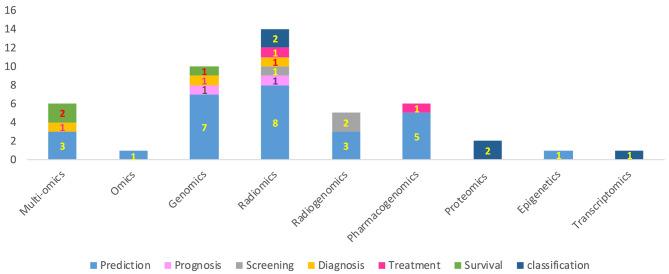
Forty-six studies were selected that focused on personalized breast cancer management using artificial intelligence models. Seventeen studies using various deep learning methods achieved a satisfactory outcome in predicting treatment response and prognosis, contributing to personalized breast cancer management. Two studies utilizing neural networks and clustering provided acceptable indicators for predicting patient survival and categorizing breast tumors. One study employed transfer learning to predict treatment response. Twenty-six studies utilizing machine-learning methods demonstrated that these techniques can improve breast cancer classification, screening, diagnosis, and prognosis. The most frequent modeling techniques used were NB, SVM, RF, XGBoost, and Reinforcement Learning. The average area under the curve (AUC) for the models was 0.91. Moreover, the average values for accuracy, sensitivity, specificity, and precision were reported to be in the range of 90-96% for the models.
CONCLUSION
Artificial intelligence has proven to be effective in assisting physicians and researchers in managing breast cancer treatment by uncovering hidden patterns in complex omics and genetic data. Intelligent processing of omics data through protein and gene pattern classification and the utilization of deep neural patterns has the potential to significantly transform the field of complex disease management.
背景
在癌症管理中,为合适的患者在合适的时间提供适当的专业治疗被认为是必要的。针对每个乳腺癌患者的遗传变化量身定制的靶向治疗是精准肿瘤学的理想特征,不仅可以减少疾病进展,还可能增加患者的生存机会。人工智能与精准肿瘤学的结合可以帮助医生为患者识别和选择更有效的治疗因素。
方法
我们于 2023 年 9 月在 PubMed、Embase、Scopus 和 Web of Science 数据库中进行了系统综述。我们使用了关键词的搜索策略,即:乳腺癌、人工智能和精准肿瘤学,以及文章标题中的同义词。排除描述性、定性、综述和非英语研究。根据 SJR 期刊和 JBI 指数以及 PRISMA2020 指南,对文章的质量评估和偏倚评估。
结果
选择了 46 项研究,重点是使用人工智能模型进行个性化乳腺癌管理。使用各种深度学习方法的 17 项研究在预测治疗反应和预后方面取得了令人满意的结果,有助于个性化乳腺癌管理。使用神经网络和聚类的两项研究为预测患者生存和分类乳腺癌提供了可接受的指标。一项研究采用迁移学习来预测治疗反应。使用机器学习方法的 26 项研究表明,这些技术可以改善乳腺癌分类、筛查、诊断和预后。最常用的建模技术是 NB、SVM、RF、XGBoost 和强化学习。模型的平均曲线下面积(AUC)为 0.91。此外,报告的模型的准确率、敏感度、特异度和精度的平均值在 90-96%之间。
结论
人工智能在通过挖掘复杂组学和遗传数据中的隐藏模式来协助医生和研究人员管理乳腺癌治疗方面已被证明是有效的。通过蛋白质和基因模式分类以及深度神经网络模式的智能处理,有潜力显著改变复杂疾病管理领域。

 Zotero 插件