
1990 年至 2019 年期间高空腹血糖导致的胰腺癌死亡率趋势及 2040 年预测。
Pancreatic cancer mortality trends attributable to high fasting blood sugar over the period 1990-2019 and projections up to 2040.
机构信息
Department of Hepatobiliary Surgery, The First Affiliated Hospital of Guangxi Medical University, Nanning, China.
Guangxi Key Laboratory of Enhanced Recovery After Surgery for Gastrointestinal Cancer, Nanning, China.
出版信息
Front Endocrinol (Lausanne). 2024 Jul 5;15:1302436. doi: 10.3389/fendo.2024.1302436. eCollection 2024.
BACKGROUND
Pancreatic cancer (PC) is a prevalent malignancy within the digestive system, with diabetes recognized as one of its well-established risk factors.
METHODS
Data on PC mortality attributed to high fasting blood sugar were retrieved from the Global Burden of Disease (GBD) study 2019 online database. To assess the temporal trends of PC burden attributable to high fasting plasma glucose (HFPG), estimated annual percentage changes (EAPCs) for age-standardized death rates (ASDRs) between 1990 and 2019 were determined using a generalized linear model. Furthermore, a Bayesian age-period-cohort (BAPC) model using the integrated nested Laplacian approximation algorithm was employed to project the disease burden over the next 20 years.
RESULTS
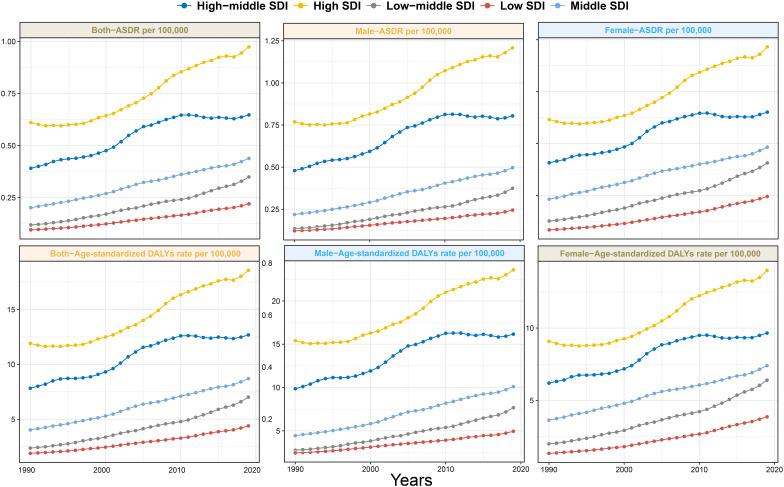
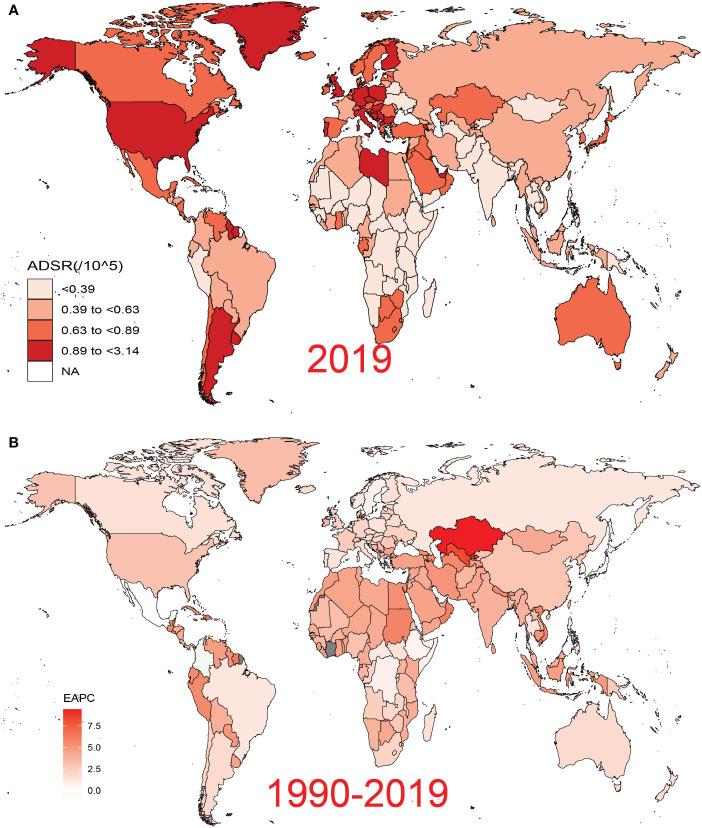
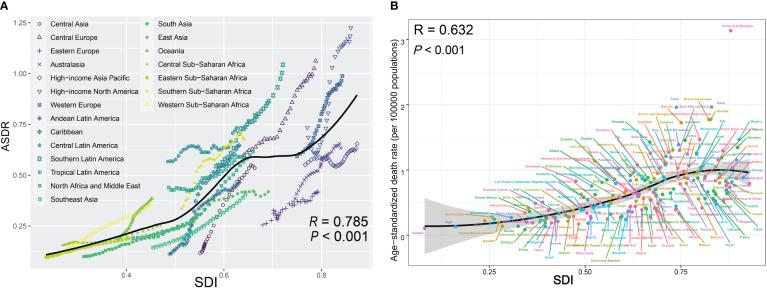
Globally, the crude death number of PC attributable to HFPG almost tripled (from 13,065.7 in 1990 to 48,358.5 in 2019) from 1990 to 2019, and the ASDR increased from 0.36/100,000 to 0.61/100,000 with an EAPC of 2.04 (95% CI 1.91-2.16). The population aged ≥70 years accounted for nearly 60% of total deaths in 2019 and experienced a more significant increase, with the death number increasing approximately fourfold and the ASDR increasing annually by 2.65%. In regions with different sociodemographic indexes (SDIs), the highest disease burden was observed in the high-SDI region, whereas more pronounced increasing trends in ASDR were observed in the low to middle-SDI, low-SDI, and middle-SDI regions. Additionally, a significantly negative association was found between EAPCs and ASDRs of PC attributable to HFPG from 1990 to 2019. Moreover, the BAPC model predicts that ASDR and age-standardized disability-adjusted life-years (DALYs) rate for PC attributed to HFPG was projected to increase obviously for men and women from 2019 to 2040.
CONCLUSIONS
The burden of PC attributed to HFPG has increased globally over the past three decades, with the elderly population and high-SDI regions carrying a relatively greater disease burden, but more adverse trends observed in low-SDI areas. Furthermore, the burden is projected to continue increasing over the next 20 years. Hence, more tailored prevention methodologies should be established to mitigate this increasing trend.
背景
胰腺癌(PC)是消化系统中一种常见的恶性肿瘤,糖尿病是其公认的风险因素之一。
方法
从 2019 年全球疾病负担(GBD)研究在线数据库中检索归因于高空腹血糖的 PC 死亡率数据。为评估高空腹血浆葡萄糖(HFPG)所致 PC 负担的时间趋势,采用广义线性模型确定了 1990 年至 2019 年年龄标准化死亡率(ASDR)的估计年百分比变化(EAPC)。此外,使用综合嵌套拉普拉斯近似算法的贝叶斯年龄-时期-队列(BAPC)模型预测未来 20 年的疾病负担。
结果
全球范围内,归因于 HFPG 的 PC 粗死亡率几乎翻了三倍(从 1990 年的 13065.7 人增至 2019 年的 48358.5 人),ASDR 从 0.36/100000 上升至 0.61/100000,EAPC 为 2.04(95%CI 1.91-2.16)。2019 年,≥70 岁的人群占总死亡人数的近 60%,且增长更为显著,死亡人数增加了约四倍,ASDR 每年增加 2.65%。在不同社会人口指数(SDI)地区,高 SDI 地区的疾病负担最高,而低到中 SDI、低 SDI 和中 SDI 地区的 ASDR 呈更显著的上升趋势。此外,1990 年至 2019 年,HFPG 所致 PC 的 EAPC 与 ASDR 呈显著负相关。此外,BAPC 模型预测,2019 年至 2040 年,HFPG 所致 PC 的 ASDR 和年龄标准化伤残调整生命年(DALYs)率预计将明显增加。
结论
在过去的三十年中,全球归因于 HFPG 的 PC 负担有所增加,老年人口和高 SDI 地区的疾病负担相对较大,但低 SDI 地区的趋势更为不利。此外,预计在未来 20 年内,这一负担将继续增加。因此,应制定更有针对性的预防方法来减轻这一上升趋势。



 Zotero 插件