
采用宏基因组学方法深入了解孟加拉国不孕妇女的阴道微生物组。
An insight into the vaginal microbiome of infertile women in Bangladesh using metagenomic approach.
机构信息
Department of Microbiology, University of Dhaka, Dhaka, Bangladesh.
EzBiome Inc., Gaithersburg, MD, United States.
出版信息
Front Cell Infect Microbiol. 2024 Jul 9;14:1390088. doi: 10.3389/fcimb.2024.1390088. eCollection 2024.
INTRODUCTION
The dysbiosis of vaginal microbiota is recognized as a potential underlying factor contributing to infertility in women. This study aimed to compare the vaginal microbiomes of infertile and fertile women to investigate their relationship with infertility.
METHODS
Metagenomic analysis was conducted on samples from 5 infertile and 5 fertile individuals using both amplicon 16S and metagenomics shotgun sequencing methods.
RESULTS AND DISCUSSION
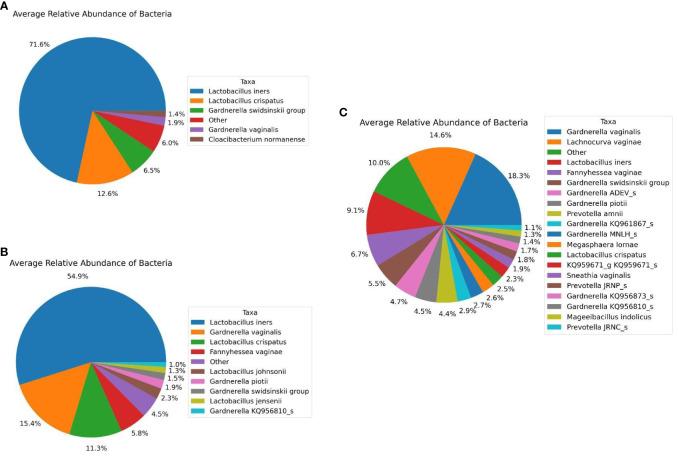
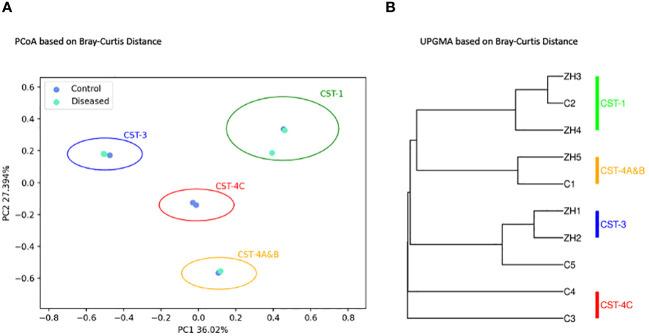
In the infertile group, the bacterial community was primarily represented by three major bacterial genera: (79.42%), (12.56%) and (3.33%), whereas, the fertile group exhibited a more diverse composition with over 8 major bacterial genera, accompanied by significantly reduced abundance of (48.79%) and (6.98%). At the species level, higher abundances of and were observed in the infertile group. Regarding the microbiome composition, only one fertile and two infertile subjects exhibited the healthiest Community State Types, CST-1, while CST-3 was observed among two infertile and one fertile subject, and CST-4 in three other fertile and one infertile subject. Overall, alpha diversity metrics indicated greater diversity and lower species richness in the control (fertile) group, while the infertile group displayed the opposite trend. However, beta-diversity analysis did not show distinct clustering of samples associated with any specific group; instead, it demonstrated CST-type specific clustering. Shotgun metagenomics further confirmed the dominance of Firmicutes, with a greater abundance of species in the infertile group. Specifically, and were identified as the most dominant and highly abundant in the infertile group. Fungi were only identified in the control group, dominated by (62.5%). Metagenome-assembled genomes (MAGs) corroborated read-based taxonomic profiling, with the taxon identified exclusively in disease samples. MAG identities shared by both groups include Shamonda orthobunyavirus, , Human endogenous retrovirus K113, , and . Interestingly, the healthy microbiomes sequenced in this study contained two clusters, and , not found in the public dataset. In conclusion, this study suggests that lower species diversity with a higher abundance of and , may contribute to female infertility in our study datasets. However, larger sample sizes are necessary to further evaluate such association.
引言
阴道微生物群的失调被认为是导致女性不孕的潜在因素之一。本研究旨在比较不孕和正常生育女性的阴道微生物组,以研究其与不孕的关系。
方法
使用扩增子 16S 和宏基因组鸟枪法测序方法,对 5 名不孕和 5 名正常生育的个体的样本进行了宏基因组分析。
结果与讨论
在不孕组中,细菌群落主要由三个主要的细菌属组成: (79.42%)、 (12.56%)和 (3.33%),而正常生育组的组成则更为多样化,有超过 8 个主要的细菌属,同时 (48.79%)和 (6.98%)的丰度显著降低。在种水平上,不孕组中 和 的丰度较高。关于微生物组组成,只有一个正常生育和两个不孕的个体表现出最健康的社区状态类型 CST-1,而 CST-3 存在于两个不孕和一个正常生育的个体中,CST-4 存在于另外三个正常生育和一个不孕的个体中。总的来说,α多样性指标表明,对照组(正常生育)的多样性更高,物种丰富度更低,而不孕组则相反。然而,β多样性分析并没有显示出与任何特定组相关的样本明显聚类,而是显示了 CST 型特异性聚类。宏基因组进一步证实了厚壁菌门的优势,不孕组中 的丰度更高。具体来说, 和 被鉴定为不孕组中最优势和最丰富的。真菌仅在对照组中被鉴定出来,主要由 (62.5%)组成。宏基因组组装基因组(MAGs)证实了基于读长的分类分析,仅在疾病样本中鉴定出分类群 。两组共享的 MAG 身份包括 Shamonda orthobunyavirus、 、Human endogenous retrovirus K113、 、和 。有趣的是,本研究中测序的健康微生物组包含了两个在公共数据集未发现的聚类 和 。总之,本研究表明,较低的物种多样性和更高的 丰度可能导致我们研究数据集中的女性不孕。然而,需要更大的样本量来进一步评估这种关联。


 Zotero 插件