
晚期肝细胞癌患者在使用乐伐替尼前后游离DNA和肝肿瘤组织的突变变化
Changes in Mutations of Cell-Free DNA and Liver Tumor Tissue in Patients with Advanced Hepatocellular Carcinoma before and after Introduction of Lenvatinib.
作者信息
Tsuruoka Mio, Ninomiya Masashi, Inoue Jun, Iwata Tomoaki, Sano Akitoshi, Sato Kosuke, Onuki Masazumi, Sawahashi Satoko, Masamune Atsushi
机构信息
Division of Gastroenterology, Tohoku University Graduate School of Medicine, Sendai, Japan,
Division of Gastroenterology, Tohoku University Graduate School of Medicine, Sendai, Japan.
出版信息
Oncology. 2024;102(12):1072-1083. doi: 10.1159/000540438. Epub 2024 Jul 24.
INTRODUCTION
Cell-free DNA (cfDNA) is expected to contribute to the decision for treatment and prediction of effects with minimally invasion. We investigated the correlation between gene mutations before and after lenvatinib (LEN) treatment and its effectiveness, in order to find advanced hepatocellular carcinoma (HCC) patients who would benefit greatly from the therapy.
METHODS
We analyzed cfDNA before and 6-8 weeks after the start of treatment in 20 advanced HCC patients who started LEN. A next-generation sequencer was used for CTNNB1 and TP53. Concerning TERT promoter, -124C>T and -146C>T mutations are researched using digital PCR. In addition, we examined liver tumor biopsy tissues by the same method. Computerized tomography evaluation was performed at 6-8 weeks and 3-4 months to assess the efficacy.
RESULTS
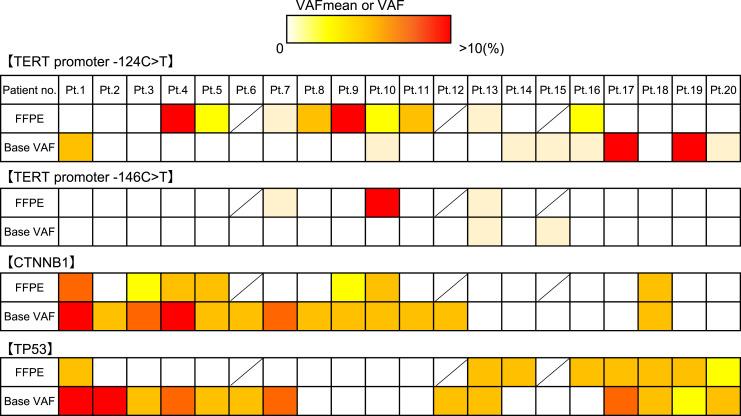
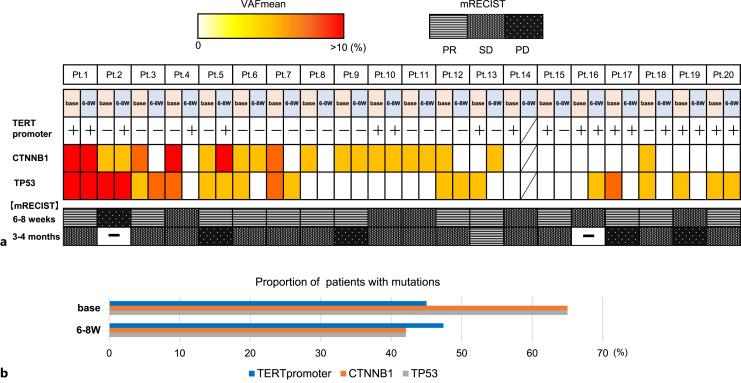
Frequencies of TERT promoter, CTNNB1, and TP53 mutations in pretreatment cfDNA were 45%, 65%, and 65%, but 53%, 41%, and 47% in HCC tissues, respectively. There were no clear correlations between these gene mutations and the disease-suppressing effect or progression-free survival. Overall, there were many cases showing a decrease in mutations after LEN treatment. Integrating the reduction of CTNNB1 and TP53 genetic mutations increased the potential for disease suppression.
CONCLUSION
This study suggests that analysis of cfDNA in advanced HCC patients may be useful for identifying LEN responders and determining therapeutic efficacy. Furthermore, it has potential for selecting responders for other molecular-targeted drugs.
引言
游离DNA(cfDNA)有望以微创方式为治疗决策和疗效预测提供依据。我们研究了乐伐替尼(LEN)治疗前后基因突变与其疗效之间的相关性,以寻找能从该治疗中显著获益的晚期肝细胞癌(HCC)患者。
方法
我们分析了20例开始使用LEN治疗的晚期HCC患者治疗开始前及治疗6 - 8周后的cfDNA。使用二代测序仪检测CTNNB1和TP53基因。对于端粒酶逆转录酶(TERT)启动子,采用数字PCR研究-124C>T和-146C>T突变。此外,我们用相同方法检测肝肿瘤活检组织。在6 - 8周和3 - 4个月时进行计算机断层扫描评估以评估疗效。
结果
治疗前cfDNA中TERT启动子、CTNNB1和TP53基因突变频率分别为45%、65%和65%,而在HCC组织中分别为53%、41%和47%。这些基因突变与疾病抑制效果或无进展生存期之间无明显相关性。总体而言,有许多病例显示LEN治疗后突变减少。综合CTNNB1和TP53基因突变的减少增加了疾病抑制的可能性。
结论
本研究表明,分析晚期HCC患者的cfDNA可能有助于识别LEN治疗的反应者并确定治疗效果。此外,它有潜力为其他分子靶向药物选择反应者。


 Zotero 插件