
识别弥漫性大B细胞淋巴瘤患者化疗期间影响癌症相关疲劳的相关因素。
Identifying relevant factors influencing cancer-related fatigue in patients with diffuse large B-cell lymphoma during chemotherapy.
作者信息
Hao Xiu-Qiao, Yang Xiang-Dan, Qi Yue
机构信息
Department of Hematology, The Fourth Hospital of Hebei Medical University, Shijiazhuang 050011, Hebei Province, China.
出版信息
World J Psychiatry. 2024 Jul 19;14(7):1017-1026. doi: 10.5498/wjp.v14.i7.1017.
BACKGROUND
Diffuse large B-cell lymphoma (DLBCL) is a rapidly growing malignant tumor, and chemotherapy is one of the treatments used to combat it. Although advancements of science and technology have resulted in more and more patients being able to receive effective treatment, they still face side effects such as fatigue and weakness. It is important to thoroughly investigate the factors that contribute to cancer-related fatigue (CRF) during chemotherapy.
AIM
To explore the factors related to CRF, anxiety, depression, and mindfulness levels in patients with DLBCL during chemotherapy.
METHODS
General information was collected from the electronic medical records of eligible patients. Sleep quality and mindfulness level scores in patients with DLBCL during chemotherapy were evaluated by the Pittsburgh Sleep Quality Index and Five Facet Mindfulness Questionnaire-Short Form. The Piper Fatigue Scale was used to evaluate the CRF status. The Self-Rating Anxiety Scale and Self-Rating Depression Scale were used to evaluate anxiety and depression status. Univariate analysis and multivariate regression analysis were used to investigate the factors related to CRF.
RESULTS
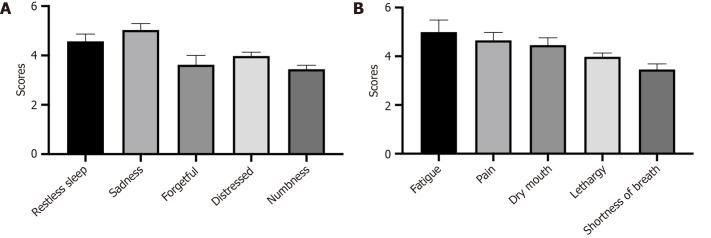
The overall average CRF level in 62 patients with DLBCL during chemotherapy was 5.74 ± 2.51. In 25 patients, the highest rate of mild fatigue was in the cognitive dimension (40.32%), and in 35 patients the highest moderate fatigue rate in the behavioral dimension (56.45%). In the emotional dimension, severe fatigue had the highest rate of occurrence, 34 cases or 29.03%. The CRF score was positively correlated with cancer experience (all < 0.01) and negatively correlated with cancer treatment efficacy (all < 0.01). Tumor staging, chemotherapy cycle, self-efficacy level, and anxiety and depression level were related to CRF in patients with DLBCL during chemotherapy.
CONCLUSION
There was a significant correlation between CRF and perceptual control level in patients. Tumor staging, chemotherapy cycle, self-efficacy level, and anxiety and depression level influenced CRF in patients with DLBCL during chemotherapy.
背景
弥漫性大B细胞淋巴瘤(DLBCL)是一种快速生长的恶性肿瘤,化疗是用于对抗它的治疗方法之一。尽管科学技术的进步使越来越多的患者能够接受有效治疗,但他们仍面临疲劳和虚弱等副作用。彻底研究化疗期间导致癌症相关疲劳(CRF)的因素很重要。
目的
探讨DLBCL患者化疗期间与CRF、焦虑、抑郁及正念水平相关的因素。
方法
从符合条件的患者电子病历中收集一般信息。采用匹兹堡睡眠质量指数和五因素正念问卷简表评估DLBCL患者化疗期间的睡眠质量和正念水平得分。采用派珀疲劳量表评估CRF状态。采用焦虑自评量表和抑郁自评量表评估焦虑和抑郁状态。采用单因素分析和多因素回归分析探讨与CRF相关的因素。
结果
62例DLBCL患者化疗期间的总体平均CRF水平为5.74±2.51。在25例患者中,轻度疲劳发生率最高的是认知维度(40.32%),在35例患者中,中度疲劳发生率最高的是行为维度(56.45%)。在情感维度,重度疲劳发生率最高,为34例或29.03%。CRF评分与癌症经历呈正相关(均P<0.01),与癌症治疗疗效呈负相关(均P<0.01)。肿瘤分期、化疗周期、自我效能水平以及焦虑和抑郁水平与DLBCL患者化疗期间的CRF相关。
结论
患者的CRF与感知控制水平之间存在显著相关性。肿瘤分期、化疗周期、自我效能水平以及焦虑和抑郁水平影响DLBCL患者化疗期间的CRF。


 Zotero 插件