
妊娠期及产后焦虑和抑郁的患病率及其相关危险因素:一项前瞻性横断面描述性多中心研究。
Prevalence of anxiety and depression and their associated risk factors throughout pregnancy and postpartum: a prospective cross-sectional descriptive multicentred study.
机构信息
Universitat de Barcelona, Fundació Assistencial Mútua Terrassa, (Terrassa), Research Group on Sexual and Reproductive Healthcare (GRASSIR), (2021-sgr-01489), Barcelona, 08221, Spain.
ASSIR Fundació Assistencial Mútua Terrassa, Universitat de Barcelona, Plaça Dr. Robert 5, Barcelona, 08221, Spain.
出版信息
BMC Pregnancy Childbirth. 2024 Jul 25;24(1):500. doi: 10.1186/s12884-024-06695-6.
OBJECTIVE
To assess the prevalence of anxiety and depression and their associated risk factors throughout the pregnancy and postpartum process using a new screening for the early detection of mental health problems.
DESIGN
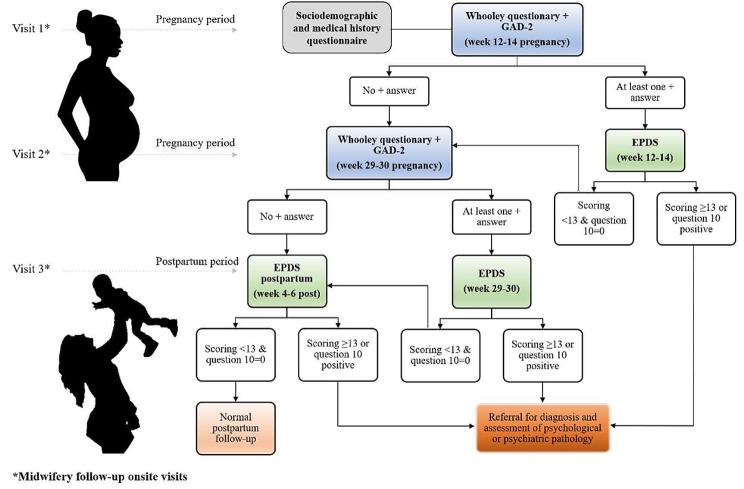
A prospective cross-sectional descriptive multicentred study. Participants were consecutively enrolled at ≥ 12 weeks' gestation and followed at three different time points: at 12-14 weeks of pregnancy, at 29-30 weeks of pregnancy, and 4-6 weeks postpartum. All women completed a mental screening at week 12-14 of pregnancy consisting of two questions from the Generalised Anxiety Disorder Scale (GAD-2) and the two Whooley questions. If this screening was positive, the woman completed the Edinburgh Postnatal Depression Scale (EPDS).
SETTING
Seven primary care centres coordinated by a Gynaecology and Obstetrics Department in the city of Terrassa (Barcelona) in northern Spain.
PARTICIPANTS
Pregnant women (N = 335, age 18-45 years), in their first trimester of pregnancy, and receiving prenatal care in the public health system between July 2018 and July 2020.
FINDINGS
The most relevant factors associated with positive screening for antenatal depression or anxiety during pregnancy, that appear after the first trimester of pregnancy, are systematically repeated throughout the pregnancy, and are maintained in the postpartum period were: a history of previous depression, previous anxiety, abuse, and marital problems. In weeks 12-14 early risk factors for positive depression and anxiety screening and positive EPDS were: age, smoking, educational level, employment status, previous psychological/psychiatric history and treatment, suicide in the family environment, voluntary termination of pregnancy and current planned pregnancy, living with a partner and partner's income. In weeks 29-30 risk factors were: being a skilled worker, a history of previous depression or anxiety, and marital problems. In weeks 4-6 postpartum, risk factors were: age, a history of previous depression or anxiety or psychological/psychiatric treatment, type of treatment, having been mistreated, and marital problems.
CONCLUSIONS
Early screening for anxiety and depression in pregnancy may enable the creation of more effective healthcare pathways, by acting long before mental health problems in pregnant women worsen or by preventing their onset. Assessment of anxiety and depression symptoms before and after childbirth and emotional support needs to be incorporated into routine practice.
目的
使用新的心理健康问题早期检测筛查工具,评估整个妊娠和产后期间焦虑和抑郁的患病率及其相关危险因素。
设计
前瞻性横断面描述性多中心研究。参与者在妊娠≥12 周时连续入组,并在三个不同时间点进行随访:妊娠 12-14 周、妊娠 29-30 周和产后 4-6 周。所有女性在妊娠 12-14 周时完成一项心理筛查,包括广泛性焦虑障碍量表(GAD-2)的两个问题和两个 Whooley 问题。如果筛查阳性,女性将完成爱丁堡产后抑郁量表(EPDS)。
地点
西班牙北部巴塞罗那市的一个妇科和产科部门协调的 7 个初级保健中心。
参与者
335 名年龄在 18-45 岁的孕妇,在妊娠早期,在公共卫生系统中接受产前护理,时间为 2018 年 7 月至 2020 年 7 月。
发现
与妊娠期间产前抑郁或焦虑阳性筛查相关的最相关因素,在妊娠早期后出现,且在整个妊娠期间反复出现,并在产后期间持续存在,包括:既往抑郁史、既往焦虑史、虐待和婚姻问题。在妊娠 12-14 周时,抑郁和焦虑阳性筛查和 EPDS 阳性的早期危险因素包括:年龄、吸烟、教育程度、就业状况、既往心理/精神病史和治疗、家庭环境中的自杀、自愿终止妊娠和当前计划妊娠、与伴侣同住和伴侣收入。在妊娠 29-30 周时,危险因素为:技术工人、既往抑郁或焦虑史和婚姻问题。在产后 4-6 周时,危险因素包括:年龄、既往抑郁或焦虑或心理/精神治疗史、治疗类型、遭受虐待和婚姻问题。
结论
早期筛查妊娠期间的焦虑和抑郁,可能通过在孕妇的心理健康问题恶化或预防其发病之前尽早采取行动,创建更有效的医疗保健途径。需要将分娩前后的焦虑和抑郁症状评估以及情感支持纳入常规实践。



 Zotero 插件