
一种动态熵方法揭示了精神分裂症中功能网络连接轨迹复杂性的降低。
A Dynamic Entropy Approach Reveals Reduced Functional Network Connectivity Trajectory Complexity in Schizophrenia.
作者信息
Blair David Sutherland, Miller Robyn L, Calhoun Vince D
机构信息
Tri-Institutional Center for Translational Research in Neuroimaging and Data Science (TReNDS), Georgia State, Georgia Tech, Emory University, Atlanta, GA 30303, USA.
出版信息
Entropy (Basel). 2024 Jun 26;26(7):545. doi: 10.3390/e26070545.
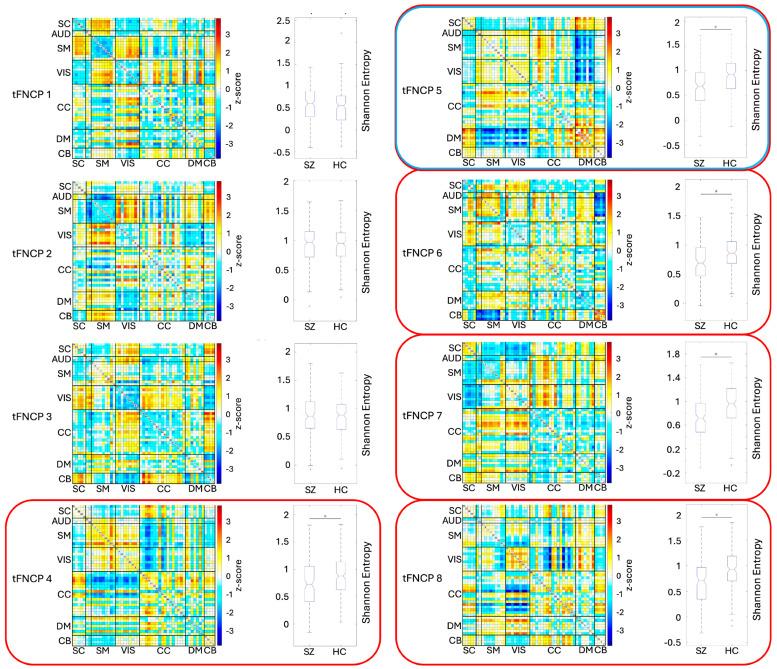
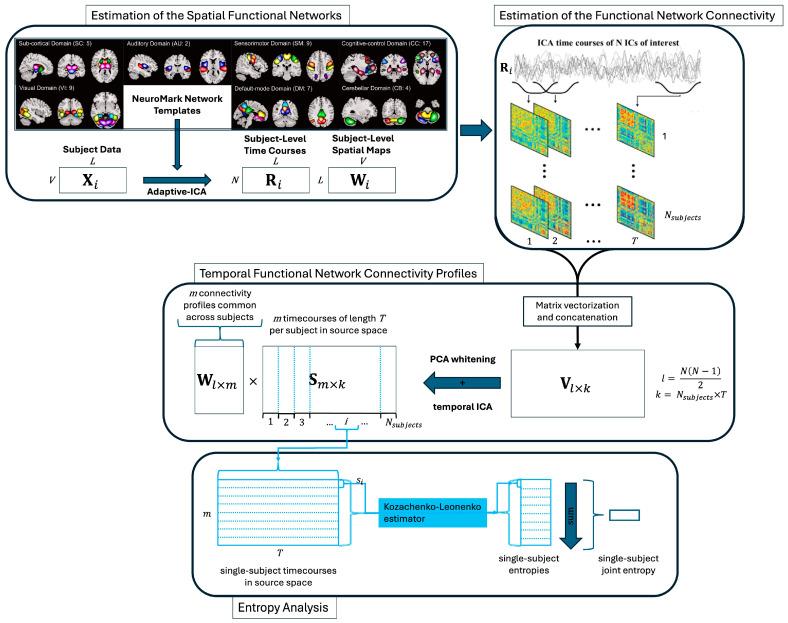
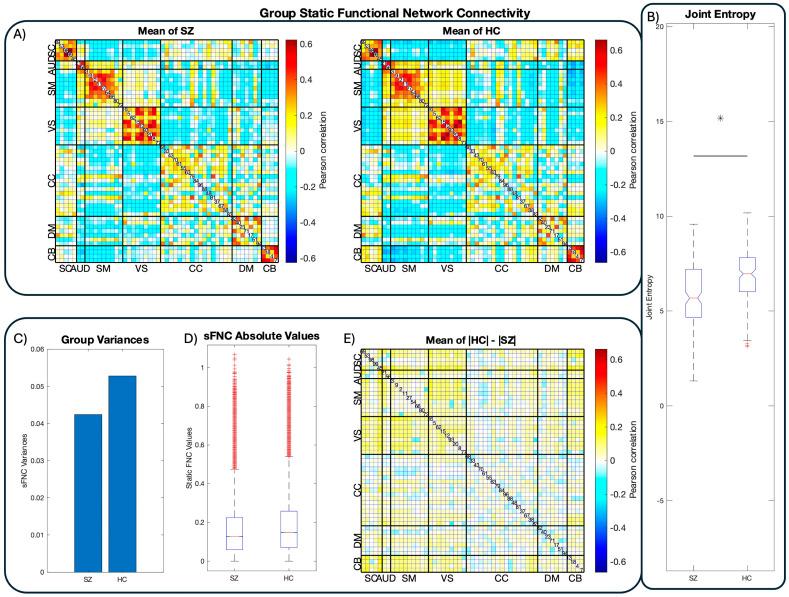
Over the past decade and a half, dynamic functional imaging has revealed low-dimensional brain connectivity measures, identified potential common human spatial connectivity states, tracked the transition patterns of these states, and demonstrated meaningful transition alterations in disorders and over the course of development. Recently, researchers have begun to analyze these data from the perspective of dynamic systems and information theory in the hopes of understanding how these dynamics support less easily quantified processes, such as information processing, cortical hierarchy, and consciousness. Little attention has been paid to the effects of psychiatric disease on these measures, however. We begin to rectify this by examining the complexity of subject trajectories in state space through the lens of information theory. Specifically, we identify a basis for the dynamic functional connectivity state space and track subject trajectories through this space over the course of the scan. The dynamic complexity of these trajectories is assessed along each dimension of the proposed basis space. Using these estimates, we demonstrate that schizophrenia patients display substantially simpler trajectories than demographically matched healthy controls and that this drop in complexity concentrates along specific dimensions. We also demonstrate that entropy generation in at least one of these dimensions is linked to cognitive performance. Overall, the results suggest great value in applying dynamic systems theory to problems of neuroimaging and reveal a substantial drop in the complexity of schizophrenia patients' brain function.
在过去十五年中,动态功能成像揭示了低维脑连接性测量方法,识别出潜在的常见人类空间连接状态,追踪了这些状态的转变模式,并证明了在疾病和发育过程中这些转变存在有意义的变化。最近,研究人员开始从动态系统和信息理论的角度分析这些数据,希望了解这些动态过程如何支持信息处理、皮质层级和意识等较难量化的过程。然而,很少有人关注精神疾病对这些测量方法的影响。我们通过信息理论的视角来研究状态空间中受试者轨迹的复杂性,从而开始纠正这一现象。具体而言,我们确定了动态功能连接状态空间的一个基础,并在扫描过程中追踪受试者在这个空间中的轨迹。沿着所提出的基础空间的每个维度评估这些轨迹的动态复杂性。利用这些估计值,我们证明精神分裂症患者的轨迹比人口统计学匹配的健康对照者要简单得多,而且这种复杂性的下降集中在特定维度上。我们还证明,这些维度中至少有一个维度的熵产生与认知表现有关。总体而言,研究结果表明将动态系统理论应用于神经影像学问题具有很大价值,并揭示了精神分裂症患者脑功能复杂性的显著下降。

 Zotero 插件