
组氨酸磷酸化:蛋白激酶和磷酸酶。
Histidine Phosphorylation: Protein Kinases and Phosphatases.
机构信息
Molecular and Cell Biology Laboratory, Salk Institute for Biological Studies, La Jolla, CA 92037, USA.
出版信息
Int J Mol Sci. 2024 Jul 21;25(14):7975. doi: 10.3390/ijms25147975.
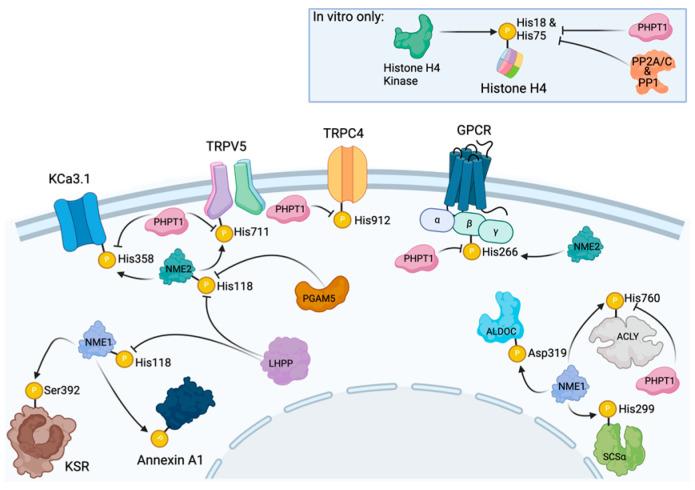
Phosphohistidine (pHis) is a reversible protein post-translational modification (PTM) that is currently poorly understood. The P-N bond in pHis is heat and acid-sensitive, making it more challenging to study than the canonical phosphoamino acids pSer, pThr, and pTyr. As advancements in the development of tools to study pHis have been made, the roles of pHis in cells are slowly being revealed. To date, a handful of enzymes responsible for controlling this modification have been identified, including the histidine kinases NME1 and NME2, as well as the phosphohistidine phosphatases PHPT1, LHPP, and PGAM5. These tools have also identified the substrates of these enzymes, granting new insights into previously unknown regulatory mechanisms. Here, we discuss the cellular function of pHis and how it is regulated on known pHis-containing proteins, as well as cellular mechanisms that regulate the activity of the pHis kinases and phosphatases themselves. We further discuss the role of the pHis kinases and phosphatases as potential tumor promoters or suppressors. Finally, we give an overview of various tools and methods currently used to study pHis biology. Given their breadth of functions, unraveling the role of pHis in mammalian systems promises radical new insights into existing and unexplored areas of cell biology.
磷酸组氨酸(pHis)是一种可逆的蛋白质翻译后修饰(PTM),目前了解甚少。pHis 中的 P-N 键对热和酸敏感,因此比经典的磷酸氨基酸 pSer、pThr 和 pTyr 更难研究。随着研究 pHis 的工具的不断发展,pHis 在细胞中的作用也在慢慢揭示。迄今为止,已经鉴定出一些负责控制这种修饰的酶,包括组氨酸激酶 NME1 和 NME2,以及磷酸组氨酸磷酸酶 PHPT1、LHPP 和 PGAM5。这些工具还确定了这些酶的底物,为以前未知的调节机制提供了新的见解。在这里,我们讨论了 pHis 的细胞功能以及它如何在已知的含有 pHis 的蛋白质上进行调节,以及调节 pHis 激酶和磷酸酶本身活性的细胞机制。我们进一步讨论了 pHis 激酶和磷酸酶作为潜在的肿瘤促进剂或抑制剂的作用。最后,我们概述了目前用于研究 pHis 生物学的各种工具和方法。鉴于其广泛的功能,阐明 pHis 在哺乳动物系统中的作用有望为细胞生物学的现有和未探索领域提供全新的见解。
 Zotero 插件